

Enthalpy of Reaction
215
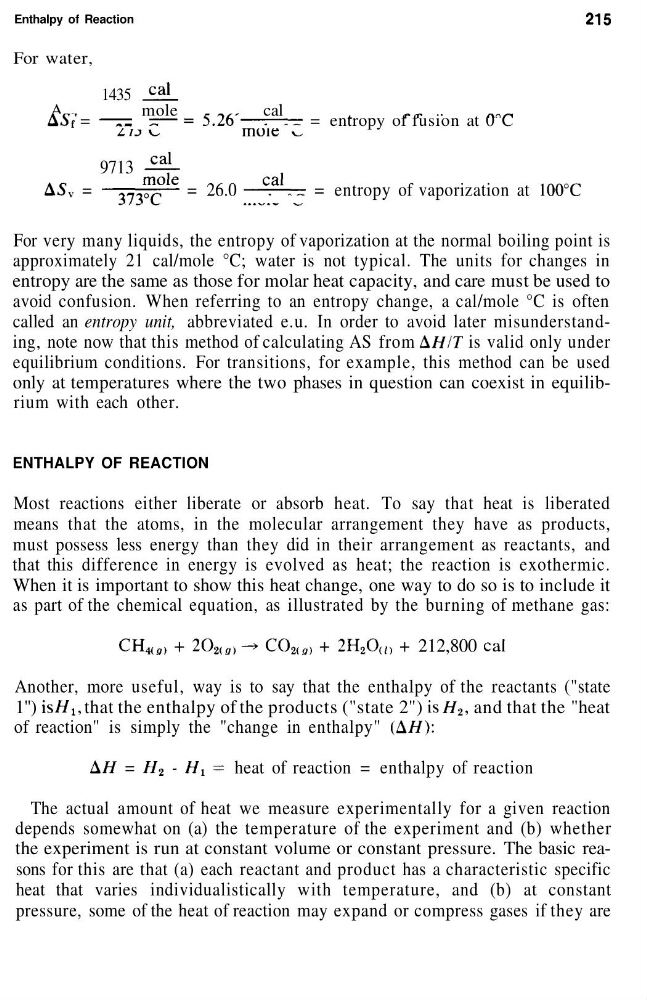
For water,
1435 _£^L
A o
mole
. ., cal
^
,,,. .
_._,
AS f = —-_ „— =5.26 —:—— = entropy of fusion at 0 C
£. I j V-1I1O1C \^s
9713 £L
^
AS V = —--. O p— = 26.0 —:—— = entropy of vaporization at 100°C
For very many liquids, the entropy of vaporization at the normal boiling point is
approximately 21 cal/mole °C; water is not typical. The units for changes in
entropy are the same as those for molar heat capacity, and care must be used to
avoid confusion. When referring to an entropy change, a cal/mole °C is often
called an entropy unit, abbreviated e.u. In order to avoid later misunderstanding, note now that this method of calculating AS from A///T is valid only under
equilibrium conditions. For transitions, for example, this method can be used
only at temperatures where the two phases in question can coexist in equilibrium with each other.
ENTHALPY OF REACTION
Most reactions either liberate or absorb heat. To say that heat is liberated
means that the atoms, in the molecular arrangement they have as products,
must possess less energy than they did in their arrangement as reactants, and
that this difference in energy is evolved as heat; the reaction is exothermic.
When it is important to show this heat change, one way to do so is to include it
as part of the chemical equation, as illustrated by the burning of methane gas:
CH 4(9) + 20 2<9) -+ C0 2(fl) + 2H 2 0,n + 212,800 cal
Another, more useful, way is to say that the enthalpy of the reactants ("state
1") is HI, that the enthalpy of the products ("state 2") is// 2 , and that the "heat
of reaction" is simply the "change in enthalpy" (A//):
A7f = H 2 - HI = heat of reaction = enthalpy of reaction
The actual amount of heat we measure experimentally for a given reaction
depends somewhat on (a) the temperature of the experiment and (b) whether
the experiment is run at constant volume or constant pressure. The basic reasons for this are that (a) each reactant and product has a characteristic specific
heat that varies individualistically with temperature, and (b) at constant
pressure, some of the heat of reaction may expand or compress gases if they are
215
For water,
1435 _£^L
A o
mole
. ., cal
^
,,,. .
_._,
AS f = —-_ „— =5.26 —:—— = entropy of fusion at 0 C
£. I j V-1I1O1C \^s
9713 £L
^
AS V = —--. O p— = 26.0 —:—— = entropy of vaporization at 100°C
For very many liquids, the entropy of vaporization at the normal boiling point is
approximately 21 cal/mole °C; water is not typical. The units for changes in
entropy are the same as those for molar heat capacity, and care must be used to
avoid confusion. When referring to an entropy change, a cal/mole °C is often
called an entropy unit, abbreviated e.u. In order to avoid later misunderstanding, note now that this method of calculating AS from A///T is valid only under
equilibrium conditions. For transitions, for example, this method can be used
only at temperatures where the two phases in question can coexist in equilibrium with each other.
ENTHALPY OF REACTION
Most reactions either liberate or absorb heat. To say that heat is liberated
means that the atoms, in the molecular arrangement they have as products,
must possess less energy than they did in their arrangement as reactants, and
that this difference in energy is evolved as heat; the reaction is exothermic.
When it is important to show this heat change, one way to do so is to include it
as part of the chemical equation, as illustrated by the burning of methane gas:
CH 4(9) + 20 2<9) -+ C0 2(fl) + 2H 2 0,n + 212,800 cal
Another, more useful, way is to say that the enthalpy of the reactants ("state
1") is HI, that the enthalpy of the products ("state 2") is// 2 , and that the "heat
of reaction" is simply the "change in enthalpy" (A//):
A7f = H 2 - HI = heat of reaction = enthalpy of reaction
The actual amount of heat we measure experimentally for a given reaction
depends somewhat on (a) the temperature of the experiment and (b) whether
the experiment is run at constant volume or constant pressure. The basic reasons for this are that (a) each reactant and product has a characteristic specific
heat that varies individualistically with temperature, and (b) at constant
pressure, some of the heat of reaction may expand or compress gases if they are