

220
Thermochemistry
in the isolated gaseous state. At first, you might think that the value of A//° =
+ 22.06 kcal/mole would be the H-C1 bond energy, but it is not. The value of
+ 22.06 represents the difference between the energy required to dissociate the
HC1 molecule and the energy liberated when the H atoms and Cl atoms combine to form H 2 and C1 2 molecules. The bond energy, however, corresponds to
the reaction
HCl< fl) —> H (s) + Cl( ff)
We could calculate A// for this if we knew (for the elements) the enthalpy of
formation of molecules from their atoms. Some crystalline elements (especially
metals) vaporize as monatomic gases, and it is not too difficult to determine
their heats of sublimation. Some elements—such as H 2 , O 2 , and Br 2 —are
diatomic gases that dissociate into atoms at high temperature; these dissociation energies may also be determined. Table 14-1 also includes the standard
enthalpies of formation of a number of atoms; these are based on the normal
physical form of the element at 25.0°C. For HC1 we find
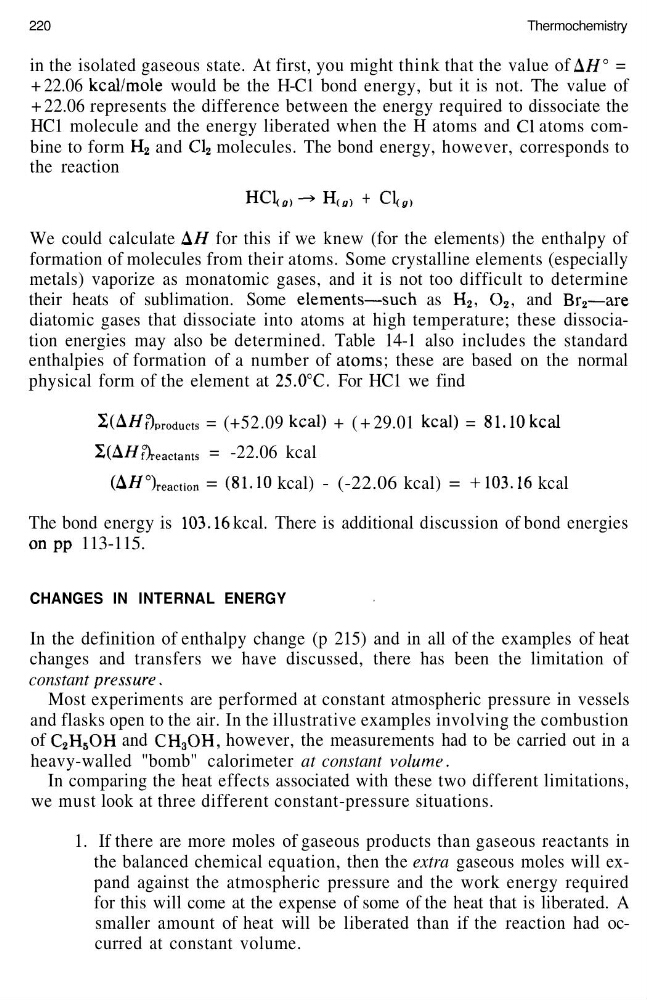
2(A//,°) produc , s = (+52.09 kcal) + ( + 29.01 kcal) = 81.10 kcal
2(A//a e actan, s = -22.06 kcal
(A//°)reaction = (81.10 kcal) - (-22.06 kcal) = +103.16 kcal
The bond energy is 103.16 kcal. There is additional discussion of bond energies
onpp 113-115.
CHANGES IN INTERNAL ENERGY
In the definition of enthalpy change (p 215) and in all of the examples of heat
changes and transfers we have discussed, there has been the limitation of
constant pressure.
Most experiments are performed at constant atmospheric pressure in vessels
and flasks open to the air. In the illustrative examples involving the combustion
of C 2 H 5 OH and CH 3 OH, however, the measurements had to be carried out in a
heavy-walled "bomb" calorimeter at constant volume.
In comparing the heat effects associated with these two different limitations,
we must look at three different constant-pressure situations.
1. If there are more moles of gaseous products than gaseous reactants in
the balanced chemical equation, then the extra gaseous moles will expand against the atmospheric pressure and the work energy required
for this will come at the expense of some of the heat that is liberated. A
smaller amount of heat will be liberated than if the reaction had occurred at constant volume.
Thermochemistry
in the isolated gaseous state. At first, you might think that the value of A//° =
+ 22.06 kcal/mole would be the H-C1 bond energy, but it is not. The value of
+ 22.06 represents the difference between the energy required to dissociate the
HC1 molecule and the energy liberated when the H atoms and Cl atoms combine to form H 2 and C1 2 molecules. The bond energy, however, corresponds to
the reaction
HCl< fl) —> H (s) + Cl( ff)
We could calculate A// for this if we knew (for the elements) the enthalpy of
formation of molecules from their atoms. Some crystalline elements (especially
metals) vaporize as monatomic gases, and it is not too difficult to determine
their heats of sublimation. Some elements—such as H 2 , O 2 , and Br 2 —are
diatomic gases that dissociate into atoms at high temperature; these dissociation energies may also be determined. Table 14-1 also includes the standard
enthalpies of formation of a number of atoms; these are based on the normal
physical form of the element at 25.0°C. For HC1 we find
2(A//,°) produc , s = (+52.09 kcal) + ( + 29.01 kcal) = 81.10 kcal
2(A//a e actan, s = -22.06 kcal
(A//°)reaction = (81.10 kcal) - (-22.06 kcal) = +103.16 kcal
The bond energy is 103.16 kcal. There is additional discussion of bond energies
onpp 113-115.
CHANGES IN INTERNAL ENERGY
In the definition of enthalpy change (p 215) and in all of the examples of heat
changes and transfers we have discussed, there has been the limitation of
constant pressure.
Most experiments are performed at constant atmospheric pressure in vessels
and flasks open to the air. In the illustrative examples involving the combustion
of C 2 H 5 OH and CH 3 OH, however, the measurements had to be carried out in a
heavy-walled "bomb" calorimeter at constant volume.
In comparing the heat effects associated with these two different limitations,
we must look at three different constant-pressure situations.
1. If there are more moles of gaseous products than gaseous reactants in
the balanced chemical equation, then the extra gaseous moles will expand against the atmospheric pressure and the work energy required
for this will come at the expense of some of the heat that is liberated. A
smaller amount of heat will be liberated than if the reaction had occurred at constant volume.