

Math Operations In Scientific Notation
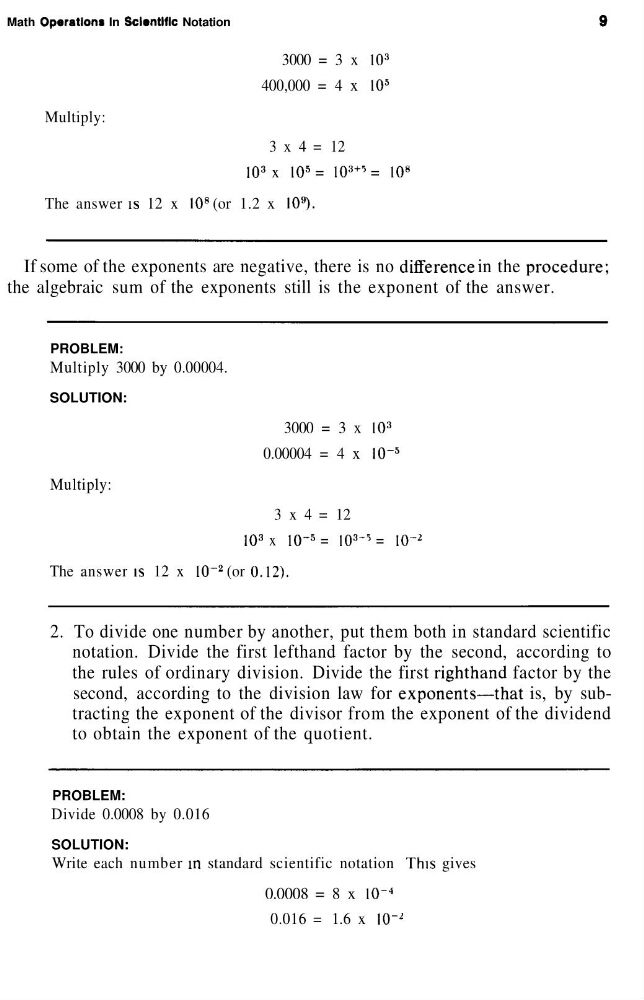
3000 = 3 x 10
3
400,000 = 4 x 10
5
Multiply:
3 x 4 = 12
10
3 x 10
5 = 10
3+5 = 10
8
The answer is 12 x 10
8 (or 1.2 x 10").
If some of the exponents are negative, there is no difference in the procedure;
the algebraic sum of the exponents still is the exponent of the answer.
PROBLEM:
Multiply 3000 by 0.00004.
SOLUTION:
3000 = 3 x 10
3
0.00004 = 4 x 10~
5
Multiply:
3 x 4 = 12
10
3 x 10~
5 = 10
3 ^
5 = 10~
2
The answer is 12 x 10~
2 (or 0.12).
2. To divide one number by another, put them both in standard scientific
notation. Divide the first lefthand factor by the second, according to
the rules of ordinary division. Divide the first righthand factor by the
second, according to the division law for exponents-—that is, by subtracting the exponent of the divisor from the exponent of the dividend
to obtain the exponent of the quotient.
PROBLEM:
Divide 0.0008 by 0.016
SOLUTION:
Write each number in standard scientific notation This gives
0.0008 = 8 x 10~
4
0.016 = 1.6 x \Q-*
3000 = 3 x 10
3
400,000 = 4 x 10
5
Multiply:
3 x 4 = 12
10
3 x 10
5 = 10
3+5 = 10
8
The answer is 12 x 10
8 (or 1.2 x 10").
If some of the exponents are negative, there is no difference in the procedure;
the algebraic sum of the exponents still is the exponent of the answer.
PROBLEM:
Multiply 3000 by 0.00004.
SOLUTION:
3000 = 3 x 10
3
0.00004 = 4 x 10~
5
Multiply:
3 x 4 = 12
10
3 x 10~
5 = 10
3 ^
5 = 10~
2
The answer is 12 x 10~
2 (or 0.12).
2. To divide one number by another, put them both in standard scientific
notation. Divide the first lefthand factor by the second, according to
the rules of ordinary division. Divide the first righthand factor by the
second, according to the division law for exponents-—that is, by subtracting the exponent of the divisor from the exponent of the dividend
to obtain the exponent of the quotient.
PROBLEM:
Divide 0.0008 by 0.016
SOLUTION:
Write each number in standard scientific notation This gives
0.0008 = 8 x 10~
4
0.016 = 1.6 x \Q-*