

10
Number Notations, Arithmetical Operations, and Calculators
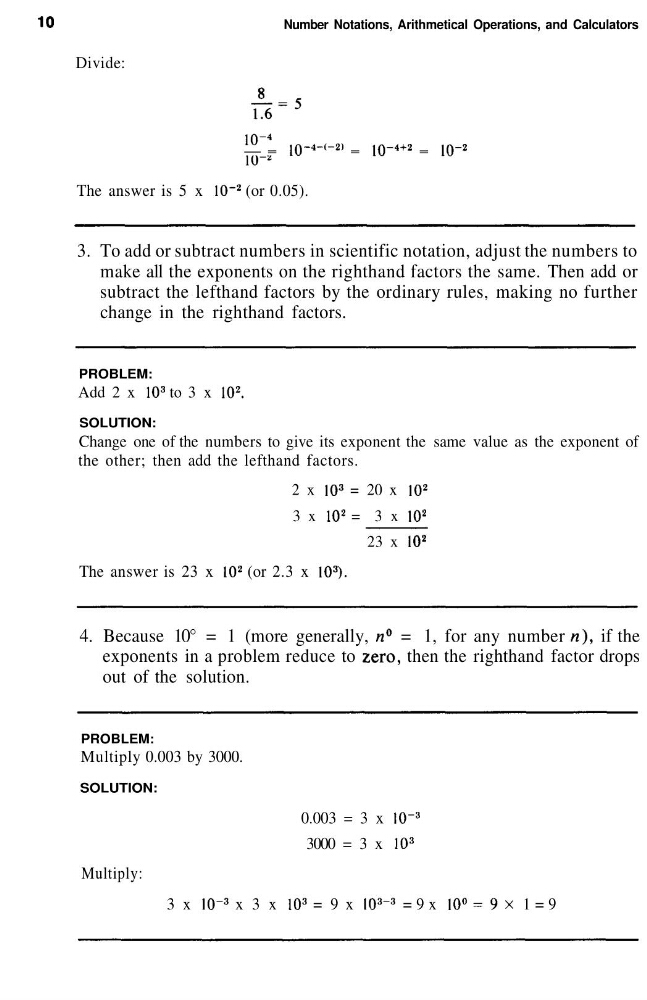
Divide:
I0~
4
— = l()~«-<-2> = 10-< +2 = ID' 2
The answer is 5 x 1Q2 (or 0.05).
3. To add or subtract numbers in scientific notation, adjust the numbers to
make all the exponents on the righthand factors the same. Then add or
subtract the lefthand factors by the ordinary rules, making no further
change in the righthand factors.
PROBLEM:
Add 2 x 10
3 to 3 x I0
2 .
SOLUTION:
Change one of the numbers to give its exponent the same value as the exponent of
the other; then add the lefthand factors.
2 x I0
3 = 20 x 10
2
3 x 10
2 = 3 x I0
2
23 x I0
2
The answer is 23 x I0
2 (or 2.3 x lO
3 ).
4. Because 10° = 1 (more generally, n° = 1, for any number n), if the
exponents in a problem reduce to zero, then the righthand factor drops
out of the solution.
PROBLEM:
Multiply 0.003 by 3000.
SOLUTION:
0.003 = 3 x IO3
3000 = 3 x 10
3
Multiply:
3 x 10~
3 x 3 x 10
3 = 9 x I0
3 ~
3 =9x 10°=9x 1=9
Number Notations, Arithmetical Operations, and Calculators
Divide:
I0~
4
— = l()~«-<-2> = 10-< +2 = ID' 2
The answer is 5 x 1Q2 (or 0.05).
3. To add or subtract numbers in scientific notation, adjust the numbers to
make all the exponents on the righthand factors the same. Then add or
subtract the lefthand factors by the ordinary rules, making no further
change in the righthand factors.
PROBLEM:
Add 2 x 10
3 to 3 x I0
2 .
SOLUTION:
Change one of the numbers to give its exponent the same value as the exponent of
the other; then add the lefthand factors.
2 x I0
3 = 20 x 10
2
3 x 10
2 = 3 x I0
2
23 x I0
2
The answer is 23 x I0
2 (or 2.3 x lO
3 ).
4. Because 10° = 1 (more generally, n° = 1, for any number n), if the
exponents in a problem reduce to zero, then the righthand factor drops
out of the solution.
PROBLEM:
Multiply 0.003 by 3000.
SOLUTION:
0.003 = 3 x IO3
3000 = 3 x 10
3
Multiply:
3 x 10~
3 x 3 x 10
3 = 9 x I0
3 ~
3 =9x 10°=9x 1=9