

8
Number Notations, Arithmetical Operations, and Calculators
this capability, you should learn to take advantage of it. [If you try to enter, in
decimal notation, numbers that are too large (for many calculators, greater than
99,999,999) or too small (for many calculators, less than 0.00000001), you will
find that not all of the digits are displayed for the large numbers, and that only 0
or only part of the digits is displayed for the small numbers. To avoid such
errors, determine for your calculator the limits for entry by decimal notation.
With most calculators, any number from 9.99999999 x 10" to 1 x 10~" can be
entered in scientific notation.]
MATH OPERATIONS IN SCIENTIFIC NOTATION
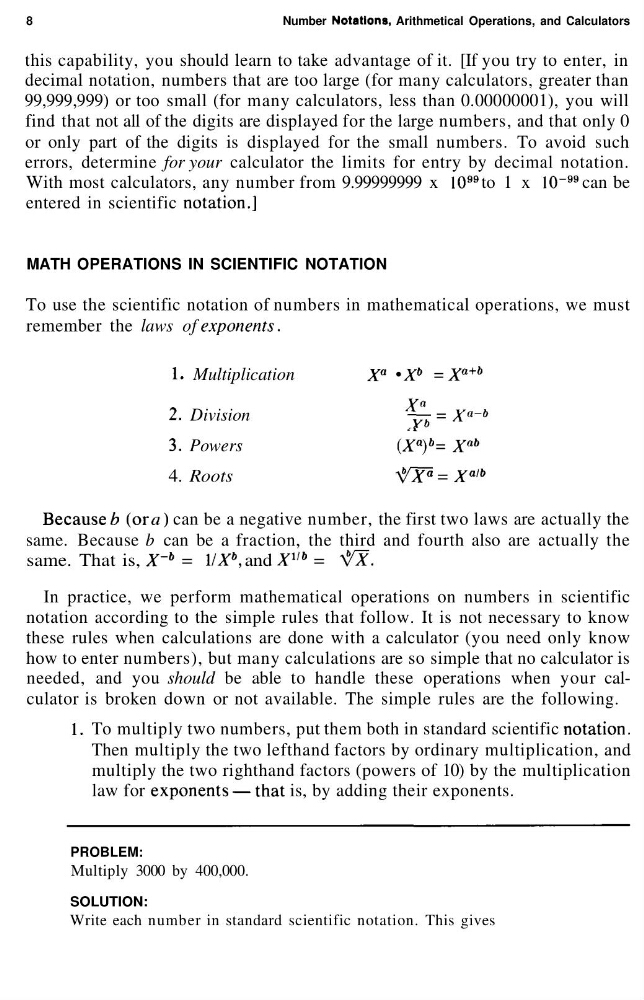
To use the scientific notation of numbers in mathematical operations, we must
remember the laws of exponents.
1 . Multiplication
X" • X" = X
a+b
X
a
2. Division
-^ = X
a ~
b
3. Powers
(X
a )
b = X
ab
4. Roots
^X° = X
alb
Because b (or a) can be a negative number, the first two laws are actually the
same. Because b can be a fraction, the third and fourth also are actually the
same. That is, X~
b = \/X
b , and X
llb = Vx.
In practice, we perform mathematical operations on numbers in scientific
notation according to the simple rules that follow. It is not necessary to know
these rules when calculations are done with a calculator (you need only know
how to enter numbers), but many calculations are so simple that no calculator is
needed, and you should be able to handle these operations when your calculator is broken down or not available. The simple rules are the following.
1. To multiply two numbers, put them both in standard scientific notation.
Then multiply the two lefthand factors by ordinary multiplication, and
multiply the two righthand factors (powers of 10) by the multiplication
law for exponents — that is, by adding their exponents.
PROBLEM:
Multiply 3000 by 400,000.
SOLUTION:
Write each number in standard scientific notation. This gives
Number Notations, Arithmetical Operations, and Calculators
this capability, you should learn to take advantage of it. [If you try to enter, in
decimal notation, numbers that are too large (for many calculators, greater than
99,999,999) or too small (for many calculators, less than 0.00000001), you will
find that not all of the digits are displayed for the large numbers, and that only 0
or only part of the digits is displayed for the small numbers. To avoid such
errors, determine for your calculator the limits for entry by decimal notation.
With most calculators, any number from 9.99999999 x 10" to 1 x 10~" can be
entered in scientific notation.]
MATH OPERATIONS IN SCIENTIFIC NOTATION
To use the scientific notation of numbers in mathematical operations, we must
remember the laws of exponents.
1 . Multiplication
X" • X" = X
a+b
X
a
2. Division
-^ = X
a ~
b
3. Powers
(X
a )
b = X
ab
4. Roots
^X° = X
alb
Because b (or a) can be a negative number, the first two laws are actually the
same. Because b can be a fraction, the third and fourth also are actually the
same. That is, X~
b = \/X
b , and X
llb = Vx.
In practice, we perform mathematical operations on numbers in scientific
notation according to the simple rules that follow. It is not necessary to know
these rules when calculations are done with a calculator (you need only know
how to enter numbers), but many calculations are so simple that no calculator is
needed, and you should be able to handle these operations when your calculator is broken down or not available. The simple rules are the following.
1. To multiply two numbers, put them both in standard scientific notation.
Then multiply the two lefthand factors by ordinary multiplication, and
multiply the two righthand factors (powers of 10) by the multiplication
law for exponents — that is, by adding their exponents.
PROBLEM:
Multiply 3000 by 400,000.
SOLUTION:
Write each number in standard scientific notation. This gives