

138
T bond
bond
IT bond
Side view
End view
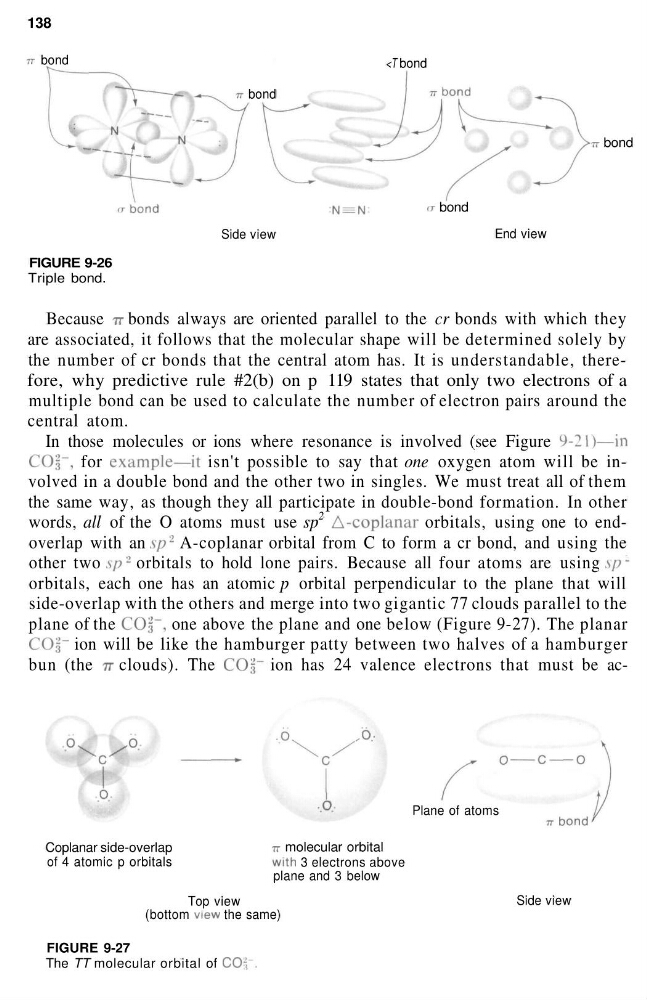
FIGURE 9-26
Triple bond.
Because ir bonds always are oriented parallel to the cr bonds with which they
are associated, it follows that the molecular shape will be determined solely by
the number of cr bonds that the central atom has. It is understandable, therefore, why predictive rule #2(b) on p 119 states that only two electrons of a
multiple bond can be used to calculate the number of electron pairs around the
central atom.
In those molecules or ions where resonance is involved (see Figure 9-21)—in
COi~, for example—it isn't possible to say that one oxygen atom will be involved in a double bond and the other two in singles. We must treat all of them
the same way, as though they all participate in double-bond formation. In other
words, all of the O atoms must use sp
2 A-coplanar orbitals, using one to endoverlap with an sp'
2 A-coplanar orbital from C to form a cr bond, and using the
other two sp
2 orbitals to hold lone pairs. Because all four atoms are using sporbitals, each one has an atomic p orbital perpendicular to the plane that will
side-overlap with the others and merge into two gigantic 77 clouds parallel to the
plane of the CO§", one above the plane and one below (Figure 9-27). The planar
CO|~ ion will be like the hamburger patty between two halves of a hamburger
bun (the TT clouds). The COjj~ ion has 24 valence electrons that must be ac,0..
•.o.
Plane of atoms
bond'
Coplanar side-overlap
of 4 atomic p orbitals
77 molecular orbital
with 3 electrons above
plane and 3 below
Top view
(bottom view the same)
FIGURE 9-27
The TT molecular orbital of COii~.
Side view
T bond
bond
IT bond
Side view
End view
FIGURE 9-26
Triple bond.
Because ir bonds always are oriented parallel to the cr bonds with which they
are associated, it follows that the molecular shape will be determined solely by
the number of cr bonds that the central atom has. It is understandable, therefore, why predictive rule #2(b) on p 119 states that only two electrons of a
multiple bond can be used to calculate the number of electron pairs around the
central atom.
In those molecules or ions where resonance is involved (see Figure 9-21)—in
COi~, for example—it isn't possible to say that one oxygen atom will be involved in a double bond and the other two in singles. We must treat all of them
the same way, as though they all participate in double-bond formation. In other
words, all of the O atoms must use sp
2 A-coplanar orbitals, using one to endoverlap with an sp'
2 A-coplanar orbital from C to form a cr bond, and using the
other two sp
2 orbitals to hold lone pairs. Because all four atoms are using sporbitals, each one has an atomic p orbital perpendicular to the plane that will
side-overlap with the others and merge into two gigantic 77 clouds parallel to the
plane of the CO§", one above the plane and one below (Figure 9-27). The planar
CO|~ ion will be like the hamburger patty between two halves of a hamburger
bun (the TT clouds). The COjj~ ion has 24 valence electrons that must be ac,0..
•.o.
Plane of atoms
bond'
Coplanar side-overlap
of 4 atomic p orbitals
77 molecular orbital
with 3 electrons above
plane and 3 below
Top view
(bottom view the same)
FIGURE 9-27
The TT molecular orbital of COii~.
Side view