

Properties of Molecular Orbitals
137
bond, you must take these atomicp orbitals into account because they contain
electrons. Let's say that M and L form a cr bond by the end-overlap of twoip
2
molecular orbitals (one from each atom). This pair of electrons will be localized
between M and L. Now, if the A planes of M and L both lie in the same plane,
the p orbitals that stick out perpendicularly above and below each of the A
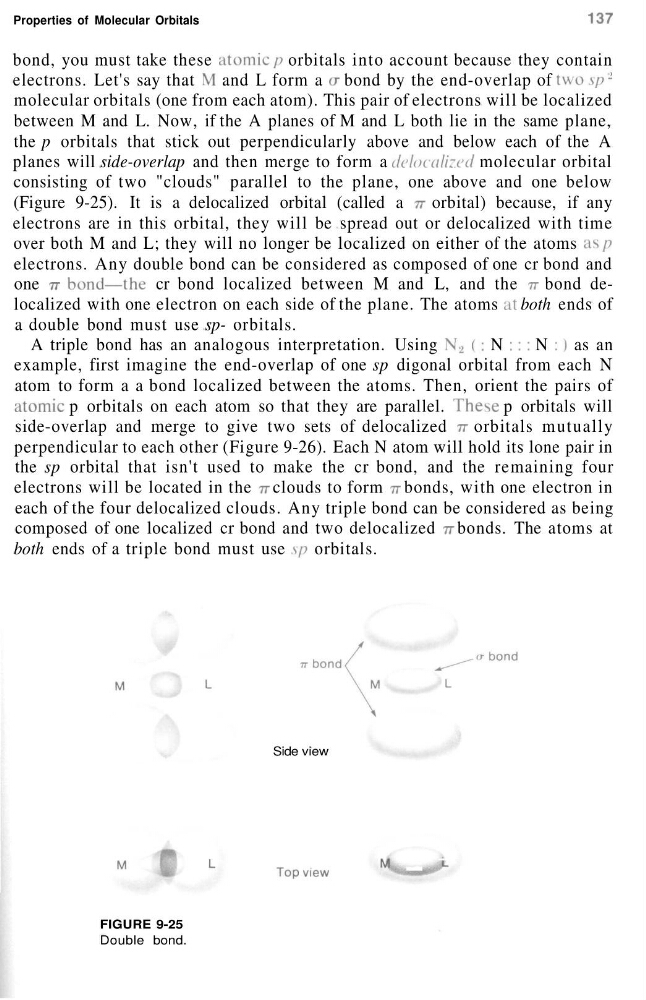
planes will side-overlap and then merge to form a ctelocali~ecl molecular orbital
consisting of two "clouds" parallel to the plane, one above and one below
(Figure 9-25). It is a delocalized orbital (called a TT orbital) because, if any
electrons are in this orbital, they will be spread out or delocalized with time
over both M and L; they will no longer be localized on either of the atoms asp
electrons. Any double bond can be considered as composed of one cr bond and
one TT bond—the cr bond localized between M and L, and the TT bond delocalized with one electron on each side of the plane. The atoms at both ends of
a double bond must use sp- orbitals.
A triple bond has an analogous interpretation. Using N 2 (: N ::: N :) as an
example, first imagine the end-overlap of one sp digonal orbital from each N
atom to form a a bond localized between the atoms. Then, orient the pairs of
atomic p orbitals on each atom so that they are parallel. These p orbitals will
side-overlap and merge to give two sets of delocalized TT orbitals mutually
perpendicular to each other (Figure 9-26). Each N atom will hold its lone pair in
the sp orbital that isn't used to make the cr bond, and the remaining four
electrons will be located in the TT clouds to form TT bonds, with one electron in
each of the four delocalized clouds. Any triple bond can be considered as being
composed of one localized cr bond and two delocalized TT bonds. The atoms at
both ends of a triple bond must use .sp orbitals.
Side view
§ l_
^%fc^
S^rfPTop view
FIGURE 9-25
Double bond.
137
bond, you must take these atomicp orbitals into account because they contain
electrons. Let's say that M and L form a cr bond by the end-overlap of twoip
2
molecular orbitals (one from each atom). This pair of electrons will be localized
between M and L. Now, if the A planes of M and L both lie in the same plane,
the p orbitals that stick out perpendicularly above and below each of the A
planes will side-overlap and then merge to form a ctelocali~ecl molecular orbital
consisting of two "clouds" parallel to the plane, one above and one below
(Figure 9-25). It is a delocalized orbital (called a TT orbital) because, if any
electrons are in this orbital, they will be spread out or delocalized with time
over both M and L; they will no longer be localized on either of the atoms asp
electrons. Any double bond can be considered as composed of one cr bond and
one TT bond—the cr bond localized between M and L, and the TT bond delocalized with one electron on each side of the plane. The atoms at both ends of
a double bond must use sp- orbitals.
A triple bond has an analogous interpretation. Using N 2 (: N ::: N :) as an
example, first imagine the end-overlap of one sp digonal orbital from each N
atom to form a a bond localized between the atoms. Then, orient the pairs of
atomic p orbitals on each atom so that they are parallel. These p orbitals will
side-overlap and merge to give two sets of delocalized TT orbitals mutually
perpendicular to each other (Figure 9-26). Each N atom will hold its lone pair in
the sp orbital that isn't used to make the cr bond, and the remaining four
electrons will be located in the TT clouds to form TT bonds, with one electron in
each of the four delocalized clouds. Any triple bond can be considered as being
composed of one localized cr bond and two delocalized TT bonds. The atoms at
both ends of a triple bond must use .sp orbitals.
Side view
§ l_
^%fc^
S^rfPTop view
FIGURE 9-25
Double bond.