

139
N
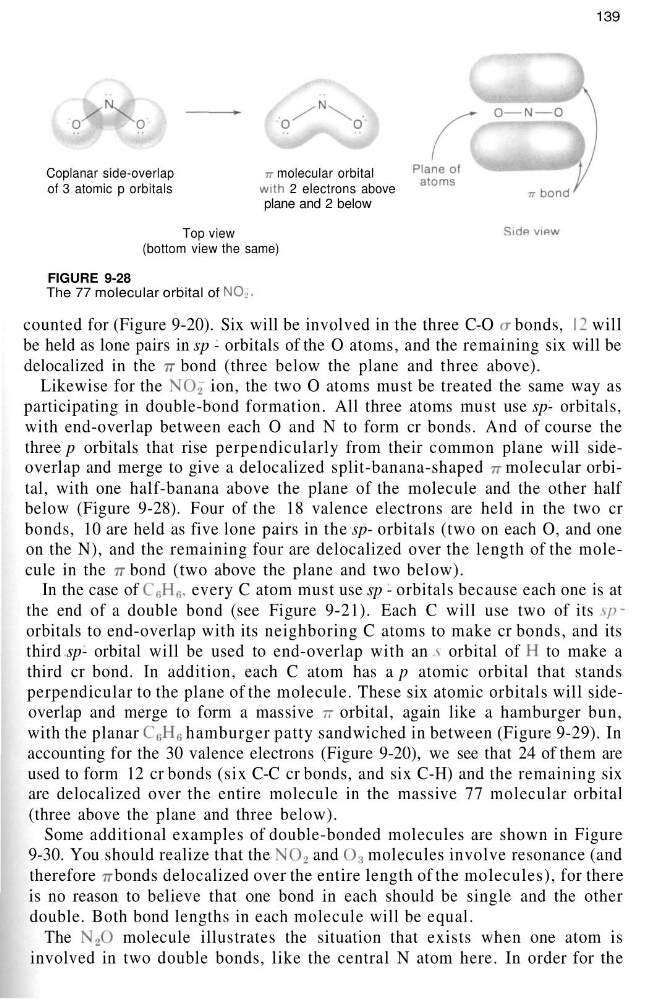
Coplanar side-overlap
IT molecular orbital
of 3 atomic p orbitals
with 2 electrons above
plane and 2 below
Top view
(bottom view the same)
FIGURE 9-28
The 77 molecular orbital of NO 2 .
counted for (Figure 9-20). Six will be involved in the three C-O cr bonds, 12 will
be held as lone pairs in sp - orbitals of the O atoms, and the remaining six will be
delocalized in the IT bond (three below the plane and three above).
Likewise for the NO^ ion, the two O atoms must be treated the same way as
participating in double-bond formation. All three atoms must use sp- orbitals,
with end-overlap between each O and N to form cr bonds. And of course the
three p orbitals that rise perpendicularly from their common plane will sideoverlap and merge to give a delocalized split-banana-shaped TT molecular orbital, with one half-banana above the plane of the molecule and the other half
below (Figure 9-28). Four of the 18 valence electrons are held in the two cr
bonds, 10 are held as five lone pairs in the sp- orbitals (two on each O, and one
on the N), and the remaining four are delocalized over the length of the molecule in the tr bond (two above the plane and two below).
In the case of C 6 H 6 , every C atom must use sp - orbitals because each one is at
the end of a double bond (see Figure 9-21). Each C will use two of its sporbitals to end-overlap with its neighboring C atoms to make cr bonds, and its
third sp- orbital will be used to end-overlap with an .v orbital of H to make a
third cr bond. In addition, each C atom has a p atomic orbital that stands
perpendicular to the plane of the molecule. These six atomic orbitals will sideoverlap and merge to form a massive TT orbital, again like a hamburger bun,
with the planar C 6 H 6 hamburger patty sandwiched in between (Figure 9-29). In
accounting for the 30 valence electrons (Figure 9-20), we see that 24 of them are
used to form 12 cr bonds (six C-C cr bonds, and six C-H) and the remaining six
are delocalized over the entire molecule in the massive 77 molecular orbital
(three above the plane and three below).
Some additional examples of double-bonded molecules are shown in Figure
9-30. You should realize that the NO 2 and O 3 molecules involve resonance (and
therefore TT bonds delocalized over the entire length of the molecules), for there
is no reason to believe that one bond in each should be single and the other
double. Both bond lengths in each molecule will be equal.
The N 2 O molecule illustrates the situation that exists when one atom is
involved in two double bonds, like the central N atom here. In order for the
N
Coplanar side-overlap
IT molecular orbital
of 3 atomic p orbitals
with 2 electrons above
plane and 2 below
Top view
(bottom view the same)
FIGURE 9-28
The 77 molecular orbital of NO 2 .
counted for (Figure 9-20). Six will be involved in the three C-O cr bonds, 12 will
be held as lone pairs in sp - orbitals of the O atoms, and the remaining six will be
delocalized in the IT bond (three below the plane and three above).
Likewise for the NO^ ion, the two O atoms must be treated the same way as
participating in double-bond formation. All three atoms must use sp- orbitals,
with end-overlap between each O and N to form cr bonds. And of course the
three p orbitals that rise perpendicularly from their common plane will sideoverlap and merge to give a delocalized split-banana-shaped TT molecular orbital, with one half-banana above the plane of the molecule and the other half
below (Figure 9-28). Four of the 18 valence electrons are held in the two cr
bonds, 10 are held as five lone pairs in the sp- orbitals (two on each O, and one
on the N), and the remaining four are delocalized over the length of the molecule in the tr bond (two above the plane and two below).
In the case of C 6 H 6 , every C atom must use sp - orbitals because each one is at
the end of a double bond (see Figure 9-21). Each C will use two of its sporbitals to end-overlap with its neighboring C atoms to make cr bonds, and its
third sp- orbital will be used to end-overlap with an .v orbital of H to make a
third cr bond. In addition, each C atom has a p atomic orbital that stands
perpendicular to the plane of the molecule. These six atomic orbitals will sideoverlap and merge to form a massive TT orbital, again like a hamburger bun,
with the planar C 6 H 6 hamburger patty sandwiched in between (Figure 9-29). In
accounting for the 30 valence electrons (Figure 9-20), we see that 24 of them are
used to form 12 cr bonds (six C-C cr bonds, and six C-H) and the remaining six
are delocalized over the entire molecule in the massive 77 molecular orbital
(three above the plane and three below).
Some additional examples of double-bonded molecules are shown in Figure
9-30. You should realize that the NO 2 and O 3 molecules involve resonance (and
therefore TT bonds delocalized over the entire length of the molecules), for there
is no reason to believe that one bond in each should be single and the other
double. Both bond lengths in each molecule will be equal.
The N 2 O molecule illustrates the situation that exists when one atom is
involved in two double bonds, like the central N atom here. In order for the