

131
F
—i
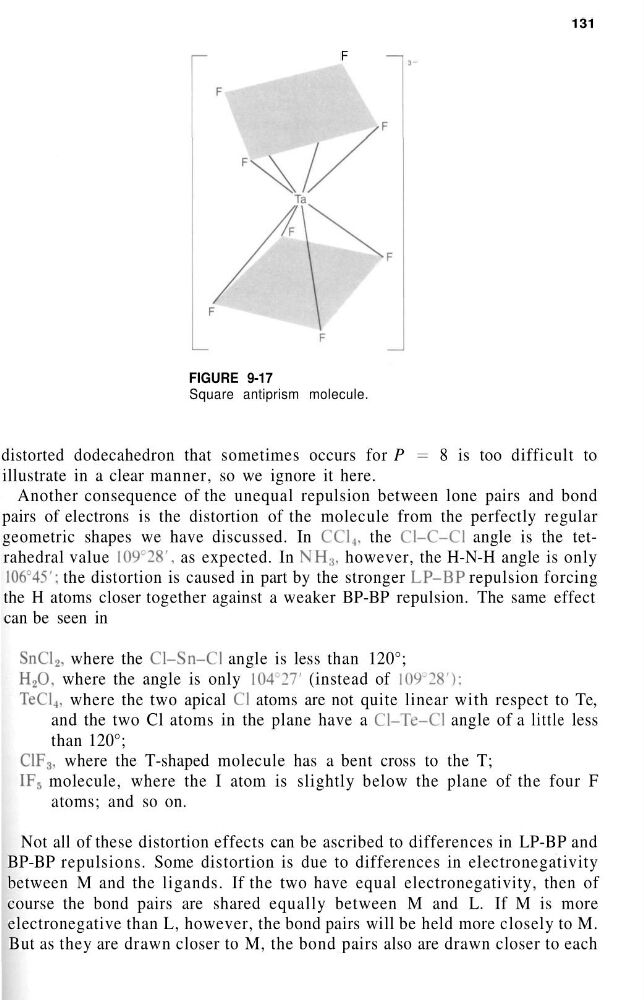
FIGURE 9-17
Square antiprism molecule.
distorted dodecahedron that sometimes occurs for P = 8 is too difficult to
illustrate in a clear manner, so we ignore it here.
Another consequence of the unequal repulsion between lone pairs and bond
pairs of electrons is the distortion of the molecule from the perfectly regular
geometric shapes we have discussed. In CCl 4 , the Cl-C-Cl angle is the tetrahedral value I09°28', as expected. In NH 3 , however, the H-N-H angle is only
106°45'; the distortion is caused in part by the stronger LP-BP repulsion forcing
the H atoms closer together against a weaker BP-BP repulsion. The same effect
can be seen in
SnCl 2 , where the Cl-Sn-Cl angle is less than 120°;
H 2 0, where the angle is only 104°27' (instead of 109°28');
TeCl 4 , where the two apical Cl atoms are not quite linear with respect to Te,
and the two Cl atoms in the plane have a Cl-Te-Cl angle of a little less
than 120°;
C1F 3 , where the T-shaped molecule has a bent cross to the T;
IF 5 molecule, where the I atom is slightly below the plane of the four F
atoms; and so on.
Not all of these distortion effects can be ascribed to differences in LP-BP and
BP-BP repulsions. Some distortion is due to differences in electronegativity
between M and the ligands. If the two have equal electronegativity, then of
course the bond pairs are shared equally between M and L. If M is more
electronegative than L, however, the bond pairs will be held more closely to M.
But as they are drawn closer to M, the bond pairs also are drawn closer to each
F
—i
FIGURE 9-17
Square antiprism molecule.
distorted dodecahedron that sometimes occurs for P = 8 is too difficult to
illustrate in a clear manner, so we ignore it here.
Another consequence of the unequal repulsion between lone pairs and bond
pairs of electrons is the distortion of the molecule from the perfectly regular
geometric shapes we have discussed. In CCl 4 , the Cl-C-Cl angle is the tetrahedral value I09°28', as expected. In NH 3 , however, the H-N-H angle is only
106°45'; the distortion is caused in part by the stronger LP-BP repulsion forcing
the H atoms closer together against a weaker BP-BP repulsion. The same effect
can be seen in
SnCl 2 , where the Cl-Sn-Cl angle is less than 120°;
H 2 0, where the angle is only 104°27' (instead of 109°28');
TeCl 4 , where the two apical Cl atoms are not quite linear with respect to Te,
and the two Cl atoms in the plane have a Cl-Te-Cl angle of a little less
than 120°;
C1F 3 , where the T-shaped molecule has a bent cross to the T;
IF 5 molecule, where the I atom is slightly below the plane of the four F
atoms; and so on.
Not all of these distortion effects can be ascribed to differences in LP-BP and
BP-BP repulsions. Some distortion is due to differences in electronegativity
between M and the ligands. If the two have equal electronegativity, then of
course the bond pairs are shared equally between M and L. If M is more
electronegative than L, however, the bond pairs will be held more closely to M.
But as they are drawn closer to M, the bond pairs also are drawn closer to each