

130
Sizes and Shapes of Molecules
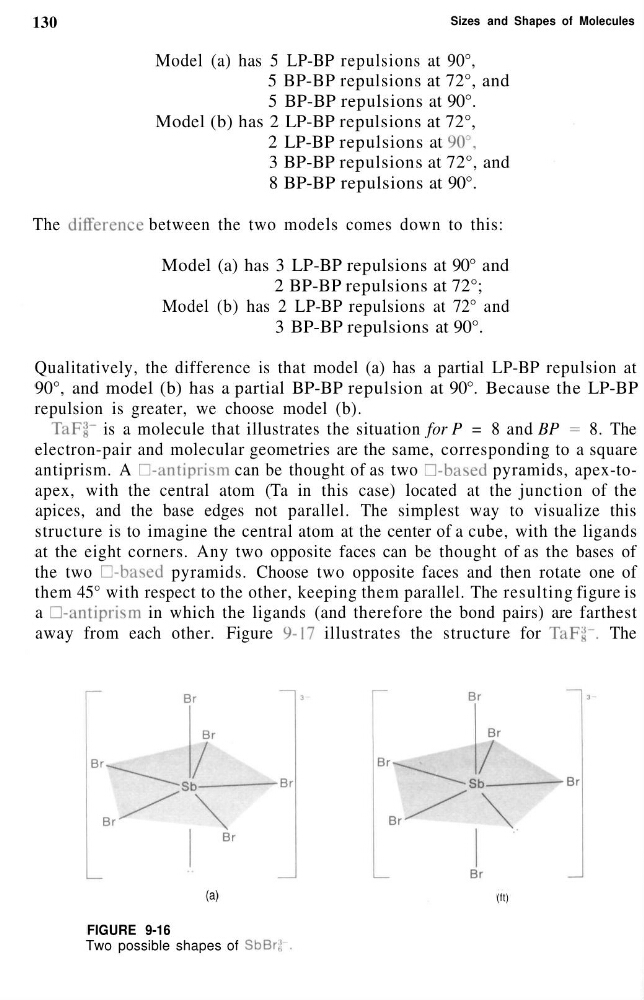
Model (a) has 5 LP-BP repulsions at 90°,
5 BP-BP repulsions at 72°, and
5 BP-BP repulsions at 90°.
Model (b) has 2 LP-BP repulsions at 72°,
2 LP-BP repulsions at 90°,
3 BP-BP repulsions at 72°, and
8 BP-BP repulsions at 90°.
The difference between the two models comes down to this:
Model (a) has 3 LP-BP repulsions at 90° and
2 BP-BP repulsions at 72°;
Model (b) has 2 LP-BP repulsions at 72° and
3 BP-BP repulsions at 90°.
Qualitatively, the difference is that model (a) has a partial LP-BP repulsion at
90°, and model (b) has a partial BP-BP repulsion at 90°. Because the LP-BP
repulsion is greater, we choose model (b).
TaFi" is a molecule that illustrates the situation for P = 8 and BP = 8. The
electron-pair and molecular geometries are the same, corresponding to a square
antiprism. A (H-antiprism can be thought of as two D-based pyramids, apex-toapex, with the central atom (Ta in this case) located at the junction of the
apices, and the base edges not parallel. The simplest way to visualize this
structure is to imagine the central atom at the center of a cube, with the ligands
at the eight corners. Any two opposite faces can be thought of as the bases of
the two D-based pyramids. Choose two opposite faces and then rotate one of
them 45° with respect to the other, keeping them parallel. The resulting figure is
a D-antiprism in which the ligands (and therefore the bond pairs) are farthest
away from each other. Figure 9-17 illustrates the structure for TaFg~. The
(a)
(ft)
FIGURE 9-16
Two possible shapes of
Sizes and Shapes of Molecules
Model (a) has 5 LP-BP repulsions at 90°,
5 BP-BP repulsions at 72°, and
5 BP-BP repulsions at 90°.
Model (b) has 2 LP-BP repulsions at 72°,
2 LP-BP repulsions at 90°,
3 BP-BP repulsions at 72°, and
8 BP-BP repulsions at 90°.
The difference between the two models comes down to this:
Model (a) has 3 LP-BP repulsions at 90° and
2 BP-BP repulsions at 72°;
Model (b) has 2 LP-BP repulsions at 72° and
3 BP-BP repulsions at 90°.
Qualitatively, the difference is that model (a) has a partial LP-BP repulsion at
90°, and model (b) has a partial BP-BP repulsion at 90°. Because the LP-BP
repulsion is greater, we choose model (b).
TaFi" is a molecule that illustrates the situation for P = 8 and BP = 8. The
electron-pair and molecular geometries are the same, corresponding to a square
antiprism. A (H-antiprism can be thought of as two D-based pyramids, apex-toapex, with the central atom (Ta in this case) located at the junction of the
apices, and the base edges not parallel. The simplest way to visualize this
structure is to imagine the central atom at the center of a cube, with the ligands
at the eight corners. Any two opposite faces can be thought of as the bases of
the two D-based pyramids. Choose two opposite faces and then rotate one of
them 45° with respect to the other, keeping them parallel. The resulting figure is
a D-antiprism in which the ligands (and therefore the bond pairs) are farthest
away from each other. Figure 9-17 illustrates the structure for TaFg~. The
(a)
(ft)
FIGURE 9-16
Two possible shapes of