

129
(a)
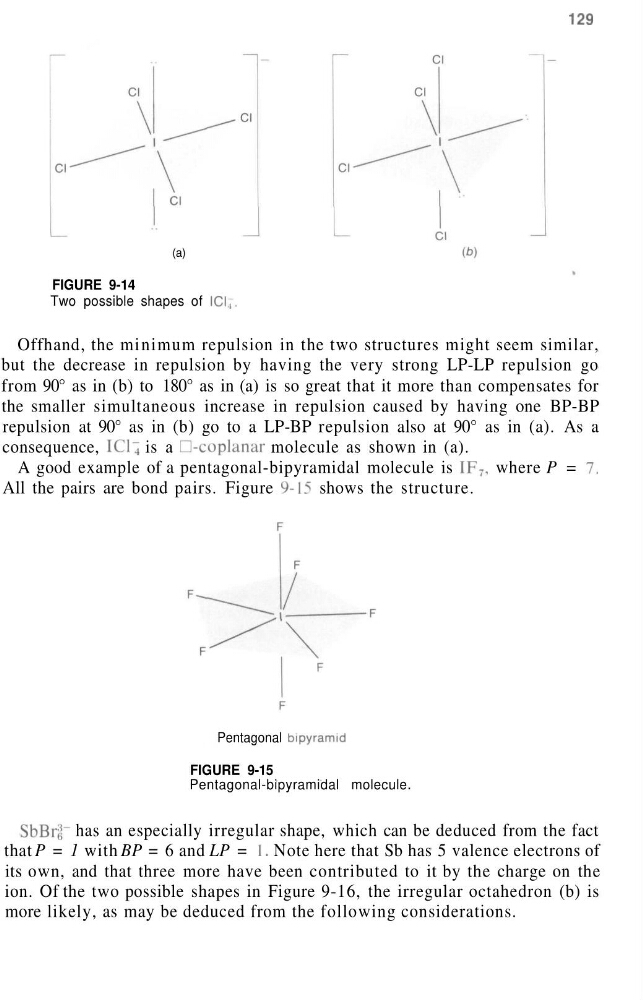
FIGURE 9-14
Two possible shapes of ICI 4 .
Offhand, the minimum repulsion in the two structures might seem similar,
but the decrease in repulsion by having the very strong LP-LP repulsion go
from 90° as in (b) to 180° as in (a) is so great that it more than compensates for
the smaller simultaneous increase in repulsion caused by having one BP-BP
repulsion at 90° as in (b) go to a LP-BP repulsion also at 90° as in (a). As a
consequence, ICl^ is a D-coplanar molecule as shown in (a).
A good example of a pentagonal-bipyramidal molecule is IF 7 , where P = 1.
All the pairs are bond pairs. Figure 9-15 shows the structure.
Pentagonal bipyramid
FIGURE 9-15
Pentagonal-bipyramidal molecule.
SbBrj|~ has an especially irregular shape, which can be deduced from the fact
that P = 1 with BP = 6 and LP = 1. Note here that Sb has 5 valence electrons of
its own, and that three more have been contributed to it by the charge on the
ion. Of the two possible shapes in Figure 9-16, the irregular octahedron (b) is
more likely, as may be deduced from the following considerations.
(a)
FIGURE 9-14
Two possible shapes of ICI 4 .
Offhand, the minimum repulsion in the two structures might seem similar,
but the decrease in repulsion by having the very strong LP-LP repulsion go
from 90° as in (b) to 180° as in (a) is so great that it more than compensates for
the smaller simultaneous increase in repulsion caused by having one BP-BP
repulsion at 90° as in (b) go to a LP-BP repulsion also at 90° as in (a). As a
consequence, ICl^ is a D-coplanar molecule as shown in (a).
A good example of a pentagonal-bipyramidal molecule is IF 7 , where P = 1.
All the pairs are bond pairs. Figure 9-15 shows the structure.
Pentagonal bipyramid
FIGURE 9-15
Pentagonal-bipyramidal molecule.
SbBrj|~ has an especially irregular shape, which can be deduced from the fact
that P = 1 with BP = 6 and LP = 1. Note here that Sb has 5 valence electrons of
its own, and that three more have been contributed to it by the charge on the
ion. Of the two possible shapes in Figure 9-16, the irregular octahedron (b) is
more likely, as may be deduced from the following considerations.