

128
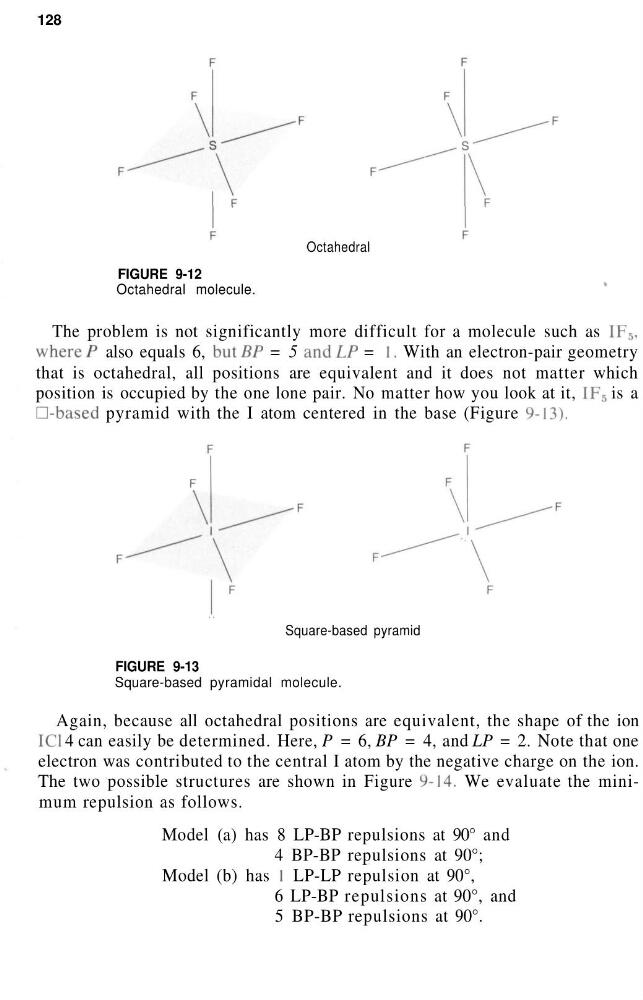
Octahedral
FIGURE 9-12
Octahedral molecule.
The problem is not significantly more difficult for a molecule such as IF 5 ,
where/
1 also equals 6, butBP = 5 andLP = 1. With an electron-pair geometry
that is octahedral, all positions are equivalent and it does not matter which
position is occupied by the one lone pair. No matter how you look at it, IF 5 is a
n-based pyramid with the I atom centered in the base (Figure 9-13).
Square-based pyramid
FIGURE 9-13
Square-based pyramidal molecule.
Again, because all octahedral positions are equivalent, the shape of the ion
ICl 4 can easily be determined. Here, P = 6, BP = 4, and LP = 2. Note that one
electron was contributed to the central I atom by the negative charge on the ion.
The two possible structures are shown in Figure 9-14. We evaluate the minimum repulsion as follows.
Model (a) has 8 LP-BP repulsions at 90° and
4 BP-BP repulsions at 90°;
Model (b) has I LP-LP repulsion at 90°,
6 LP-BP repulsions at 90°, and
5 BP-BP repulsions at 90°.
Octahedral
FIGURE 9-12
Octahedral molecule.
The problem is not significantly more difficult for a molecule such as IF 5 ,
where/
1 also equals 6, butBP = 5 andLP = 1. With an electron-pair geometry
that is octahedral, all positions are equivalent and it does not matter which
position is occupied by the one lone pair. No matter how you look at it, IF 5 is a
n-based pyramid with the I atom centered in the base (Figure 9-13).
Square-based pyramid
FIGURE 9-13
Square-based pyramidal molecule.
Again, because all octahedral positions are equivalent, the shape of the ion
ICl 4 can easily be determined. Here, P = 6, BP = 4, and LP = 2. Note that one
electron was contributed to the central I atom by the negative charge on the ion.
The two possible structures are shown in Figure 9-14. We evaluate the minimum repulsion as follows.
Model (a) has 8 LP-BP repulsions at 90° and
4 BP-BP repulsions at 90°;
Model (b) has I LP-LP repulsion at 90°,
6 LP-BP repulsions at 90°, and
5 BP-BP repulsions at 90°.