

127
Cl
(a)
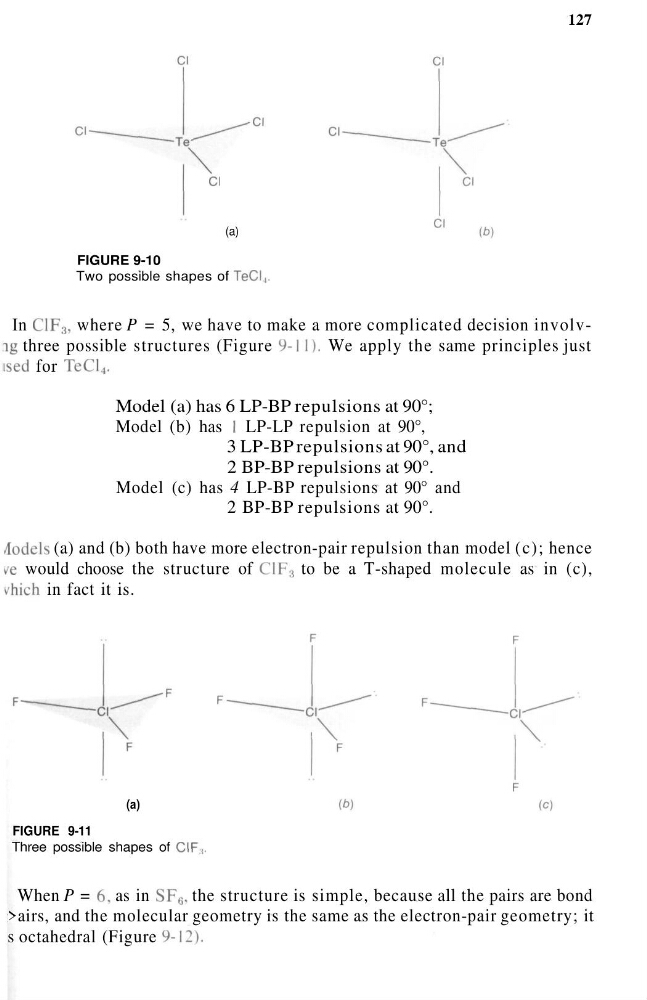
FIGURE 9-10
Two possible shapes of TeCI 4 .
In ClF 3 , where P = 5, we have to make a more complicated decision involvig three possible structures (Figure 9-11). We apply the same principles just
ised for TeCl 4 .
Model (a) has 6 LP-BP repulsions at 90°;
Model (b) has I LP-LP repulsion at 90°,
3 LP-BP repulsions at 90°, and
2 BP-BP repulsions at 90°.
Model (c) has 4 LP-BP repulsions at 90° and
2 BP-BP repulsions at 90°.
Models (a) and (b) both have more electron-pair repulsion than model (c); hence
k-e would choose the structure of ClF 3 to be a T-shaped molecule as in (c),
in fact it is.
(a)
FIGURE 9-11
Three possible shapes of CIF :1 .
When P = 6, as in SF 6 , the structure is simple, because all the pairs are bond
>airs, and the molecular geometry is the same as the electron-pair geometry; it
s octahedral (Figure 9-12).
Cl
(a)
FIGURE 9-10
Two possible shapes of TeCI 4 .
In ClF 3 , where P = 5, we have to make a more complicated decision involvig three possible structures (Figure 9-11). We apply the same principles just
ised for TeCl 4 .
Model (a) has 6 LP-BP repulsions at 90°;
Model (b) has I LP-LP repulsion at 90°,
3 LP-BP repulsions at 90°, and
2 BP-BP repulsions at 90°.
Model (c) has 4 LP-BP repulsions at 90° and
2 BP-BP repulsions at 90°.
Models (a) and (b) both have more electron-pair repulsion than model (c); hence
k-e would choose the structure of ClF 3 to be a T-shaped molecule as in (c),
in fact it is.
(a)
FIGURE 9-11
Three possible shapes of CIF :1 .
When P = 6, as in SF 6 , the structure is simple, because all the pairs are bond
>airs, and the molecular geometry is the same as the electron-pair geometry; it
s octahedral (Figure 9-12).