

126
Cl.
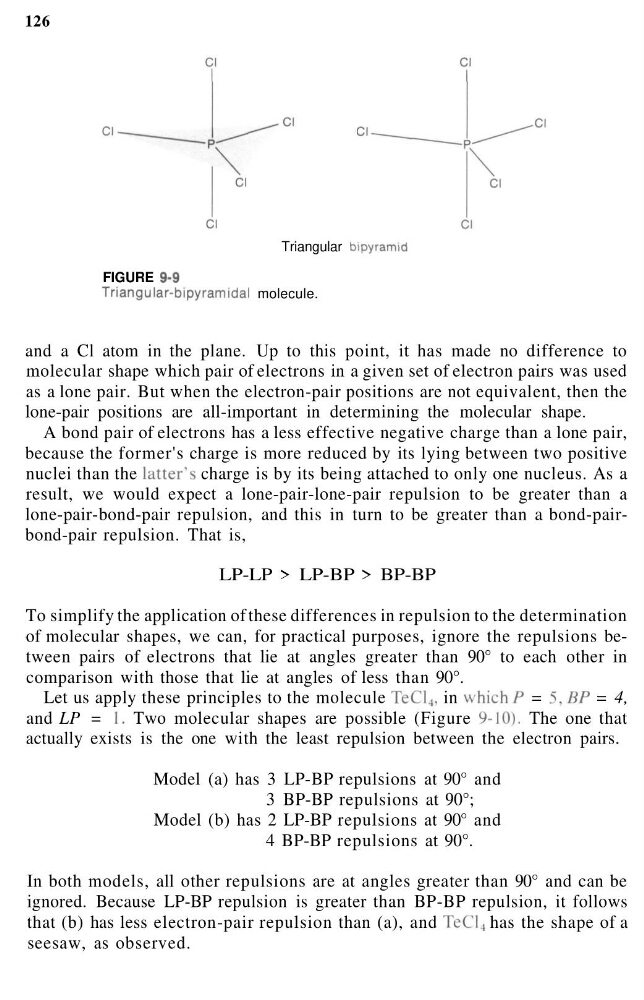
Triangular bipyramid
FIGURE 9-9
Triangular-bipyramidal molecule.
and a Cl atom in the plane. Up to this point, it has made no difference to
molecular shape which pair of electrons in a given set of electron pairs was used
as a lone pair. But when the electron-pair positions are not equivalent, then the
lone-pair positions are all-important in determining the molecular shape.
A bond pair of electrons has a less effective negative charge than a lone pair,
because the former's charge is more reduced by its lying between two positive
nuclei than the latter's charge is by its being attached to only one nucleus. As a
result, we would expect a lone-pair-lone-pair repulsion to be greater than a
lone-pair-bond-pair repulsion, and this in turn to be greater than a bond-pairbond-pair repulsion. That is,
LP-LP > LP-BP > BP-BP
To simplify the application of these differences in repulsion to the determination
of molecular shapes, we can, for practical purposes, ignore the repulsions between pairs of electrons that lie at angles greater than 90° to each other in
comparison with those that lie at angles of less than 90°.
Let us apply these principles to the molecule TeCl 4 , in which/" = 5,BP = 4,
and LP = I. Two molecular shapes are possible (Figure 9-10). The one that
actually exists is the one with the least repulsion between the electron pairs.
Model (a) has 3 LP-BP repulsions at 90° and
3 BP-BP repulsions at 90°;
Model (b) has 2 LP-BP repulsions at 90° and
4 BP-BP repulsions at 90°.
In both models, all other repulsions are at angles greater than 90° and can be
ignored. Because LP-BP repulsion is greater than BP-BP repulsion, it follows
that (b) has less electron-pair repulsion than (a), and TeCl 4 has the shape of a
seesaw, as observed.
Cl.
Triangular bipyramid
FIGURE 9-9
Triangular-bipyramidal molecule.
and a Cl atom in the plane. Up to this point, it has made no difference to
molecular shape which pair of electrons in a given set of electron pairs was used
as a lone pair. But when the electron-pair positions are not equivalent, then the
lone-pair positions are all-important in determining the molecular shape.
A bond pair of electrons has a less effective negative charge than a lone pair,
because the former's charge is more reduced by its lying between two positive
nuclei than the latter's charge is by its being attached to only one nucleus. As a
result, we would expect a lone-pair-lone-pair repulsion to be greater than a
lone-pair-bond-pair repulsion, and this in turn to be greater than a bond-pairbond-pair repulsion. That is,
LP-LP > LP-BP > BP-BP
To simplify the application of these differences in repulsion to the determination
of molecular shapes, we can, for practical purposes, ignore the repulsions between pairs of electrons that lie at angles greater than 90° to each other in
comparison with those that lie at angles of less than 90°.
Let us apply these principles to the molecule TeCl 4 , in which/" = 5,BP = 4,
and LP = I. Two molecular shapes are possible (Figure 9-10). The one that
actually exists is the one with the least repulsion between the electron pairs.
Model (a) has 3 LP-BP repulsions at 90° and
3 BP-BP repulsions at 90°;
Model (b) has 2 LP-BP repulsions at 90° and
4 BP-BP repulsions at 90°.
In both models, all other repulsions are at angles greater than 90° and can be
ignored. Because LP-BP repulsion is greater than BP-BP repulsion, it follows
that (b) has less electron-pair repulsion than (a), and TeCl 4 has the shape of a
seesaw, as observed.