

Shapes of Molecules
125
occupies a tetrahedral position in the electron-pair geometry. The term
"pyramid" is applied to irregular tetrahedra, the term "tetrahedron" only to
regular (equal-edged) tetrahedra.
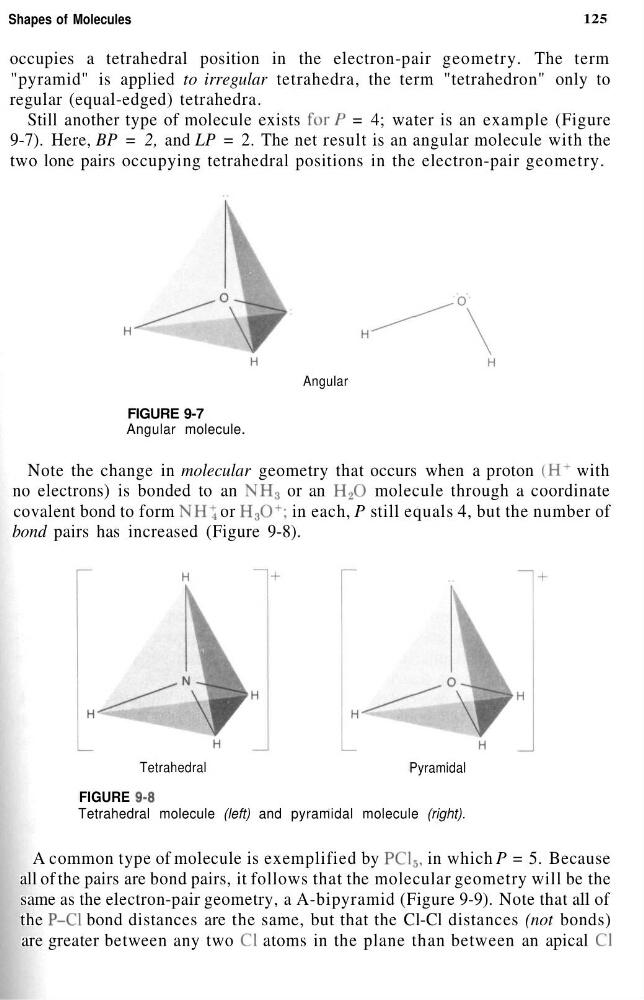
Still another type of molecule exists for/
3 = 4; water is an example (Figure
9-7). Here, BP = 2, and LP = 2. The net result is an angular molecule with the
two lone pairs occupying tetrahedral positions in the electron-pair geometry.
Angular
FIGURE 9-7
Angular molecule.
Note the change in molecular geometry that occurs when a proton (H
+ with
no electrons) is bonded to an NH 3 or an H 2 O molecule through a coordinate
covalent bond to form NHt or H 3 O
+ ; in each, P still equals 4, but the number of
bond pairs has increased (Figure 9-8).
Tetrahedral
Pyramidal
FIGURE 9-8
Tetrahedral molecule (left) and pyramidal molecule (right).
A common type of molecule is exemplified by PCl 5 , in which P = 5. Because
all of the pairs are bond pairs, it follows that the molecular geometry will be the
same as the electron-pair geometry, a A-bipyramid (Figure 9-9). Note that all of
the P-CI bond distances are the same, but that the Cl-Cl distances (not bonds)
are greater between any two Cl atoms in the plane than between an apical Cl
125
occupies a tetrahedral position in the electron-pair geometry. The term
"pyramid" is applied to irregular tetrahedra, the term "tetrahedron" only to
regular (equal-edged) tetrahedra.
Still another type of molecule exists for/
3 = 4; water is an example (Figure
9-7). Here, BP = 2, and LP = 2. The net result is an angular molecule with the
two lone pairs occupying tetrahedral positions in the electron-pair geometry.
Angular
FIGURE 9-7
Angular molecule.
Note the change in molecular geometry that occurs when a proton (H
+ with
no electrons) is bonded to an NH 3 or an H 2 O molecule through a coordinate
covalent bond to form NHt or H 3 O
+ ; in each, P still equals 4, but the number of
bond pairs has increased (Figure 9-8).
Tetrahedral
Pyramidal
FIGURE 9-8
Tetrahedral molecule (left) and pyramidal molecule (right).
A common type of molecule is exemplified by PCl 5 , in which P = 5. Because
all of the pairs are bond pairs, it follows that the molecular geometry will be the
same as the electron-pair geometry, a A-bipyramid (Figure 9-9). Note that all of
the P-CI bond distances are the same, but that the Cl-Cl distances (not bonds)
are greater between any two Cl atoms in the plane than between an apical Cl