

132
Sizes and Shapes of Molecules
other and, in an effort to reduce this added repulsion, they tend to widen the
angle between them. The net result is a distortion. Compare the following sets
of bond angles, which reflect both the differences in LP-BP and BP-BP repulsions, and the differences in electronegativity between M and L (H-M-H angles
are cited):
NH 3 , I06°45'; PH 3 , 93°50'; AsH 3 , 9l°35'; SbH 3 , 9l°30';
H 2 O, I04°27'; H 2 S, 92°20'.
If the ligands are more electronegative than M, then the bond pairs are drawn
farther from M and away from each other, a situation that assists the lone pair
in making the L-M-L angle smaller as it operates against this weaker BP-BP
repulsion. For example, compare NH 3 (I06°45') with NF 3 (I02°9'), and H 2 O
(104°27
; ) with OF 2 (lOl°30').
Multiple Bonds
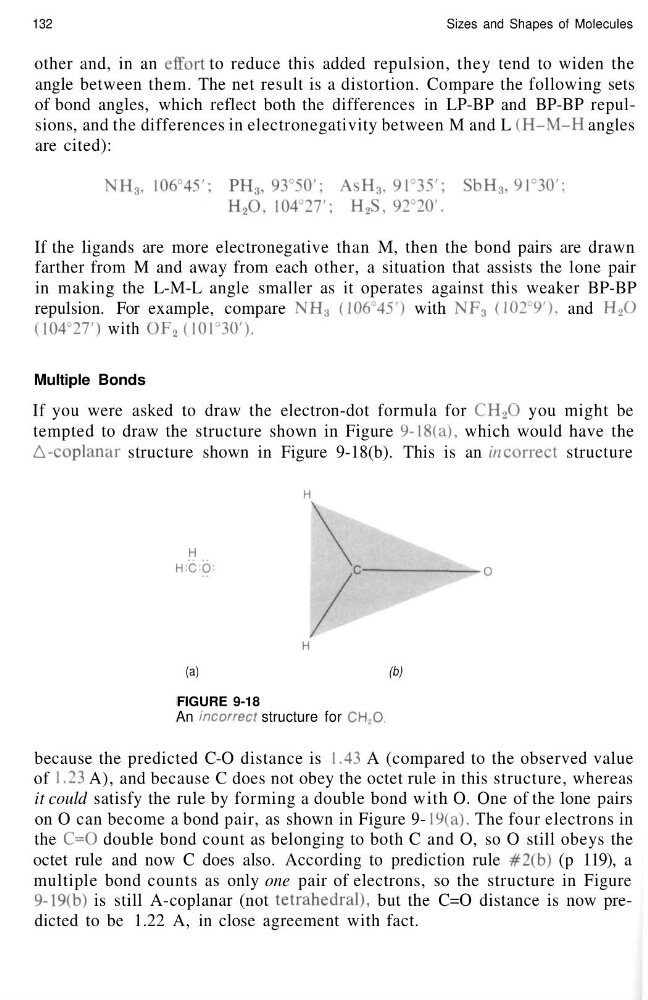
If you were asked to draw the electron-dot formula for CH 2 O you might be
tempted to draw the structure shown in Figure 9-l8(a), which would have the
A-coplanar structure shown in Figure 9-18(b). This is an /^correct structure
H
H:C:0:
(a)
(b)
FIGURE 9-18
An incorrect structure for CH 2 O.
because the predicted C-O distance is 1.43 A (compared to the observed value
of 1.23 A), and because C does not obey the octet rule in this structure, whereas
it could satisfy the rule by forming a double bond with O. One of the lone pairs
on O can become a bond pair, as shown in Figure 9- I9(a). The four electrons in
the C=O double bond count as belonging to both C and O, so O still obeys the
octet rule and now C does also. According to prediction rule #2(b) (p 119), a
multiple bond counts as only one pair of electrons, so the structure in Figure
9-19(b) is still A-coplanar (not tetrahedral), but the C=O distance is now predicted to be 1.22 A, in close agreement with fact.
Sizes and Shapes of Molecules
other and, in an effort to reduce this added repulsion, they tend to widen the
angle between them. The net result is a distortion. Compare the following sets
of bond angles, which reflect both the differences in LP-BP and BP-BP repulsions, and the differences in electronegativity between M and L (H-M-H angles
are cited):
NH 3 , I06°45'; PH 3 , 93°50'; AsH 3 , 9l°35'; SbH 3 , 9l°30';
H 2 O, I04°27'; H 2 S, 92°20'.
If the ligands are more electronegative than M, then the bond pairs are drawn
farther from M and away from each other, a situation that assists the lone pair
in making the L-M-L angle smaller as it operates against this weaker BP-BP
repulsion. For example, compare NH 3 (I06°45') with NF 3 (I02°9'), and H 2 O
(104°27
; ) with OF 2 (lOl°30').
Multiple Bonds
If you were asked to draw the electron-dot formula for CH 2 O you might be
tempted to draw the structure shown in Figure 9-l8(a), which would have the
A-coplanar structure shown in Figure 9-18(b). This is an /^correct structure
H
H:C:0:
(a)
(b)
FIGURE 9-18
An incorrect structure for CH 2 O.
because the predicted C-O distance is 1.43 A (compared to the observed value
of 1.23 A), and because C does not obey the octet rule in this structure, whereas
it could satisfy the rule by forming a double bond with O. One of the lone pairs
on O can become a bond pair, as shown in Figure 9- I9(a). The four electrons in
the C=O double bond count as belonging to both C and O, so O still obeys the
octet rule and now C does also. According to prediction rule #2(b) (p 119), a
multiple bond counts as only one pair of electrons, so the structure in Figure
9-19(b) is still A-coplanar (not tetrahedral), but the C=O distance is now predicted to be 1.22 A, in close agreement with fact.