

122
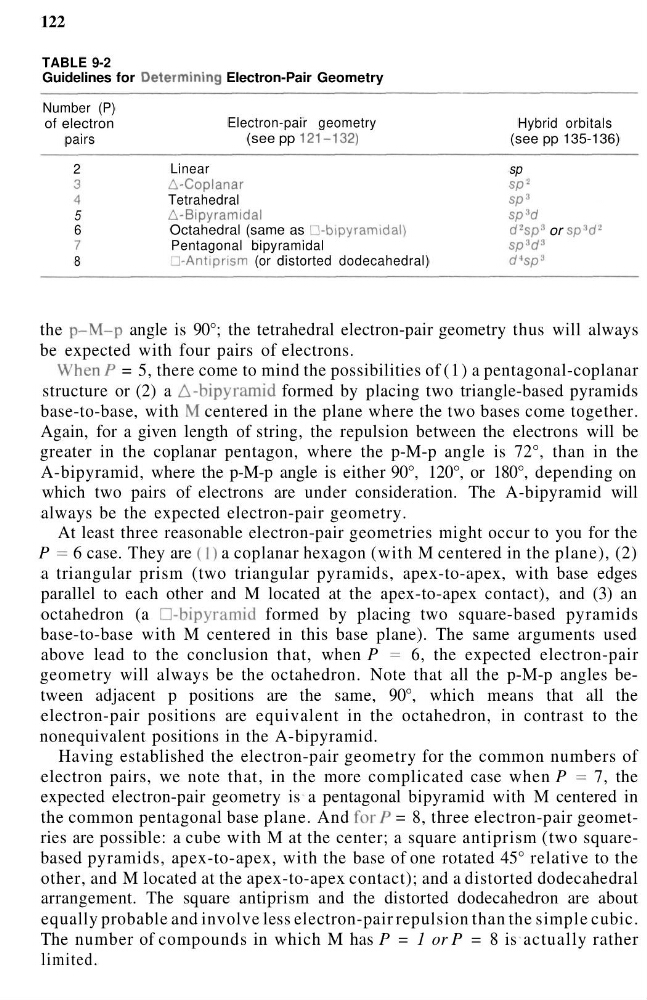
TABLE 9-2
Guidelines for Determining Electron-Pair Geometry
Number (P)
of electron
pairs
2
•'.
4
5
6
/
8
Electron-pair geometry
(see pp 121-132)
Linear
A-Coplanar
Tetrahedral
A-Bipyramidal
Octahedral (same as D-bipyramidal)
Pentagonal bipyramidal
D-Antiprism (or distorted dodecahedral)
Hybrid orbitals
(see pp 135-136)
sp
sp'
sp
3
sp
3 d
d*sp
3 or sp
3 d
2
sp
3 d
3
d"sp
3
the p-M-p angle is 90°; the tetrahedral electron-pair geometry thus will always
be expected with four pairs of electrons.
When/
3 = 5, there come to mind the possibilities of (1) a pentagonal-coplanar
structure or (2) a A-bipyramid formed by placing two triangle-based pyramids
base-to-base, with M centered in the plane where the two bases come together.
Again, for a given length of string, the repulsion between the electrons will be
greater in the coplanar pentagon, where the p-M-p angle is 72°, than in the
A-bipyramid, where the p-M-p angle is either 90°, 120°, or 180°, depending on
which two pairs of electrons are under consideration. The A-bipyramid will
always be the expected electron-pair geometry.
At least three reasonable electron-pair geometries might occur to you for the
P = 6 case. They are (1) a coplanar hexagon (with M centered in the plane), (2)
a triangular prism (two triangular pyramids, apex-to-apex, with base edges
parallel to each other and M located at the apex-to-apex contact), and (3) an
octahedron (a D-bipyramid formed by placing two square-based pyramids
base-to-base with M centered in this base plane). The same arguments used
above lead to the conclusion that, when P = 6, the expected electron-pair
geometry will always be the octahedron. Note that all the p-M-p angles between adjacent p positions are the same, 90°, which means that all the
electron-pair positions are equivalent in the octahedron, in contrast to the
nonequivalent positions in the A-bipyramid.
Having established the electron-pair geometry for the common numbers of
electron pairs, we note that, in the more complicated case when P =- 7, the
expected electron-pair geometry is a pentagonal bipyramid with M centered in
the common pentagonal base plane. And for/
3 = 8, three electron-pair geometries are possible: a cube with M at the center; a square antiprism (two squarebased pyramids, apex-to-apex, with the base of one rotated 45° relative to the
other, and M located at the apex-to-apex contact); and a distorted dodecahedral
arrangement. The square antiprism and the distorted dodecahedron are about
equally probable and involve less electron-pair repulsion than the simple cubic.
The number of compounds in which M has P = 1 or P = 8 is actually rather
limited.
TABLE 9-2
Guidelines for Determining Electron-Pair Geometry
Number (P)
of electron
pairs
2
•'.
4
5
6
/
8
Electron-pair geometry
(see pp 121-132)
Linear
A-Coplanar
Tetrahedral
A-Bipyramidal
Octahedral (same as D-bipyramidal)
Pentagonal bipyramidal
D-Antiprism (or distorted dodecahedral)
Hybrid orbitals
(see pp 135-136)
sp
sp'
sp
3
sp
3 d
d*sp
3 or sp
3 d
2
sp
3 d
3
d"sp
3
the p-M-p angle is 90°; the tetrahedral electron-pair geometry thus will always
be expected with four pairs of electrons.
When/
3 = 5, there come to mind the possibilities of (1) a pentagonal-coplanar
structure or (2) a A-bipyramid formed by placing two triangle-based pyramids
base-to-base, with M centered in the plane where the two bases come together.
Again, for a given length of string, the repulsion between the electrons will be
greater in the coplanar pentagon, where the p-M-p angle is 72°, than in the
A-bipyramid, where the p-M-p angle is either 90°, 120°, or 180°, depending on
which two pairs of electrons are under consideration. The A-bipyramid will
always be the expected electron-pair geometry.
At least three reasonable electron-pair geometries might occur to you for the
P = 6 case. They are (1) a coplanar hexagon (with M centered in the plane), (2)
a triangular prism (two triangular pyramids, apex-to-apex, with base edges
parallel to each other and M located at the apex-to-apex contact), and (3) an
octahedron (a D-bipyramid formed by placing two square-based pyramids
base-to-base with M centered in this base plane). The same arguments used
above lead to the conclusion that, when P = 6, the expected electron-pair
geometry will always be the octahedron. Note that all the p-M-p angles between adjacent p positions are the same, 90°, which means that all the
electron-pair positions are equivalent in the octahedron, in contrast to the
nonequivalent positions in the A-bipyramid.
Having established the electron-pair geometry for the common numbers of
electron pairs, we note that, in the more complicated case when P =- 7, the
expected electron-pair geometry is a pentagonal bipyramid with M centered in
the common pentagonal base plane. And for/
3 = 8, three electron-pair geometries are possible: a cube with M at the center; a square antiprism (two squarebased pyramids, apex-to-apex, with the base of one rotated 45° relative to the
other, and M located at the apex-to-apex contact); and a distorted dodecahedral
arrangement. The square antiprism and the distorted dodecahedron are about
equally probable and involve less electron-pair repulsion than the simple cubic.
The number of compounds in which M has P = 1 or P = 8 is actually rather
limited.