

Shapes of Molecules
123
Molecular Geometries
Now, let us look at molecular geometries or shapes. These are determined by
the number (BP) of electron pairs that are used as bond pairs, for these bond
pairs will lie in molecular orbitals between M and L (the ligands) in positions
determined by P, as we have just discussed. The total number of pairs often
(usually) will be equal to the number of ligands attached to M. When this is true
(that is, when P --= BP), the molecular geometry will be identical to the
electron-pair geometry. In the sketches, the electron-pair geometry is shown by
shaded planes, and bond pairs of electrons by solid lines. The lone pairs (LP) of
electrons are shown as dots.
When/
3 = I, we have a trivial case (such as HCl, in which H is considered to
be the central atom), in which the only pair is of necessity a bond pair or there
would be no molecule at all. The shape is typical of all diatomic molecules
regardless of the number of electron pairs—it is a "dumbbell" molecule.
When P = 2, as in BeCl 2 (Figure 9-2), the molecular geometry is linear,
because both pairs are bond pairs repelling each other at 180°.
Be
Cl
Be
Cl
Linear
FIGURE 9-2
Linear molecule.
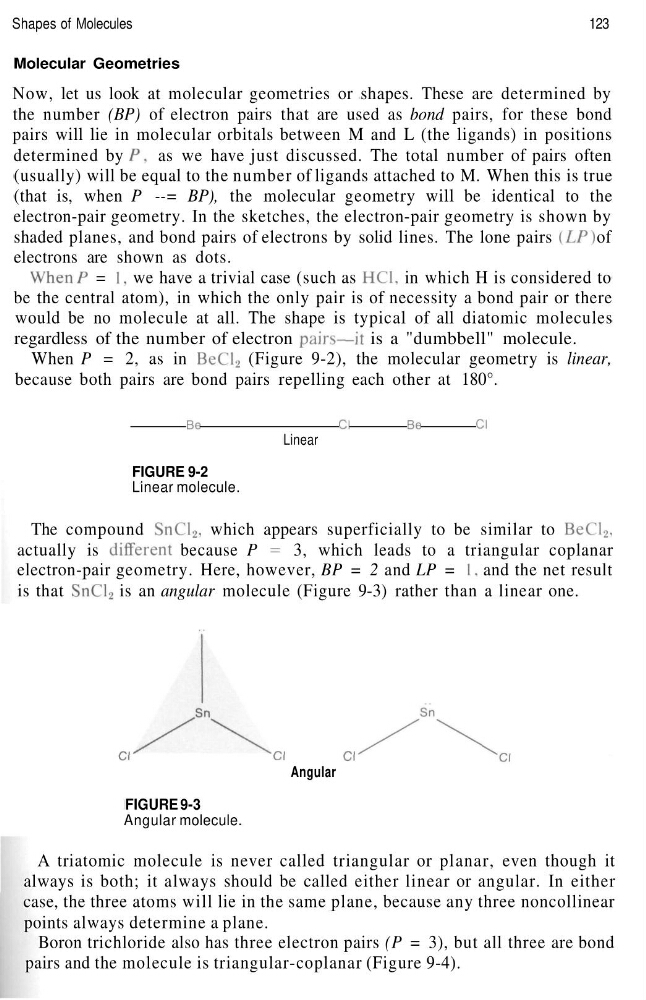
The compound SnCl 2 , which appears superficially to be similar to BeCl 2 ,
actually is different because P ---- 3, which leads to a triangular coplanar
electron-pair geometry. Here, however, BP = 2 and LP = 1, and the net result
is that SnCl 2 is an angular molecule (Figure 9-3) rather than a linear one.
ci
ci
Angular
FIGURE 9-3
Angular molecule.
A triatomic molecule is never called triangular or planar, even though it
always is both; it always should be called either linear or angular. In either
case, the three atoms will lie in the same plane, because any three noncollinear
points always determine a plane.
Boron trichloride also has three electron pairs (P = 3), but all three are bond
pairs and the molecule is triangular-coplanar (Figure 9-4).
123
Molecular Geometries
Now, let us look at molecular geometries or shapes. These are determined by
the number (BP) of electron pairs that are used as bond pairs, for these bond
pairs will lie in molecular orbitals between M and L (the ligands) in positions
determined by P, as we have just discussed. The total number of pairs often
(usually) will be equal to the number of ligands attached to M. When this is true
(that is, when P --= BP), the molecular geometry will be identical to the
electron-pair geometry. In the sketches, the electron-pair geometry is shown by
shaded planes, and bond pairs of electrons by solid lines. The lone pairs (LP) of
electrons are shown as dots.
When/
3 = I, we have a trivial case (such as HCl, in which H is considered to
be the central atom), in which the only pair is of necessity a bond pair or there
would be no molecule at all. The shape is typical of all diatomic molecules
regardless of the number of electron pairs—it is a "dumbbell" molecule.
When P = 2, as in BeCl 2 (Figure 9-2), the molecular geometry is linear,
because both pairs are bond pairs repelling each other at 180°.
Be
Cl
Be
Cl
Linear
FIGURE 9-2
Linear molecule.
The compound SnCl 2 , which appears superficially to be similar to BeCl 2 ,
actually is different because P ---- 3, which leads to a triangular coplanar
electron-pair geometry. Here, however, BP = 2 and LP = 1, and the net result
is that SnCl 2 is an angular molecule (Figure 9-3) rather than a linear one.
ci
ci
Angular
FIGURE 9-3
Angular molecule.
A triatomic molecule is never called triangular or planar, even though it
always is both; it always should be called either linear or angular. In either
case, the three atoms will lie in the same plane, because any three noncollinear
points always determine a plane.
Boron trichloride also has three electron pairs (P = 3), but all three are bond
pairs and the molecule is triangular-coplanar (Figure 9-4).