

121
Cl Cl
B
Cl
Cl • P Cl
Cl
H
H N H
H
Cl
Cl
Cl
F>
Cl
Cl.
F Cl F
F
O
O S O
O
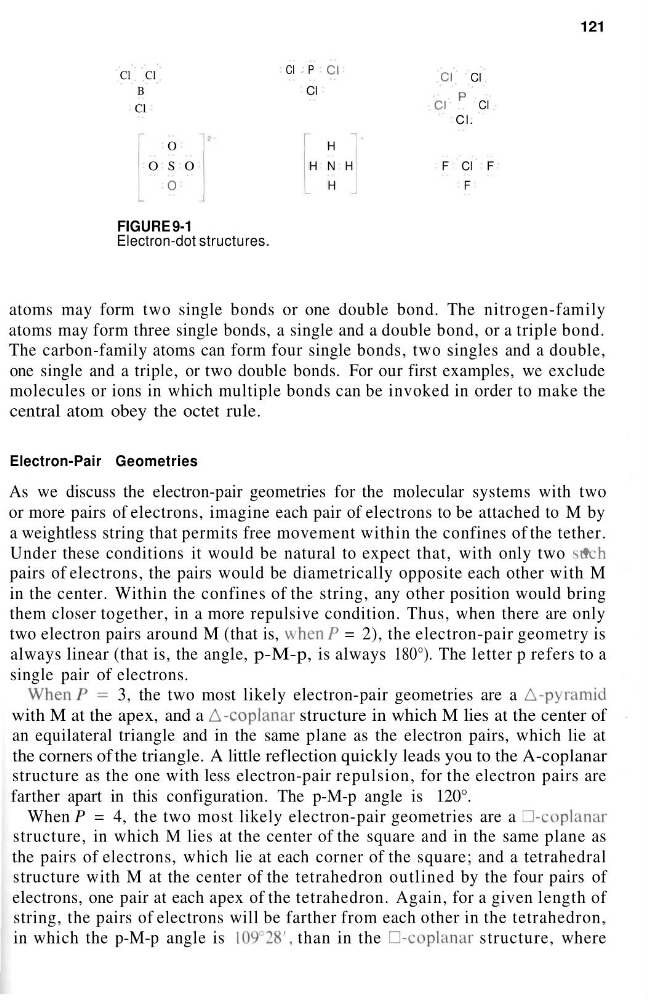
FIGURE 9-1
Electron-dot structures.
atoms may form two single bonds or one double bond. The nitrogen-family
atoms may form three single bonds, a single and a double bond, or a triple bond.
The carbon-family atoms can form four single bonds, two singles and a double,
one single and a triple, or two double bonds. For our first examples, we exclude
molecules or ions in which multiple bonds can be invoked in order to make the
central atom obey the octet rule.
Electron-Pair Geometries
As we discuss the electron-pair geometries for the molecular systems with two
or more pairs of electrons, imagine each pair of electrons to be attached to M by
a weightless string that permits free movement within the confines of the tether.
Under these conditions it would be natural to expect that, with only two siJch
pairs of electrons, the pairs would be diametrically opposite each other with M
in the center. Within the confines of the string, any other position would bring
them closer together, in a more repulsive condition. Thus, when there are only
two electron pairs around M (that is, whenP = 2), the electron-pair geometry is
always linear (that is, the angle, p-M-p, is always 180°). The letter p refers to a
single pair of electrons.
When/
3 = 3, the two most likely electron-pair geometries are a A-pyramid
with M at the apex, and a A-coplanar structure in which M lies at the center of
an equilateral triangle and in the same plane as the electron pairs, which lie at
the corners of the triangle. A little reflection quickly leads you to the A-coplanar
structure as the one with less electron-pair repulsion, for the electron pairs are
farther apart in this configuration. The p-M-p angle is 120°.
When P = 4, the two most likely electron-pair geometries are a D-coplanar
structure, in which M lies at the center of the square and in the same plane as
the pairs of electrons, which lie at each corner of the square; and a tetrahedral
structure with M at the center of the tetrahedron outlined by the four pairs of
electrons, one pair at each apex of the tetrahedron. Again, for a given length of
string, the pairs of electrons will be farther from each other in the tetrahedron,
in which the p-M-p angle is 109°28', than in the D-coplanar structure, where
Cl Cl
B
Cl
Cl • P Cl
Cl
H
H N H
H
Cl
Cl
Cl
F>
Cl
Cl.
F Cl F
F
O
O S O
O
FIGURE 9-1
Electron-dot structures.
atoms may form two single bonds or one double bond. The nitrogen-family
atoms may form three single bonds, a single and a double bond, or a triple bond.
The carbon-family atoms can form four single bonds, two singles and a double,
one single and a triple, or two double bonds. For our first examples, we exclude
molecules or ions in which multiple bonds can be invoked in order to make the
central atom obey the octet rule.
Electron-Pair Geometries
As we discuss the electron-pair geometries for the molecular systems with two
or more pairs of electrons, imagine each pair of electrons to be attached to M by
a weightless string that permits free movement within the confines of the tether.
Under these conditions it would be natural to expect that, with only two siJch
pairs of electrons, the pairs would be diametrically opposite each other with M
in the center. Within the confines of the string, any other position would bring
them closer together, in a more repulsive condition. Thus, when there are only
two electron pairs around M (that is, whenP = 2), the electron-pair geometry is
always linear (that is, the angle, p-M-p, is always 180°). The letter p refers to a
single pair of electrons.
When/
3 = 3, the two most likely electron-pair geometries are a A-pyramid
with M at the apex, and a A-coplanar structure in which M lies at the center of
an equilateral triangle and in the same plane as the electron pairs, which lie at
the corners of the triangle. A little reflection quickly leads you to the A-coplanar
structure as the one with less electron-pair repulsion, for the electron pairs are
farther apart in this configuration. The p-M-p angle is 120°.
When P = 4, the two most likely electron-pair geometries are a D-coplanar
structure, in which M lies at the center of the square and in the same plane as
the pairs of electrons, which lie at each corner of the square; and a tetrahedral
structure with M at the center of the tetrahedron outlined by the four pairs of
electrons, one pair at each apex of the tetrahedron. Again, for a given length of
string, the pairs of electrons will be farther from each other in the tetrahedron,
in which the p-M-p angle is 109°28', than in the D-coplanar structure, where