

MAXIMA AND MINIMA
/'(*) = 2(x - a,) + 2(x - a 2 ) + • • • + 2(x - oj.
••• + «J//i. Now, /"(Jt) = 2n >0. So, by the
Setting this equal to 0 and solving for x, x = (a, + o, +
second-derivative test, there is a relative minimum at
A: - (a, + a, + • • • + a,,)/n. However, since this is the only relative extremum, the graph of the continuous
function f(x) must go up on both sides of (a, + a 2 + • • • + a,,)/n and must keep on going up (since, if it ever
turned around and started going down, there would have to be another relative extremum).
13.22
Find the absolute maximum and minimum of f(x) = -4*+ 5 on [-2,3].
Since f(x) is a decreasing linear function, the absolute maximum is attained at the left endpoint and the
absolute minimum at the right endpoint. So, the absolute maximum is -4(-2) + 5 = 13, and the absolute
minimum is -4(3) + 5 = -7.
13.24
Find the absolute maximum and minimum of f(x) - x
3 + 2x
2 + x - 1 on [-1,1].
- /'(•*) = 3*
2 + 4x + 1 = (3* + l)(x + 1). Setting /'(*) = 0, we obtain the critical numbers x = -1
x = - |. Hence, we need only tabulate the values at -1, -|, and 1. From these values, we see that the
absolute maximum is 3, attained at x = 1, and the absolute minimum is - £, attained at x = - £.
and
Setting /'(.v) = 0, we find
13.26
13.27
Find the absolute maximum and minimum of f(x) = x
2 /16 + 1 Ix on [1,4].
I /'(*) = */8 - 1 Ix
1 . Setting f'(x) = 0, we have x* = 8, x = 2. We tabulate the values of /(*) for the
critical number x = 2 and the endpoints. Thus, the absolute maximum | is attained at .v = 4, and the
absolute minimum 3 at x = 2.
Find the absolute maximum and minimum of the function/on [0, 2], where
For Osj;
2 -i. Setting /'(*) = 0, we find *
2 =!, x =±{. Only * is in the given
interval. For 1<*<2, /'(*) = 2x +1. Setting /'(*) = 0, we obtain the critical number x = - ±,
which is not in the given interval. We also have to check the value of f(x) at x = 1, where the derivative might
not exist. We see that the absolute maximum ^ is attained at x = 2, and the absolute minimum - ^ at
x= \.
85
13.23
Find the absolute maximum and minimum of f(x) = 2x
2 - Ix - 10 on [-1,3].
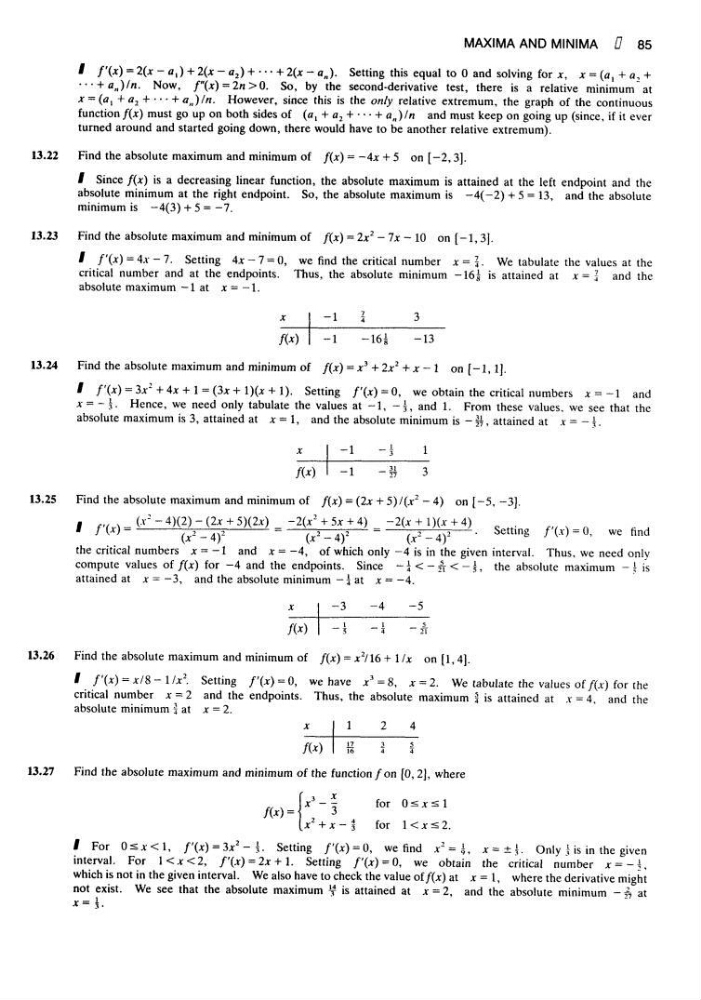
/'(*) = 4.v - 7. Setting 4x - 1 = 0, we find the critical number x=l. We tabulate the values at the
critical number and at the endpoints. Thus, the absolute minimum -16| is attained at x = | and the
absolute maximum —1 at x = — 1.
13.25
Find the absolute maximum and minimum of f(x) = (2x + 5)/(x
2 - 4) on [-5,-3].
the critical numbers x = -1 and x = -4, of which only -4 is in the given interval. Thus, we need only
compute values of f(x) for -4 and the endpoints. Since - j < - ^ < - 5, the absolute maximum -
l
? is
attained at x = -3, and the absolute minimum -| at x = -4.
X
ft*)
-1
-1
7
4
-16|
3
-13
x
/«
-1
1
_!
31
27
1
3
x
/«
-3
i
5
-4
i
4
-5
— 21
X
/«
1
17
16
2
4
4
5
4
for
for
/'(*) = 2(x - a,) + 2(x - a 2 ) + • • • + 2(x - oj.
••• + «J//i. Now, /"(Jt) = 2n >0. So, by the
Setting this equal to 0 and solving for x, x = (a, + o, +
second-derivative test, there is a relative minimum at
A: - (a, + a, + • • • + a,,)/n. However, since this is the only relative extremum, the graph of the continuous
function f(x) must go up on both sides of (a, + a 2 + • • • + a,,)/n and must keep on going up (since, if it ever
turned around and started going down, there would have to be another relative extremum).
13.22
Find the absolute maximum and minimum of f(x) = -4*+ 5 on [-2,3].
Since f(x) is a decreasing linear function, the absolute maximum is attained at the left endpoint and the
absolute minimum at the right endpoint. So, the absolute maximum is -4(-2) + 5 = 13, and the absolute
minimum is -4(3) + 5 = -7.
13.24
Find the absolute maximum and minimum of f(x) - x
3 + 2x
2 + x - 1 on [-1,1].
- /'(•*) = 3*
2 + 4x + 1 = (3* + l)(x + 1). Setting /'(*) = 0, we obtain the critical numbers x = -1
x = - |. Hence, we need only tabulate the values at -1, -|, and 1. From these values, we see that the
absolute maximum is 3, attained at x = 1, and the absolute minimum is - £, attained at x = - £.
and
Setting /'(.v) = 0, we find
13.26
13.27
Find the absolute maximum and minimum of f(x) = x
2 /16 + 1 Ix on [1,4].
I /'(*) = */8 - 1 Ix
1 . Setting f'(x) = 0, we have x* = 8, x = 2. We tabulate the values of /(*) for the
critical number x = 2 and the endpoints. Thus, the absolute maximum | is attained at .v = 4, and the
absolute minimum 3 at x = 2.
Find the absolute maximum and minimum of the function/on [0, 2], where
For Osj;
2 =!, x =±{. Only * is in the given
interval. For 1<*<2, /'(*) = 2x +1. Setting /'(*) = 0, we obtain the critical number x = - ±,
which is not in the given interval. We also have to check the value of f(x) at x = 1, where the derivative might
not exist. We see that the absolute maximum ^ is attained at x = 2, and the absolute minimum - ^ at
x= \.
85
13.23
Find the absolute maximum and minimum of f(x) = 2x
2 - Ix - 10 on [-1,3].
/'(*) = 4.v - 7. Setting 4x - 1 = 0, we find the critical number x=l. We tabulate the values at the
critical number and at the endpoints. Thus, the absolute minimum -16| is attained at x = | and the
absolute maximum —1 at x = — 1.
13.25
Find the absolute maximum and minimum of f(x) = (2x + 5)/(x
2 - 4) on [-5,-3].
the critical numbers x = -1 and x = -4, of which only -4 is in the given interval. Thus, we need only
compute values of f(x) for -4 and the endpoints. Since - j < - ^ < - 5, the absolute maximum -
l
? is
attained at x = -3, and the absolute minimum -| at x = -4.
X
ft*)
-1
-1
7
4
-16|
3
-13
x
/«
-1
1
_!
31
27
1
3
x
/«
-3
i
5
-4
i
4
-5
— 21
X
/«
1
17
16
2
4
4
5
4
for
for