

CHAPTER 13
13.16
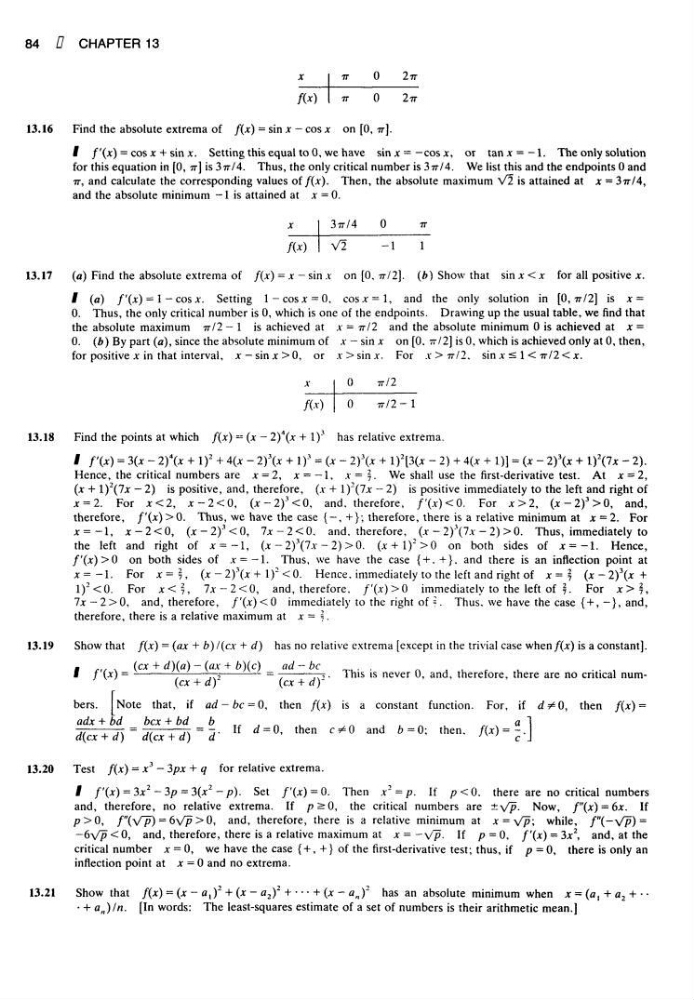
Find the absolute extrema of f(x) = sin x — cos x on [0, TT].
/'(*)
= cos x + sin x. Setting this equal to 0, we have sin* =-cos*, or tan AC = -1. The only solution
for this equation in [0, TT] is 3?r/4. Thus, the only critical number is 377/4. We list this and the endpoints 0 and
77, and calculate the corresponding values of f(x). Then, the absolute maximum V2 is attained at x = 377/4,
and the absolute minimum -1 is attained at x = 0.
13.17
(a) Find the absolute extrema of /(*) = x - sin .v on [0, 77/2]. (ft) Show that sin;t<;t for all positive or.
(a) /'(*) = 1 - cos AT. Setting l-cos;c = 0, COSJT = !, and the only solution in [0,77/2] is x =
0. Thus, the only critical number is 0, which is one of the endpoints. Drawing up the usual table, we find that
the absolute maximum 77/2 - 1 is achieved at .v = 77/2 and the absolute minimum 0 is achieved at x =
0. (b) By part (a), since the absolute minimum of x - sin x on [0. 77/2] is 0, which is achieved only at 0, then,
for positive A: in that interval, x — sinx>0, or A'> sin AT. For .v > 77/2, sin x s 1 < 77/2 < x.
This is never 0, and, therefore, there are no critical num13.20
Test f(x) = x
3 - 3px + q for relative extrema.
/'(A-) = 3jt2 - 3p - 3(x2 — p). Set f'(x) = 0. Then x~ = p. If p<0. there are no critical numbers
and, therefore, no relative extrema. If ps?Q, the critical numbers are ±\fp. Now, f"(x) = 6x. If
p>0, /"(V7>) = 6\/P > 0, and, therefore, there is a relative minimum at x = \/p; while, f"(-Vp) =
—6Vp<0, and, therefore, there is a relative maximum at x=—\fp. If p = 0, f'(x) = 3x2, and, at the
critical number x = 0, we have the case { + , +} of the first-derivative test; thus, if p = 0, there is only an
inflection point at x = 0 and no extrema.
13.21
Show that f(x) = (x - a,)
2 + (x - a 2 )
2 + ••• + (x - a,,)
2
has an absolute minimum when x = (a, + a 2 + • •
• + a,,)In. [In words: The least-squares estimate of a set of numbers is their arithmetic mean.]
bers. Note that, if ad-bc = Q, then f(x) is a constant function. For, if rf^O, then
and i>=0; then.
13.19
Show that f(x) = (ax + b)/(cx + d) has no relative extrema [except in the trivial case when/(jc) is a constant].
13.18
Find the points at which f(x) ~ (x - 2)
4 (x + I)
3
has relative extrema.
f'(x) = 3O - 2)
4 O + I)
2 + 40 - 2)
3 0 + I)
3 = (x - 2)\x + l)
2 [3(x - 2) + 4(x + 1)] = (x - 2)
3
(jc + l)
2 (7x - 2).
Hence, the critical numbers are x = 2, x = —l, x=j. We shall use the first-derivative test. At x = 2,
(x + l)
2 (7Ar — 2) is positive, and, therefore, (x + l)~(7x - 2) is positive immediately to the left and right of
x = 2. For x<2, x-2<0, (;t-2)
3 <0, and, therefore, /'(.v)<0. For x>2, (x-2)
3 >0, and,
therefore, /'(x)>0. Thus, we have the case {-, +}; therefore, there is a relative minimum at x = 2. For
* = -!, x-2<0, (x-2)
3 <0, 7*-2<0, and. therefore, (.v - 2)
3 (7.v - 2) >0. Thus, immediately to
the left and right of * = -!, (jc - 2)
3 (7.v - 2) >0. (A- + l)
2 >0 on both sides of *=-!. Hence,
/'(*)>0 on both sides of AC=—1. Thus, we have the case { + .+}. and there is an inflection point at
x=-l. For Jt=f, (jc -2)
3 (* + I)
2 <0. Hence, immediately to the left and right of x = % (je-2)
3 (* +
1)
2 <0. For x0 immediately to the left of |. For x>j,
7x-2>0, and, therefore, f'(x)<0 immediately to the right of 5. Thus, we have the case { + ,-}, and,
therefore, there is a relative maximum at x = ^.
84
X
/(*)
77
IT
0
0
ITT
277
X
/«
377/4
V2
0
-1
77
1
A'
/(.v)
0
0
77/2
77/2-1
then
If rf = 0,
13.16
Find the absolute extrema of f(x) = sin x — cos x on [0, TT].
/'(*)
= cos x + sin x. Setting this equal to 0, we have sin* =-cos*, or tan AC = -1. The only solution
for this equation in [0, TT] is 3?r/4. Thus, the only critical number is 377/4. We list this and the endpoints 0 and
77, and calculate the corresponding values of f(x). Then, the absolute maximum V2 is attained at x = 377/4,
and the absolute minimum -1 is attained at x = 0.
13.17
(a) Find the absolute extrema of /(*) = x - sin .v on [0, 77/2]. (ft) Show that sin;t<;t for all positive or.
(a) /'(*) = 1 - cos AT. Setting l-cos;c = 0, COSJT = !, and the only solution in [0,77/2] is x =
0. Thus, the only critical number is 0, which is one of the endpoints. Drawing up the usual table, we find that
the absolute maximum 77/2 - 1 is achieved at .v = 77/2 and the absolute minimum 0 is achieved at x =
0. (b) By part (a), since the absolute minimum of x - sin x on [0. 77/2] is 0, which is achieved only at 0, then,
for positive A: in that interval, x — sinx>0, or A'> sin AT. For .v > 77/2, sin x s 1 < 77/2 < x.
This is never 0, and, therefore, there are no critical num13.20
Test f(x) = x
3 - 3px + q for relative extrema.
/'(A-) = 3jt2 - 3p - 3(x2 — p). Set f'(x) = 0. Then x~ = p. If p<0. there are no critical numbers
and, therefore, no relative extrema. If ps?Q, the critical numbers are ±\fp. Now, f"(x) = 6x. If
p>0, /"(V7>) = 6\/P > 0, and, therefore, there is a relative minimum at x = \/p; while, f"(-Vp) =
—6Vp<0, and, therefore, there is a relative maximum at x=—\fp. If p = 0, f'(x) = 3x2, and, at the
critical number x = 0, we have the case { + , +} of the first-derivative test; thus, if p = 0, there is only an
inflection point at x = 0 and no extrema.
13.21
Show that f(x) = (x - a,)
2 + (x - a 2 )
2 + ••• + (x - a,,)
2
has an absolute minimum when x = (a, + a 2 + • •
• + a,,)In. [In words: The least-squares estimate of a set of numbers is their arithmetic mean.]
bers. Note that, if ad-bc = Q, then f(x) is a constant function. For, if rf^O, then
and i>=0; then.
13.19
Show that f(x) = (ax + b)/(cx + d) has no relative extrema [except in the trivial case when/(jc) is a constant].
13.18
Find the points at which f(x) ~ (x - 2)
4 (x + I)
3
has relative extrema.
f'(x) = 3O - 2)
4 O + I)
2 + 40 - 2)
3 0 + I)
3 = (x - 2)\x + l)
2 [3(x - 2) + 4(x + 1)] = (x - 2)
3
(jc + l)
2 (7x - 2).
Hence, the critical numbers are x = 2, x = —l, x=j. We shall use the first-derivative test. At x = 2,
(x + l)
2 (7Ar — 2) is positive, and, therefore, (x + l)~(7x - 2) is positive immediately to the left and right of
x = 2. For x<2, x-2<0, (;t-2)
3 <0, and, therefore, /'(.v)<0. For x>2, (x-2)
3 >0, and,
therefore, /'(x)>0. Thus, we have the case {-, +}; therefore, there is a relative minimum at x = 2. For
* = -!, x-2<0, (x-2)
3 <0, 7*-2<0, and. therefore, (.v - 2)
3 (7.v - 2) >0. Thus, immediately to
the left and right of * = -!, (jc - 2)
3 (7.v - 2) >0. (A- + l)
2 >0 on both sides of *=-!. Hence,
/'(*)>0 on both sides of AC=—1. Thus, we have the case { + .+}. and there is an inflection point at
x=-l. For Jt=f, (jc -2)
3 (* + I)
2 <0. Hence, immediately to the left and right of x = % (je-2)
3 (* +
1)
2 <0. For x
7x-2>0, and, therefore, f'(x)<0 immediately to the right of 5. Thus, we have the case { + ,-}, and,
therefore, there is a relative maximum at x = ^.
84
X
/(*)
77
IT
0
0
ITT
277
X
/«
377/4
V2
0
-1
77
1
A'
/(.v)
0
0
77/2
77/2-1
then
If rf = 0,