

MAXIMA AND MINIMA
13.10
Find the absolute maximum and minimum of the function f(x) = 4x
2 - 7x + 3 on the interval [-2,3].
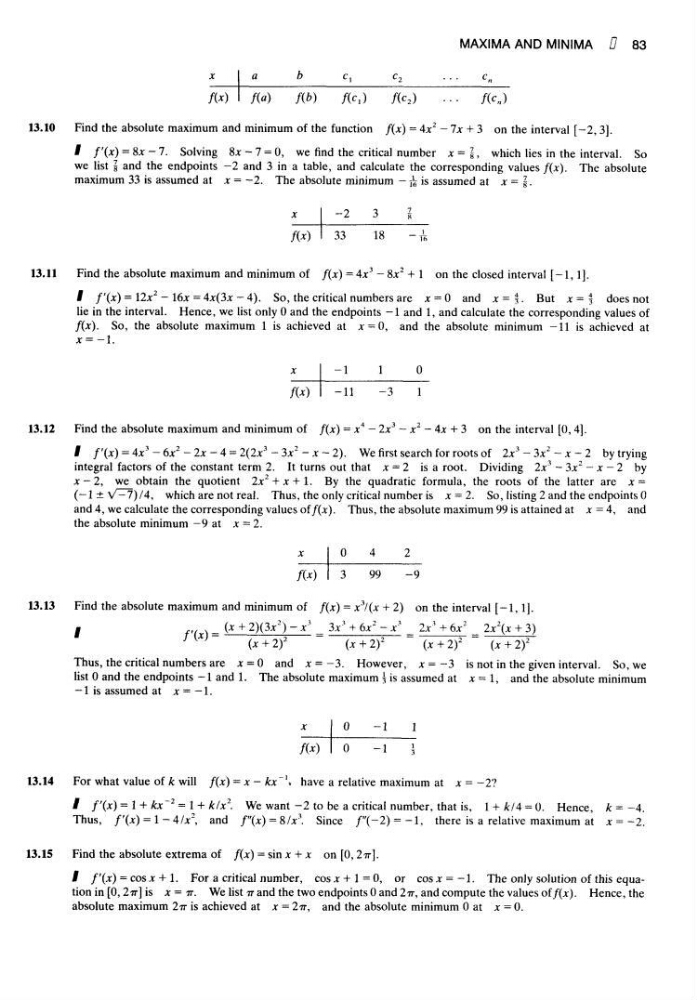
/'(*) = 8* - 7. Solving Sx -1 = 0, we find the critical number x=l, which lies in the interval. So
we list 1 and the endpoints -2 and 3 in a table, and calculate the corresponding values/(x). The absolute
maximum 33 is assumed at x = —2. The absolute minimum - A is assumed at x = 1.
13.11
Find the absolute maximum and minimum of f(x) = 4x
3 - Sx
2 + 1 on the closed interval [-1,1].
I /'(*) = 12x
2 - I6x = 4x(3x -4). So, the critical numbers are x = 0 and x=%. But *=f does not
lie in the interval. Hence, we list only 0 and the endpoints -1 and 1, and calculate the corresponding values of
f(x). So, the absolute maximum 1 is achieved at x = 0, and the absolute minimum -11 is achieved at
*=-!.
13.13
Find the absolute maximum and minimum of f(x) = x
3 /(x + 2) on the interval f-1,1].
Thus, the critical numbers are x = 0 and x = -3. However, x = -3 is not in the given interval. So, we
list 0 and the endpoints -1 and 1. The absolute maximum 5 is assumed at x = l, and the absolute minimum
— 1 is assumed at x = — 1 .
13.14
For what value of k will f(x) = x - kx \ have a relative maximum at x = -2?
f'(x) = 1 + kx~2 = 1 + klx2. We want-2 to be a critical number, that is, l + fc/4 = 0. Hence, k =-4.
Thus, f'(x) = 1 -4/x
2 , and f"(x) = 8/x\ Since /"(-2) = -l, there is a relative maximum at * =-2.
13.15
Find the absolute extrema of /(*) = sin x + x on[0,2-7r].
/'(*) = cos x + 1- For a critical number, cos*+1=0, or cos* = -l. The only solution of this equation in [0,2ir] is x = TT. We list TT and the two endpoints 0 and 2w, and compute the values of/(jc). Hence, the
absolute maximum 2IT is achieved at x = 2w, and the absolute minimum 0 at x = 0.
83
X
/w
a
/(«)
b
f(b)
c,
/(O
C 2
/(c 2 )
c«
• •
/(O
A;
/«
__2
33
3
18
7
8
1
16
*
/«
-1
-11
1
-3
0
1
X
/w
0
3
4
99
2
-9
13.12
Find the absolute maximum and minimum of f(x) = x
4 - 2x
3 - x
2 - 4x + 3 on the interval [0, 4].
f'(x) = 4x
3 - 6x
2 - 2x - 4 = 2(2x
3 -3x
2 -x~2). We first search for roots of 2x
3 - 3x
2 ~ x - 2 by trying
integral factors of the constant term 2. It turns out that x = 2 is a root. Dividing 2x
3 - 3x
2 - x -2 by
x — 2, we obtain the quotient 2x
2 + x + l. By the quadratic formula, the roots of the latter are x =
(—l±V^7)/4, which are not real. Thus, the only critical number is x = 2. So, listing 2 and the endpointsO
and 4, we calculate the corresponding values off(x). Thus, the absolute maximum 99 is attained at x = 4, and
the absolute minimum -9 at x = 2.
x
/«
0
0
-1
1
-1
13.10
Find the absolute maximum and minimum of the function f(x) = 4x
2 - 7x + 3 on the interval [-2,3].
/'(*) = 8* - 7. Solving Sx -1 = 0, we find the critical number x=l, which lies in the interval. So
we list 1 and the endpoints -2 and 3 in a table, and calculate the corresponding values/(x). The absolute
maximum 33 is assumed at x = —2. The absolute minimum - A is assumed at x = 1.
13.11
Find the absolute maximum and minimum of f(x) = 4x
3 - Sx
2 + 1 on the closed interval [-1,1].
I /'(*) = 12x
2 - I6x = 4x(3x -4). So, the critical numbers are x = 0 and x=%. But *=f does not
lie in the interval. Hence, we list only 0 and the endpoints -1 and 1, and calculate the corresponding values of
f(x). So, the absolute maximum 1 is achieved at x = 0, and the absolute minimum -11 is achieved at
*=-!.
13.13
Find the absolute maximum and minimum of f(x) = x
3 /(x + 2) on the interval f-1,1].
Thus, the critical numbers are x = 0 and x = -3. However, x = -3 is not in the given interval. So, we
list 0 and the endpoints -1 and 1. The absolute maximum 5 is assumed at x = l, and the absolute minimum
— 1 is assumed at x = — 1 .
13.14
For what value of k will f(x) = x - kx \ have a relative maximum at x = -2?
f'(x) = 1 + kx~2 = 1 + klx2. We want-2 to be a critical number, that is, l + fc/4 = 0. Hence, k =-4.
Thus, f'(x) = 1 -4/x
2 , and f"(x) = 8/x\ Since /"(-2) = -l, there is a relative maximum at * =-2.
13.15
Find the absolute extrema of /(*) = sin x + x on[0,2-7r].
/'(*) = cos x + 1- For a critical number, cos*+1=0, or cos* = -l. The only solution of this equation in [0,2ir] is x = TT. We list TT and the two endpoints 0 and 2w, and compute the values of/(jc). Hence, the
absolute maximum 2IT is achieved at x = 2w, and the absolute minimum 0 at x = 0.
83
X
/w
a
/(«)
b
f(b)
c,
/(O
C 2
/(c 2 )
c«
• •
/(O
A;
/«
__2
33
3
18
7
8
1
16
*
/«
-1
-11
1
-3
0
1
X
/w
0
3
4
99
2
-9
13.12
Find the absolute maximum and minimum of f(x) = x
4 - 2x
3 - x
2 - 4x + 3 on the interval [0, 4].
f'(x) = 4x
3 - 6x
2 - 2x - 4 = 2(2x
3 -3x
2 -x~2). We first search for roots of 2x
3 - 3x
2 ~ x - 2 by trying
integral factors of the constant term 2. It turns out that x = 2 is a root. Dividing 2x
3 - 3x
2 - x -2 by
x — 2, we obtain the quotient 2x
2 + x + l. By the quadratic formula, the roots of the latter are x =
(—l±V^7)/4, which are not real. Thus, the only critical number is x = 2. So, listing 2 and the endpointsO
and 4, we calculate the corresponding values off(x). Thus, the absolute maximum 99 is attained at x = 4, and
the absolute minimum -9 at x = 2.
x
/«
0
0
-1
1
-1