

86
Setting /'(*)=0, we have 2x
2 = l, x
2 =\, * = ±V2/2. So, the only critical number in [0, +00) i s
x = V2/2. At that point, the first derivative test involves the case { + , -}, and, therefore, there is a relative
maximum at x = V2~/2, where y = 2V3/9. Since this is the only critical number in the given interval, the
relative maximum is actually an absolute maximum.
13.30
Find the absolute maximum and minimum of f(x) = cos
2 x + sin x on [0, ir].
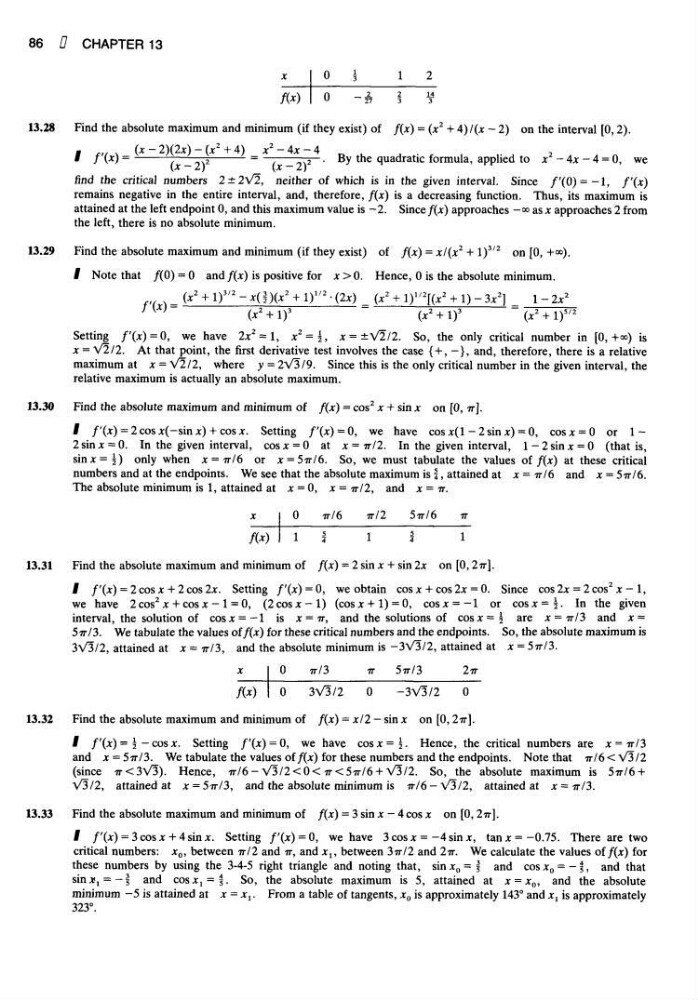
/'(*) = 2cos*(-sinx) + cosjc. Setting /'(*) = °> we have cos jc(l -2sinx) = 0, cos* = 0 or 12sinx =0. In the given interval, cosx = 0 at x = trl2. In the given interval, l-2sinx = 0 (that is,
sinx=i) only when A: = 77/6 or x = 5ir/6. So, we must tabulate the values of f(x) at these critical
numbers and at the endpoints. We see that the absolute maximum is f, attained at x = 77/6 and x = 577/6.
The absolute minimum is 1, attained at x=0, x= ir!2, and x = 77.
13.31 Find the absolute maximum and minimum of f(x) = 2 sin x + sin 2x on [0,2IT].
/'(*) = 2 cos x + 2 cos 2x. Setting /'(AC) = 0, we obtain cos x + cos 2x = 0. Since cos 2x = 2 cos
2 x - 1,
we have 2cos
2 x + cosx — 1 = 0, (2cosx — 1) (cos* + 1) = 0, cosx = — 1 or cos x —\. In the given
interval, the solution of cosx= — 1 is x = 77, and the solutions of cos;t=j are x = 7r/3 and x =
STT/S. We tabulate the values of f(x) for these critical numbers and the endpoints. So, the absolute maximum is
3V3/2, attained at x - 77/3, and the absolute minimum is -3V3/2, attained at x = 577/3.
13.32
Find the absolute maximum and minimum of f(x) = x/2 — sin x on [0,2-n],
' /'(*)
= \ ~
cosx - Setting f'(x) = 0, we have cosx=j. Hence, the critical numbers are x = 77/3
and x = 577/3. We tabulate the values of f(x) for these numbers and the endpoints. Note that 77/6
V5/2, attained at x = 5-7r/3, and the absolute minimum is ir/6 —V5/2, attained at x = ir/3.
13.33 Find the absolute maximum and minimum of f(x) = 3 sin x — 4 cos x on [0,2-rr].
f'(x) = 3 cos x + 4 sin x. Setting f'(x) = 0, we have 3 cos x = -4 sin x, tan *=-0.75. There are two
critical numbers: x 0 , between ir/2 and IT, and x l , between 37T/2 and 2ir. We calculate the values of f(x) for
these numbers by using the 3-4-5 right triangle and noting that, sin x 0 = f and cos x 0 = - 5, and that
8^*, = -! and COSA:^^. So, the absolute maximum is 5, attained at x = x 0 , and the absolute
minimum -5 is attained at x = x } . From a table of tangents, x 0 is approximately 143° and *, is approximately
323°.
13.28 Find the absolute maximum and minimum (if they exist) of /(*) = (x
2 + 4)/(x -2) on the interval [0, 2).
By the quadratic formula, applied to x
2 — 4* — 4 = 0, we
find the critical numbers 2±2V2, neither of which is in the given interval. Since /'(0) = -1, /'(*)
remains negative in the entire interval, and, therefore, f(x) is a decreasing function. Thus, its maximum is
attained at the left endpoint 0, and this maximum value is -2. Since/(x) approaches -<» as x approaches 2 from
the left, there is no absolute minimum
13.29 Find the absolute maximum and minimum (if they exist) of f(x) = x/(x
2 + I)
3 '
2 on [0, +»).
Note that /(O) = 0 and f(x) is positive for x> 0. Hence, 0 is the absolute minimum.
X
/«
0
0
i
3
~ TJ
1
§
2
¥
CHAPTER 13
x
/«
0
1
7T/6
5
4
77/2
1
57T/6
5
77
1
X
/«
0
0
77/3
3V3/2
77
0
577/3
-3V3/2
277
0
Setting /'(*)=0, we have 2x
2 = l, x
2 =\, * = ±V2/2. So, the only critical number in [0, +00) i s
x = V2/2. At that point, the first derivative test involves the case { + , -}, and, therefore, there is a relative
maximum at x = V2~/2, where y = 2V3/9. Since this is the only critical number in the given interval, the
relative maximum is actually an absolute maximum.
13.30
Find the absolute maximum and minimum of f(x) = cos
2 x + sin x on [0, ir].
/'(*) = 2cos*(-sinx) + cosjc. Setting /'(*) = °> we have cos jc(l -2sinx) = 0, cos* = 0 or 12sinx =0. In the given interval, cosx = 0 at x = trl2. In the given interval, l-2sinx = 0 (that is,
sinx=i) only when A: = 77/6 or x = 5ir/6. So, we must tabulate the values of f(x) at these critical
numbers and at the endpoints. We see that the absolute maximum is f, attained at x = 77/6 and x = 577/6.
The absolute minimum is 1, attained at x=0, x= ir!2, and x = 77.
13.31 Find the absolute maximum and minimum of f(x) = 2 sin x + sin 2x on [0,2IT].
/'(*) = 2 cos x + 2 cos 2x. Setting /'(AC) = 0, we obtain cos x + cos 2x = 0. Since cos 2x = 2 cos
2 x - 1,
we have 2cos
2 x + cosx — 1 = 0, (2cosx — 1) (cos* + 1) = 0, cosx = — 1 or cos x —\. In the given
interval, the solution of cosx= — 1 is x = 77, and the solutions of cos;t=j are x = 7r/3 and x =
STT/S. We tabulate the values of f(x) for these critical numbers and the endpoints. So, the absolute maximum is
3V3/2, attained at x - 77/3, and the absolute minimum is -3V3/2, attained at x = 577/3.
13.32
Find the absolute maximum and minimum of f(x) = x/2 — sin x on [0,2-n],
' /'(*)
= \ ~
cosx - Setting f'(x) = 0, we have cosx=j. Hence, the critical numbers are x = 77/3
and x = 577/3. We tabulate the values of f(x) for these numbers and the endpoints. Note that 77/6
V5/2, attained at x = 5-7r/3, and the absolute minimum is ir/6 —V5/2, attained at x = ir/3.
13.33 Find the absolute maximum and minimum of f(x) = 3 sin x — 4 cos x on [0,2-rr].
f'(x) = 3 cos x + 4 sin x. Setting f'(x) = 0, we have 3 cos x = -4 sin x, tan *=-0.75. There are two
critical numbers: x 0 , between ir/2 and IT, and x l , between 37T/2 and 2ir. We calculate the values of f(x) for
these numbers by using the 3-4-5 right triangle and noting that, sin x 0 = f and cos x 0 = - 5, and that
8^*, = -! and COSA:^^. So, the absolute maximum is 5, attained at x = x 0 , and the absolute
minimum -5 is attained at x = x } . From a table of tangents, x 0 is approximately 143° and *, is approximately
323°.
13.28 Find the absolute maximum and minimum (if they exist) of /(*) = (x
2 + 4)/(x -2) on the interval [0, 2).
By the quadratic formula, applied to x
2 — 4* — 4 = 0, we
find the critical numbers 2±2V2, neither of which is in the given interval. Since /'(0) = -1, /'(*)
remains negative in the entire interval, and, therefore, f(x) is a decreasing function. Thus, its maximum is
attained at the left endpoint 0, and this maximum value is -2. Since/(x) approaches -<» as x approaches 2 from
the left, there is no absolute minimum
13.29 Find the absolute maximum and minimum (if they exist) of f(x) = x/(x
2 + I)
3 '
2 on [0, +»).
Note that /(O) = 0 and f(x) is positive for x> 0. Hence, 0 is the absolute minimum.
X
/«
0
0
i
3
~ TJ
1
§
2
¥
CHAPTER 13
x
/«
0
1
7T/6
5
4
77/2
1
57T/6
5
77
1
X
/«
0
0
77/3
3V3/2
77
0
577/3
-3V3/2
277
0