

9.16
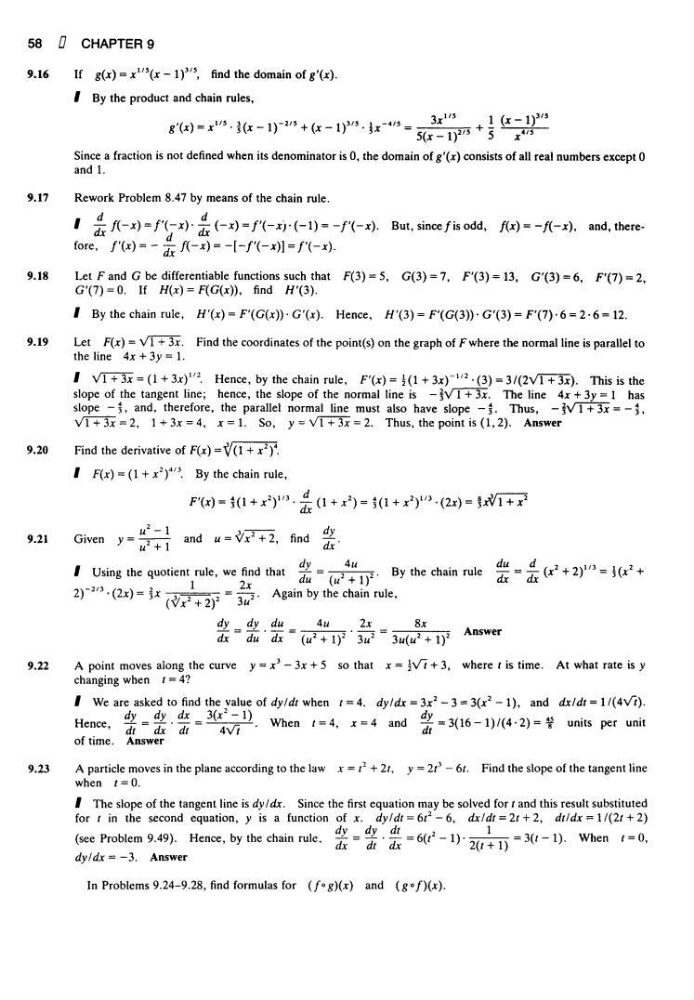
If g(jt) = *"
5 (jt-l)
3 '
5 , find the domain of g'WBy the product and chain rules,
Since a fraction is not defined when its denominator is 0, the domain of g'(x) consists of all real numbers except 0
and 1.
CHAPTER 9
58
9.17
Rework Problem 8.47 by means of the chain rule.
But, since/is odd,
and, therefore, /'(*) = -
9.18
Let F and G be differentiable functions such that F(3) = 5, G(3) = 7, F'(3) = 13, G'(3)=6, F'(7) = 2,
G'(7) = 0. If H(x) = F(G(x)), find //'(3).
By the chain rule, H'(x) = F'(G(x))-G'(x). Hence, H'(3) = F'(G(3))- G'(3) = F'(7)-6 = 2-6= 12.
9.19
Let F(x) =
Find the coordinates of the point(s) on the graph of F where the normal line is parallel to
the line 4x + 3y = l.
Hence, by the chain rule,
This is the
slope of the tangent line; hence, the slope of the normal line is
The line
has
slope - 5, and, therefore, the parallel normal line must also have slope
Thus,
Answer
Thus, the point is (1,2).
Find the derivative of F(x) =
J.20
By the chain rule
9.21
Given
and
find
Using the quotient rule, we find that
By the chain rule
Again by the chain rule,
Answer
9.22
A point moves along the curve y = x* — 3x + 5 so that x = i\Tt + 3, where r is time. At what rate is y
changing when t = 4?
We are asked to find the value of dyldt when t = 4. dyldx = 3x
2 - 3 = 3(x
2 - 1), and dxldt = 1 /(4V7).
Hence,
of time.
When
and
units per unit
Answer
9.23
A particle moves in the plane according to the law x = t~ + 2t, y = 2t
3 - 6t. Find the slope of the tangent line
when t = 0.
The slope of the tangent line is dyldx. Since the first equation may be solved for t and this result substituted
for / in the second equation, y is a function of x. dy/dt = 6t
2 — 6, dx/dt = 2t + 2, dtldx = l/(2t + 2)
(see Problem 9.49). Hence, by the chain rule,
When t = 0,
Answer
In Problems 9.24-9.28, find formulas for (f°g)(x) and (g°f)(x).
/(-*)=/'(-*)
(-*)=/'(-*)•(-!) = -/'(-*).
/«=-/(-*),
/(-*)=-[-/'(-*)]=/'(-*)4* + 3y = l
So,
= 2, 1+3* = 4, jc = l
f(jt) = (l + x
2 )
4 '
3 .
/ = 4, x = 4
= 3(16-l)/(4-2)=f
dyldx = -3.
If g(jt) = *"
5 (jt-l)
3 '
5 , find the domain of g'WBy the product and chain rules,
Since a fraction is not defined when its denominator is 0, the domain of g'(x) consists of all real numbers except 0
and 1.
CHAPTER 9
58
9.17
Rework Problem 8.47 by means of the chain rule.
But, since/is odd,
and, therefore, /'(*) = -
9.18
Let F and G be differentiable functions such that F(3) = 5, G(3) = 7, F'(3) = 13, G'(3)=6, F'(7) = 2,
G'(7) = 0. If H(x) = F(G(x)), find //'(3).
By the chain rule, H'(x) = F'(G(x))-G'(x). Hence, H'(3) = F'(G(3))- G'(3) = F'(7)-6 = 2-6= 12.
9.19
Let F(x) =
Find the coordinates of the point(s) on the graph of F where the normal line is parallel to
the line 4x + 3y = l.
Hence, by the chain rule,
This is the
slope of the tangent line; hence, the slope of the normal line is
The line
has
slope - 5, and, therefore, the parallel normal line must also have slope
Thus,
Answer
Thus, the point is (1,2).
Find the derivative of F(x) =
J.20
By the chain rule
9.21
Given
and
find
Using the quotient rule, we find that
By the chain rule
Again by the chain rule,
Answer
9.22
A point moves along the curve y = x* — 3x + 5 so that x = i\Tt + 3, where r is time. At what rate is y
changing when t = 4?
We are asked to find the value of dyldt when t = 4. dyldx = 3x
2 - 3 = 3(x
2 - 1), and dxldt = 1 /(4V7).
Hence,
of time.
When
and
units per unit
Answer
9.23
A particle moves in the plane according to the law x = t~ + 2t, y = 2t
3 - 6t. Find the slope of the tangent line
when t = 0.
The slope of the tangent line is dyldx. Since the first equation may be solved for t and this result substituted
for / in the second equation, y is a function of x. dy/dt = 6t
2 — 6, dx/dt = 2t + 2, dtldx = l/(2t + 2)
(see Problem 9.49). Hence, by the chain rule,
When t = 0,
Answer
In Problems 9.24-9.28, find formulas for (f°g)(x) and (g°f)(x).
/(-*)=/'(-*)
(-*)=/'(-*)•(-!) = -/'(-*).
/«=-/(-*),
/(-*)=-[-/'(-*)]=/'(-*)4* + 3y = l
So,
= 2, 1+3* = 4, jc = l
f(jt) = (l + x
2 )
4 '
3 .
/ = 4, x = 4
= 3(16-l)/(4-2)=f
dyldx = -3.