

THE CHAIN RULE
57
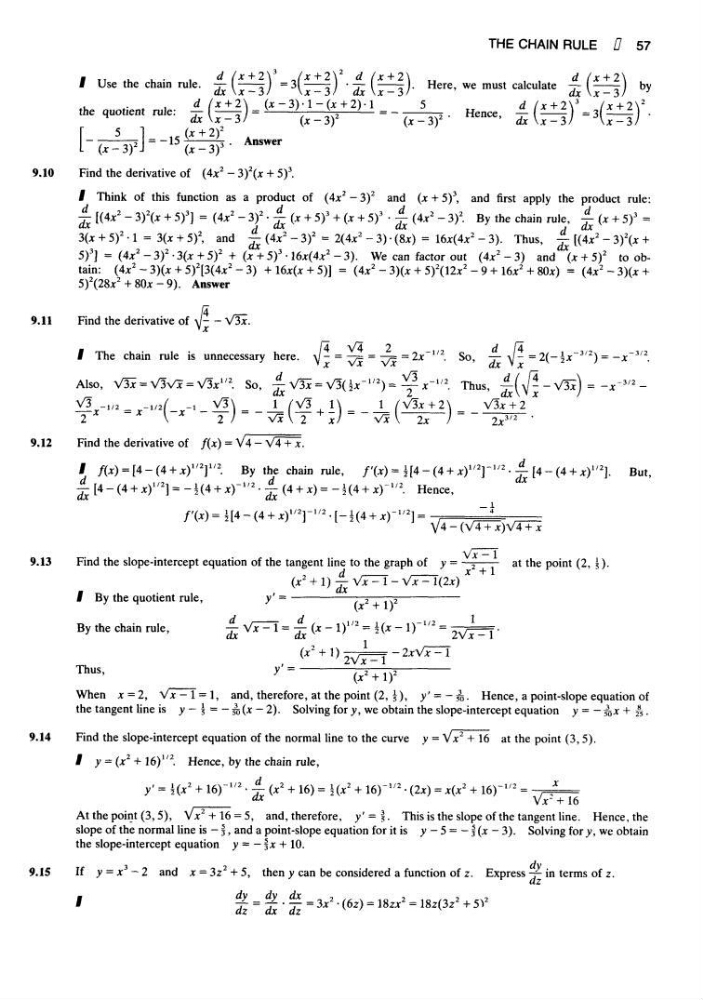
Use the chain rule.
Here, we must calculate
Hence,
the quotient rule:
9.10
Find the derivative of (4x
2 - 3)
2
(x + 5)
3
.
Think of this function as a product of (4x
2 - 3)
2
and (x + 5)
3
, and first apply the product rule:
By the chain rule,
jnd
Answer
We can factor out (4x
2 - 3)
Thus,
and (x + 5)
2
9.11
Find the derivative of
to obtain: (4^;
2 - 3)(x + 5)
2
[3(4*
2 - 3) +16^ + 5)] = (4x
2 - 3)(x + 5f(12x
2 - 9 + 16x
2 + 80x) = (4x
2 -3)(* +
The chain rule is unnecessary here.
Also,
So,
Thus,
Find the derivative of
9.12
By the chain rule,
Hence,
But,
9.13
Find the slope-intercept equation of the tangent line to the graph of
at the point (2, 5)By the quotient rule,
By the chain rule,
Thus,
9.14
9.15
If y = x —2 and x = 3z
2 + 5, then y can be considered a function of z. Express
Find the slope-intercept equation of the normal line to the curve
it the point (3,5).
and, therefore, at the point (2, 5),
When x = 2,
the tangent line is
Hence, a point-slope equation of
Solving tor y, we obtain the slope-intercept equation
At the point (3,5),
and, therefore.
This is the slope of the tangent line. Hence, the
Solving for y, we obtair
, and a point-slope equation for it is
slope of the normal line is — §
the slope-intercept equation
Hence, by the chain rule,
Answer
by
[(4x
2 -3)
2 (jt + 5)
3
] = (4;c
2 -3)
2 -
(x + 5)
3 + (x + 5)
3 •
(4*
2 -3)
2 .
(* + 5)
3 =
3(* + 5)
2 • 1 = 3(* + 5)
2
,
(4x
2 - 3)
2 = 2(4*
2 - 3) • (8x) = I6x(4x
2 - 3).
t(4^
2 -3)
2 (jc +
5)
3
] = (4^
2 - 3)
2 • 3(x + 5)
2 + (x + 5)
3 -16^(4jc
2 -3).
5)
2 (28x
2 + 80A:-9).
So,
3, = (*
2 + 16)"
2
.
in terms of z.
57
Use the chain rule.
Here, we must calculate
Hence,
the quotient rule:
9.10
Find the derivative of (4x
2 - 3)
2
(x + 5)
3
.
Think of this function as a product of (4x
2 - 3)
2
and (x + 5)
3
, and first apply the product rule:
By the chain rule,
jnd
Answer
We can factor out (4x
2 - 3)
Thus,
and (x + 5)
2
9.11
Find the derivative of
to obtain: (4^;
2 - 3)(x + 5)
2
[3(4*
2 - 3) +16^ + 5)] = (4x
2 - 3)(x + 5f(12x
2 - 9 + 16x
2 + 80x) = (4x
2 -3)(* +
The chain rule is unnecessary here.
Also,
So,
Thus,
Find the derivative of
9.12
By the chain rule,
Hence,
But,
9.13
Find the slope-intercept equation of the tangent line to the graph of
at the point (2, 5)By the quotient rule,
By the chain rule,
Thus,
9.14
9.15
If y = x —2 and x = 3z
2 + 5, then y can be considered a function of z. Express
Find the slope-intercept equation of the normal line to the curve
it the point (3,5).
and, therefore, at the point (2, 5),
When x = 2,
the tangent line is
Hence, a point-slope equation of
Solving tor y, we obtain the slope-intercept equation
At the point (3,5),
and, therefore.
This is the slope of the tangent line. Hence, the
Solving for y, we obtair
, and a point-slope equation for it is
slope of the normal line is — §
the slope-intercept equation
Hence, by the chain rule,
Answer
by
[(4x
2 -3)
2 (jt + 5)
3
] = (4;c
2 -3)
2 -
(x + 5)
3 + (x + 5)
3 •
(4*
2 -3)
2 .
(* + 5)
3 =
3(* + 5)
2 • 1 = 3(* + 5)
2
,
(4x
2 - 3)
2 = 2(4*
2 - 3) • (8x) = I6x(4x
2 - 3).
t(4^
2 -3)
2 (jc +
5)
3
] = (4^
2 - 3)
2 • 3(x + 5)
2 + (x + 5)
3 -16^(4jc
2 -3).
5)
2 (28x
2 + 80A:-9).
So,
3, = (*
2 + 16)"
2
.
in terms of z.