

9.24
9.25
A*) = 2x
3 -x
2 + 4, g(x) = 3.
9.26
THE CHAIN RULE
(/o £)«=/(£«) =/(3) = 49
(g "/)« = £(/(*)) = 3
9.27
9.28
9.29
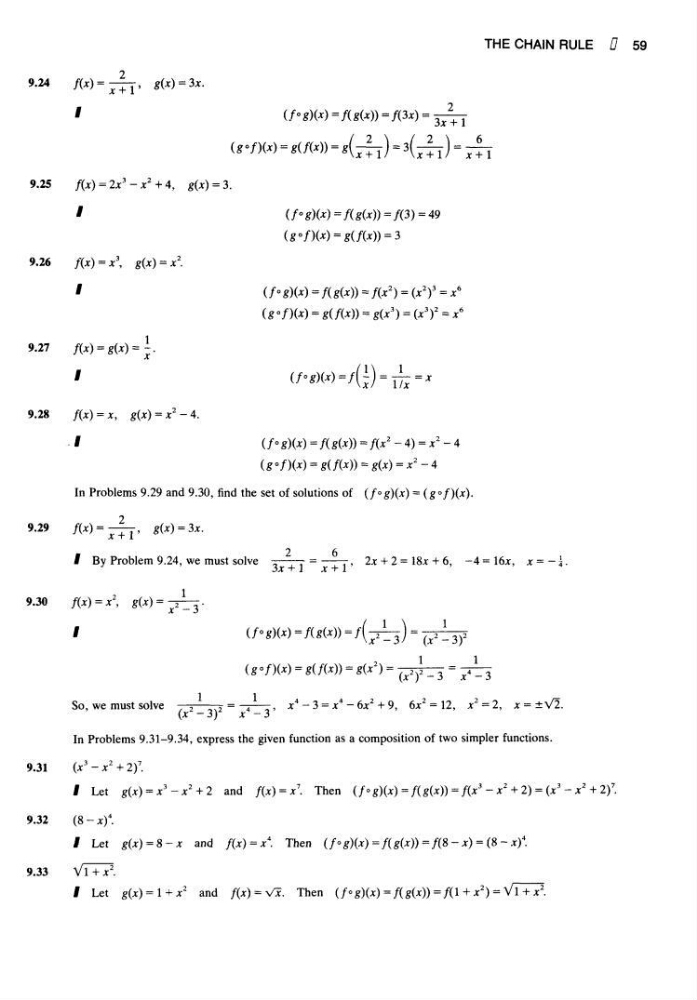
In Problems 9.29 and 9.30, find the set of solutions of (f°g)(x) = (g°f)(x).
9.30
/(*) = x
2 ,
In Problems 9.31-9.34, express the given function as a composition of two simpler functions.
9.31
9.32
9.33
59
f(x) = x\ g(x) = x
2 .
(f° g)W = f(g(x)) = f(x2) = (x2)3 = x6
(g°/)to = S(/W) = g(x3) = (x3)2 = x6
/(*) = *, g(x) = x
2 -4.
(f°g)(x) = /(g(^)) = f(x
2 - 4) = x
2 - 4
(g°f)(x) = g(f(x)) = g(x) = x
2 -4
By Problem 9.24, we must solve
2x + 2= 18*+ 6, -4=16*, * = -|.
X-3 = x4-6x2 + 9, 6x2 = 12, x2 = 2, x =
4
So, we must solve
Let g(x) = x*-x2 + 2 and f(x) = x7. Then (/»g)(jc) = f(g(x)) = /(*3 - x2 + 2) = (x3 - x2 + 2)7.
Let g(x) = 8-jc and /(x) = x
4 . Then (/»g)(At) =/(gW) =/(8 - x) = (8 - x)
4 .
(8-x)
4 .
Then
g(x) = 3x.
Let g(x) = l + x
2 and f(x) = Vx
(/°g)W=/(gW) = /(i + ^
2
) =
(x3-x2 + 2)7.
g(x) = 3x.
9.25
A*) = 2x
3 -x
2 + 4, g(x) = 3.
9.26
THE CHAIN RULE
(/o £)«=/(£«) =/(3) = 49
(g "/)« = £(/(*)) = 3
9.27
9.28
9.29
In Problems 9.29 and 9.30, find the set of solutions of (f°g)(x) = (g°f)(x).
9.30
/(*) = x
2 ,
In Problems 9.31-9.34, express the given function as a composition of two simpler functions.
9.31
9.32
9.33
59
f(x) = x\ g(x) = x
2 .
(f° g)W = f(g(x)) = f(x2) = (x2)3 = x6
(g°/)to = S(/W) = g(x3) = (x3)2 = x6
/(*) = *, g(x) = x
2 -4.
(f°g)(x) = /(g(^)) = f(x
2 - 4) = x
2 - 4
(g°f)(x) = g(f(x)) = g(x) = x
2 -4
By Problem 9.24, we must solve
2x + 2= 18*+ 6, -4=16*, * = -|.
X-3 = x4-6x2 + 9, 6x2 = 12, x2 = 2, x =
4
So, we must solve
Let g(x) = x*-x2 + 2 and f(x) = x7. Then (/»g)(jc) = f(g(x)) = /(*3 - x2 + 2) = (x3 - x2 + 2)7.
Let g(x) = 8-jc and /(x) = x
4 . Then (/»g)(At) =/(gW) =/(8 - x) = (8 - x)
4 .
(8-x)
4 .
Then
g(x) = 3x.
Let g(x) = l + x
2 and f(x) = Vx
(/°g)W=/(gW) = /(i + ^
2
) =
(x3-x2 + 2)7.
g(x) = 3x.