

CONTINUITY
7.19
7.20
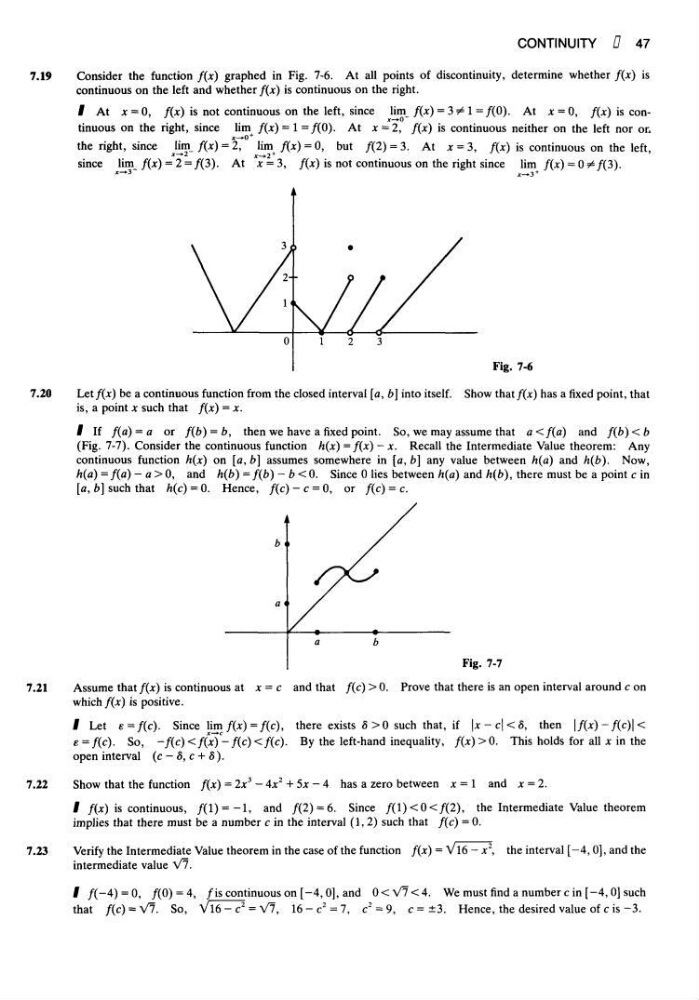
Consider the function f(x) graphed in Fig. 7-6. At all points of discontinuity, determine whether f(x) is
continuous on the left and whether/(*) is continuous on the right.
At * = 0, f(x) is not continuous on the left, since lim /(*) = 3^1=/(0). At x = 0, /(Discontinuous on the right, since lim f(x) = 1 =/(0). At x = 2, f(x) is continuous neither on the left nor on
*—0
+
the right, since lim f(x) = 2, lim /(*) = 0, but /(2) = 3. At x = 3, f(x) is continuous on the left,
x—>2
x—»2
+
since lim f(x) - 2 = /(3). At x = 3, f(x) is not continuous on the right since lim f(x)-Q=tf(3).
-.~
Let/(jc) be a continuous function from the closed interval [a, b] into itself. Show that/(x) has a fixed point, that
is, a point x such that f(x) = x.
If /(a) = a or f(b) = b, then we have a fixed point. So, we may assume that a
continuous function h(x) on [a, b] assumes somewhere in [a, b] any value between h(a) and h(b). Now,
h(a) = f(a) — a > 0, and h(b) = f(b) - b < 0. Since 0 lies between /j(a) and h(b), there must be a point c in
[a, b] such that fc(c) = 0. Hence, /(c) - c = 0, or /(c) = c.
7.21
Assume that f(x) is continuous at x = c and that f(c) > 0. Prove that there is an open interval around c on
which f(x) is positive.
Let e=/(c). Since lim/(*) =/(c), there exists 8 > 0 such that, if \x-c\<8, then \f(x)-f(c)\<
e = /(c). So, -/(c)0. This holds for all * in the
open interval (c - 8, c + S).
7.22
Show that the function f(x) = 2x
3 - 4x
2 + 5x - 4 has a zero between x = I and x = 2.
(*) is continuous, /(!)=-!, and /(2) = 6. Since /(l)<0 implies that there must be a number c in the interval (1,2) such that /(c) = 0.
7.23
Verify the Intermediate Value theorem in the case of the function f(x) =
intermediate value V7.
/(-4) = 0> /(0) = 4, /is continuous on [-4,0], and 0
2 = V7, 16-c
2 = 7, c
2 = 9, c=±3. Hence, the desired value of c is-3.
Fig. 7-6
Fig. 7-7
47
the interval [-4, 0], and the
7.19
7.20
Consider the function f(x) graphed in Fig. 7-6. At all points of discontinuity, determine whether f(x) is
continuous on the left and whether/(*) is continuous on the right.
At * = 0, f(x) is not continuous on the left, since lim /(*) = 3^1=/(0). At x = 0, /(Discontinuous on the right, since lim f(x) = 1 =/(0). At x = 2, f(x) is continuous neither on the left nor on
*—0
+
the right, since lim f(x) = 2, lim /(*) = 0, but /(2) = 3. At x = 3, f(x) is continuous on the left,
x—>2
x—»2
+
since lim f(x) - 2 = /(3). At x = 3, f(x) is not continuous on the right since lim f(x)-Q=tf(3).
-.~
Let/(jc) be a continuous function from the closed interval [a, b] into itself. Show that/(x) has a fixed point, that
is, a point x such that f(x) = x.
If /(a) = a or f(b) = b, then we have a fixed point. So, we may assume that a
continuous function h(x) on [a, b] assumes somewhere in [a, b] any value between h(a) and h(b). Now,
h(a) = f(a) — a > 0, and h(b) = f(b) - b < 0. Since 0 lies between /j(a) and h(b), there must be a point c in
[a, b] such that fc(c) = 0. Hence, /(c) - c = 0, or /(c) = c.
7.21
Assume that f(x) is continuous at x = c and that f(c) > 0. Prove that there is an open interval around c on
which f(x) is positive.
Let e=/(c). Since lim/(*) =/(c), there exists 8 > 0 such that, if \x-c\<8, then \f(x)-f(c)\<
e = /(c). So, -/(c)0. This holds for all * in the
open interval (c - 8, c + S).
7.22
Show that the function f(x) = 2x
3 - 4x
2 + 5x - 4 has a zero between x = I and x = 2.
(*) is continuous, /(!)=-!, and /(2) = 6. Since /(l)<0 implies that there must be a number c in the interval (1,2) such that /(c) = 0.
7.23
Verify the Intermediate Value theorem in the case of the function f(x) =
intermediate value V7.
/(-4) = 0> /(0) = 4, /is continuous on [-4,0], and 0
2 = V7, 16-c
2 = 7, c
2 = 9, c=±3. Hence, the desired value of c is-3.
Fig. 7-6
Fig. 7-7
47
the interval [-4, 0], and the