

7.13
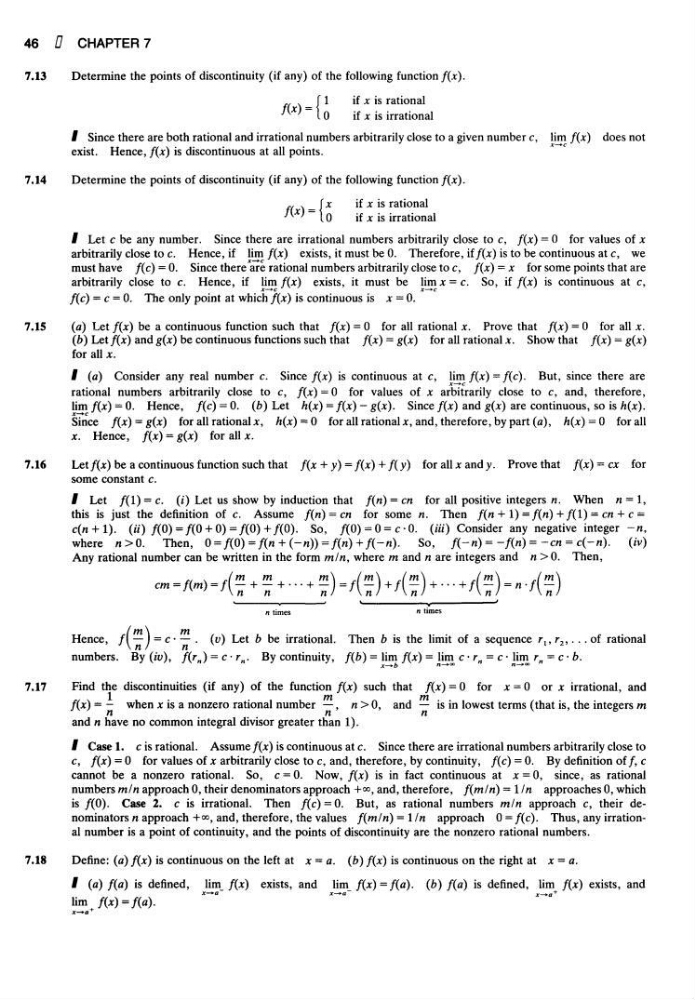
Determine the points of discontinuity (if any) of the following function f(x).
Since there are both rational and irrational numbers arbitrarily close to a given number c, lim f(x) does not
exist. Hence, f(x) is discontinuous at all points.
7.14 Determine the points of discontinuity (if any) of the following function f(x).
Let c be any number. Since there are irrational numbers arbitrarily close to c, f(x) = 0 for values of x
arbitrarily close to c. Hence, if lim f(x) exists, it must be 0. Therefore, if f(x) is to be continuous at c, we
must have /(c) = 0. Since there are rational numbers arbitrarily close to c, f(x) = x for some points that are
arbitrarily close to c. Hence, if lim f(x) exists, it must be lim;e = c. So, if /(*) is continuous at c,
/(c) = c = 0. The only point at which f(x) is continuous is x = 0.
7.15
(a) Let f(x) be a continuous function such that f(x) = 0 for all rational x. Prove that f(x) = 0 for all x.
(b) Letf(x) and g(x) be continuous functions such that f(x) = g(x) for all rational x. Show that f(x) = g(x)
for all x.
(a) Consider any real number c. Since f(x) is continuous at c, lim f(x) = f(c). But, since there are
rational numbers arbitrarily close to c, f(x) = 0 for values of x arbitrarily close to c, and, therefore,
lim f(x) = 0. Hence, /(c) = 0. (b) Let h(x) = f(x) - g(x). Since f(x) and g(x) are continuous, so is h(x).
Since f(x) = g(x) for all rational*, h(x) = 0 for all rational*, and, therefore, by part (a), h(x) = 0 for all
x. Hence, f(x) = g(x) for all x.
7.16
Letf(x) be a continuous function such that f(x + y) = f(x) + f(y) for all* andy. Prove that f(x) = ex for
some constant c.
Let /(I) = c. (i) Let us show by induction that f(n) = en for all positive integers n. When n = 1,
this is just the definition of c. Assume f(n) = cn for some n. Then f(n + 1) =f(n) + /(!) = en + c =
c(n + l). (ii) /(0)=/(0 + 0)=/(0)+/(0). So, /(0) = 0 = c-0. (Hi) Consider any negative integer -n,
where n >0.
Then, 0 = /(0) =/(n + (-n)) =/(n)+/(-«). So, f(-n)=-f(n)=-cn = c(-n). (iv)
Any rational number can be written in the form m/n, where m and n are integers and n >0. Then,
if x is rational
if x is irrational
7.17
Hence,
t , r 2 ,. . . of rational
numbers. By (if), /(r n ) = c • /•„. By continuity, f(b) = lim f(x) = lim c • r n = c • lim r n = c • b.
Find the discontinuities (if any) of the function f(x) such that f(x) = 0 for x = 0 or x irrational, and
f(x) = — when x is a nonzero rational number —, n > 0, and — is in lowest terms (that is, the integers m
n
n
n
and n have no common integral divisor greater than 1).
Casel. c is rational. Assume f{x) is continuous ate. Since there are irrational numbers arbitrarily close to
c > /M
= 0 for values of * arbitrarily close to c, and, therefore, by continuity, /(c) = 0. By definition of /, c
cannot be a nonzero rational. So, c = 0. Now, f(x) is in fact continuous at x = Q, since, as rational
numbers m/n approach 0, their denominators approach +°°, and, therefore, /(m/n) = 1 In approaches 0, which
is /(O). Case 2. c is irrational. Then /(c) = 0. But, as rational numbers m/n approach c, their denominators n approach +<*>, and, therefore, the values /(m/n) = 1 In approach 0 = /(c). Thus, any irrational number is a point of continuity, and the points of discontinuity are the nonzero rational numbers.
Define: (a) f(x) is continuous on the left at x = a. (b) f(x) is continuous on the right at x = a.
(a) f(d) is defined, lim /(*) exists, and lim f(x)=f(a).
(b) f(a) is defined, lim f(x) exists, and
lim +f(x)=f(a).
7.18
/« =
1
0
/w =
x
if x is rational
0
if x is irrational
46
CHAPTER 7
(v) Let fc be irrational. Then b is the limit of a sequence r
Download
from Wow! eBook
Determine the points of discontinuity (if any) of the following function f(x).
Since there are both rational and irrational numbers arbitrarily close to a given number c, lim f(x) does not
exist. Hence, f(x) is discontinuous at all points.
7.14 Determine the points of discontinuity (if any) of the following function f(x).
Let c be any number. Since there are irrational numbers arbitrarily close to c, f(x) = 0 for values of x
arbitrarily close to c. Hence, if lim f(x) exists, it must be 0. Therefore, if f(x) is to be continuous at c, we
must have /(c) = 0. Since there are rational numbers arbitrarily close to c, f(x) = x for some points that are
arbitrarily close to c. Hence, if lim f(x) exists, it must be lim;e = c. So, if /(*) is continuous at c,
/(c) = c = 0. The only point at which f(x) is continuous is x = 0.
7.15
(a) Let f(x) be a continuous function such that f(x) = 0 for all rational x. Prove that f(x) = 0 for all x.
(b) Letf(x) and g(x) be continuous functions such that f(x) = g(x) for all rational x. Show that f(x) = g(x)
for all x.
(a) Consider any real number c. Since f(x) is continuous at c, lim f(x) = f(c). But, since there are
rational numbers arbitrarily close to c, f(x) = 0 for values of x arbitrarily close to c, and, therefore,
lim f(x) = 0. Hence, /(c) = 0. (b) Let h(x) = f(x) - g(x). Since f(x) and g(x) are continuous, so is h(x).
Since f(x) = g(x) for all rational*, h(x) = 0 for all rational*, and, therefore, by part (a), h(x) = 0 for all
x. Hence, f(x) = g(x) for all x.
7.16
Letf(x) be a continuous function such that f(x + y) = f(x) + f(y) for all* andy. Prove that f(x) = ex for
some constant c.
Let /(I) = c. (i) Let us show by induction that f(n) = en for all positive integers n. When n = 1,
this is just the definition of c. Assume f(n) = cn for some n. Then f(n + 1) =f(n) + /(!) = en + c =
c(n + l). (ii) /(0)=/(0 + 0)=/(0)+/(0). So, /(0) = 0 = c-0. (Hi) Consider any negative integer -n,
where n >0.
Then, 0 = /(0) =/(n + (-n)) =/(n)+/(-«). So, f(-n)=-f(n)=-cn = c(-n). (iv)
Any rational number can be written in the form m/n, where m and n are integers and n >0. Then,
if x is rational
if x is irrational
7.17
Hence,
t , r 2 ,. . . of rational
numbers. By (if), /(r n ) = c • /•„. By continuity, f(b) = lim f(x) = lim c • r n = c • lim r n = c • b.
Find the discontinuities (if any) of the function f(x) such that f(x) = 0 for x = 0 or x irrational, and
f(x) = — when x is a nonzero rational number —, n > 0, and — is in lowest terms (that is, the integers m
n
n
n
and n have no common integral divisor greater than 1).
Casel. c is rational. Assume f{x) is continuous ate. Since there are irrational numbers arbitrarily close to
c > /M
= 0 for values of * arbitrarily close to c, and, therefore, by continuity, /(c) = 0. By definition of /, c
cannot be a nonzero rational. So, c = 0. Now, f(x) is in fact continuous at x = Q, since, as rational
numbers m/n approach 0, their denominators approach +°°, and, therefore, /(m/n) = 1 In approaches 0, which
is /(O). Case 2. c is irrational. Then /(c) = 0. But, as rational numbers m/n approach c, their denominators n approach +<*>, and, therefore, the values /(m/n) = 1 In approach 0 = /(c). Thus, any irrational number is a point of continuity, and the points of discontinuity are the nonzero rational numbers.
Define: (a) f(x) is continuous on the left at x = a. (b) f(x) is continuous on the right at x = a.
(a) f(d) is defined, lim /(*) exists, and lim f(x)=f(a).
(b) f(a) is defined, lim f(x) exists, and
lim +f(x)=f(a).
7.18
/« =
1
0
/w =
x
if x is rational
0
if x is irrational
46
CHAPTER 7
(v) Let fc be irrational. Then b is the limit of a sequence r
Download
from Wow! eBook