

7.24
Is f(x) = [x] continuous over the interval [1,2] 1
Consider the function / such that f(x) = 2x if 0l. Is f continuous
over [0,1]?
Yes. When continuity over an interval is considered, at the endpoints we are concerned with only the
one-sided limit. So, although/is discontinuous at x = l, the left-hand limit at 1 is 2 and /(I) — 2.
Is the function of Problem 7.26 continuous over [1,2]?
No. The right-hand limit at x=l is lim (* - 1) = 0, whereas /(I) = 2.
7.26
7.27
7.28
Let
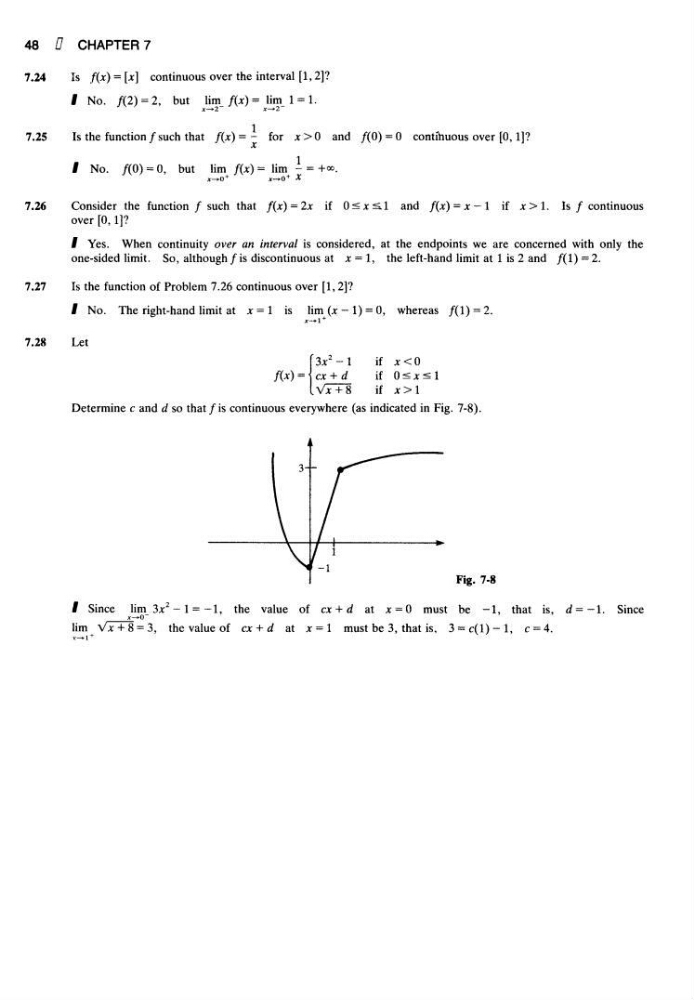
Fig. 7-8
Since lim 3x
2 -1 = — 1, the value of ex + d at x = 0 must be — 1, that is. d=—l. Since
i-*0~
lim Vx+ 8 = 3, the value of c* + d at x = l must be 3, that is, 3 = c(l)-l, c = 4.
r-»l +
Determine c and d so that/is continuous everywhere (as indicated in Fig. 7-8).
48
CHAPTER 7
No. /(2) = 2, but lim /(*) = lim 1 = 1.
7.25
Is the function / such that f(x) =
1
X
for x > 0 and /(O) = 0 contiguous over [0,1]?
No. /(0) = 0, but lim f(x)= lim
x^O*
*-»0
+
1
X
= +00.
if
if
if
Is f(x) = [x] continuous over the interval [1,2] 1
Consider the function / such that f(x) = 2x if 0
over [0,1]?
Yes. When continuity over an interval is considered, at the endpoints we are concerned with only the
one-sided limit. So, although/is discontinuous at x = l, the left-hand limit at 1 is 2 and /(I) — 2.
Is the function of Problem 7.26 continuous over [1,2]?
No. The right-hand limit at x=l is lim (* - 1) = 0, whereas /(I) = 2.
7.26
7.27
7.28
Let
Fig. 7-8
Since lim 3x
2 -1 = — 1, the value of ex + d at x = 0 must be — 1, that is. d=—l. Since
i-*0~
lim Vx+ 8 = 3, the value of c* + d at x = l must be 3, that is, 3 = c(l)-l, c = 4.
r-»l +
Determine c and d so that/is continuous everywhere (as indicated in Fig. 7-8).
48
CHAPTER 7
No. /(2) = 2, but lim /(*) = lim 1 = 1.
7.25
Is the function / such that f(x) =
1
X
for x > 0 and /(O) = 0 contiguous over [0,1]?
No. /(0) = 0, but lim f(x)= lim
x^O*
*-»0
+
1
X
= +00.
if
if
if