

DIFFERENTIAL EQUATIONS
437
show that y = y p + z is a general solution of the Riccati equation (1).
z'-(Q + 2Ry p )z = Rz
2
(2)
1. Assume y=y p + z, where 2 is a solution of the Bernoulli equation (2). Then, y'=y^+ z '~
(P+Qy p + Ry
2
p ) + (Rz
2 + (Q+2Ry p )z] = P+ Q(y p + z) + R(y
2
p + 2y p z + z
2 ) = P+ Qy + R(y p + z)
2 =
P+ Qy
+ y
2 - Hence, y is a solution of (1). 2. Assume y is a solution of (1). Let z=y - y p . Then
z[£? + R(z + 2y p )\ = z(Q + 2/?y p + /?z) = Rz
2 + (Q + 2Ry p )z. Thus, z is a solution of the Bernoulli equation
(2).
46.44
Solve the equation
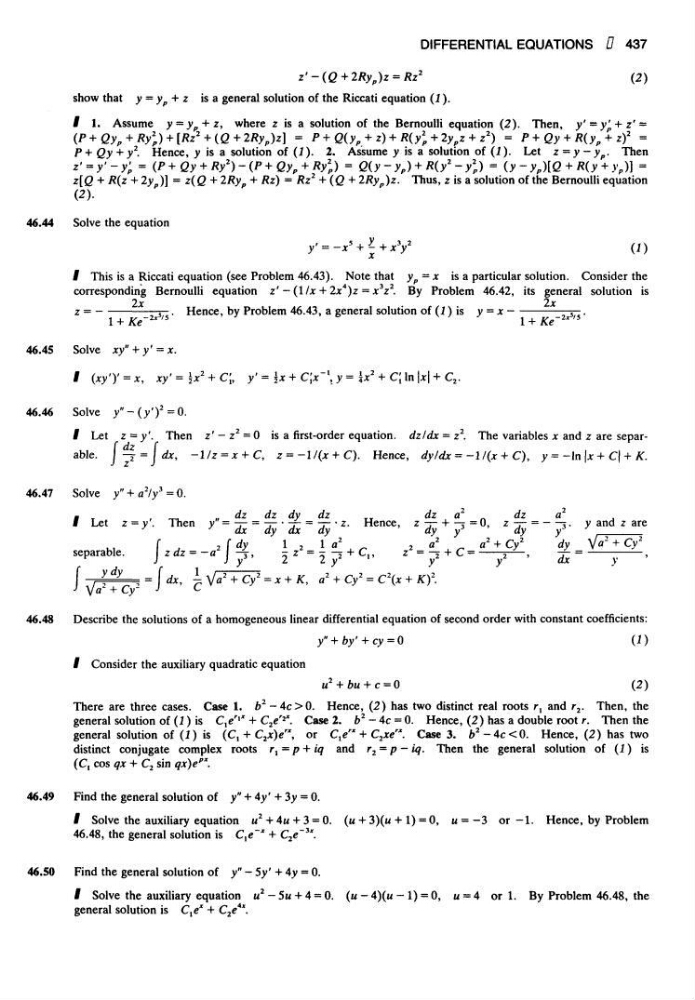
This is a Riccati equation (see Problem 46.43). Note that y p = x is a particular solution. Consider the
corresponding Bernoulli equation z' - (l/x + 2x*)z = x
3 z
2 . By Problem 46.42, its general solution is
Hence, by Problem 46.43, a general solution of (1) is
46.45
Solve xy" + y'= x.
46.46 Solve /-(/)
2 = 0.
(xy')'=x,
Let z = y'. Then z'-z
2 =0 is a first-order equation. dz/dx = z
2 . The variables x and z are separable.
-l/z = x + C, z = -l/(x + C). Hence, dy/dx = -\l(x + C), y = -In I* + Cl + K.
46.47
Solve /'+aV=0Let z = v'. Then
Hence,
y and z are
separable.
46.48
Describe the solutions of a homogeneous linear differential equation of second order with constant coefficients:
y"+ by' + cy =0
(1)
Consider the auxiliary quadratic equation
u
2 + bu + c = 0
(2)
There are three cases. Case 1. b -4c>0. Hence, (2) has two distinct real roots r, and r 2 . Then, the
general solution of (1) is C l e'
1 ' + C 2 e
v . Case 2. 6
2 -4c = 0. Hence, (2) has a double root r. Then the
general solution of (1) is (C, + C 2 x)e", or C,e" + C 2 *e". Case 3. i>
2 -4c<0. Hence, (2) has two
distinct conjugate complex roots r, = p + iq and r 2 = p — iq. Then the general solution of (1) is
(C, cos qx + C 2 sin qx)e
p *.
46.49
Find the general solution of y" + 4y' + 3y = 0.
Solve the auxiliary equation u
2 + 4a + 3 = 0. (u + 3)(u + 1) = 0, u = -3 or -1. Hence, by Problem
46.48, the general solution is C^e~* + C 2 e~
3 *.
46.50
Find the general solution of y" - 5y' + 4y = 0.
Solve the auxiliary equation M
2 -5w + 4 = 0. (« - 4)(u - 1) = 0, u = 4 or 1. By Problem 46.48, the
general solution is C^e' + C 2 e**.
437
show that y = y p + z is a general solution of the Riccati equation (1).
z'-(Q + 2Ry p )z = Rz
2
(2)
1. Assume y=y p + z, where 2 is a solution of the Bernoulli equation (2). Then, y'=y^+ z '~
(P+Qy p + Ry
2
p ) + (Rz
2 + (Q+2Ry p )z] = P+ Q(y p + z) + R(y
2
p + 2y p z + z
2 ) = P+ Qy + R(y p + z)
2 =
P+ Qy
+ y
2 - Hence, y is a solution of (1). 2. Assume y is a solution of (1). Let z=y - y p . Then
z[£? + R(z + 2y p )\ = z(Q + 2/?y p + /?z) = Rz
2 + (Q + 2Ry p )z. Thus, z is a solution of the Bernoulli equation
(2).
46.44
Solve the equation
This is a Riccati equation (see Problem 46.43). Note that y p = x is a particular solution. Consider the
corresponding Bernoulli equation z' - (l/x + 2x*)z = x
3 z
2 . By Problem 46.42, its general solution is
Hence, by Problem 46.43, a general solution of (1) is
46.45
Solve xy" + y'= x.
46.46 Solve /-(/)
2 = 0.
(xy')'=x,
Let z = y'. Then z'-z
2 =0 is a first-order equation. dz/dx = z
2 . The variables x and z are separable.
-l/z = x + C, z = -l/(x + C). Hence, dy/dx = -\l(x + C), y = -In I* + Cl + K.
46.47
Solve /'+aV=0Let z = v'. Then
Hence,
y and z are
separable.
46.48
Describe the solutions of a homogeneous linear differential equation of second order with constant coefficients:
y"+ by' + cy =0
(1)
Consider the auxiliary quadratic equation
u
2 + bu + c = 0
(2)
There are three cases. Case 1. b -4c>0. Hence, (2) has two distinct real roots r, and r 2 . Then, the
general solution of (1) is C l e'
1 ' + C 2 e
v . Case 2. 6
2 -4c = 0. Hence, (2) has a double root r. Then the
general solution of (1) is (C, + C 2 x)e", or C,e" + C 2 *e". Case 3. i>
2 -4c<0. Hence, (2) has two
distinct conjugate complex roots r, = p + iq and r 2 = p — iq. Then the general solution of (1) is
(C, cos qx + C 2 sin qx)e
p *.
46.49
Find the general solution of y" + 4y' + 3y = 0.
Solve the auxiliary equation u
2 + 4a + 3 = 0. (u + 3)(u + 1) = 0, u = -3 or -1. Hence, by Problem
46.48, the general solution is C^e~* + C 2 e~
3 *.
46.50
Find the general solution of y" - 5y' + 4y = 0.
Solve the auxiliary equation M
2 -5w + 4 = 0. (« - 4)(u - 1) = 0, u = 4 or 1. By Problem 46.48, the
general solution is C^e' + C 2 e**.