

436
CHAPTER 46
46.37
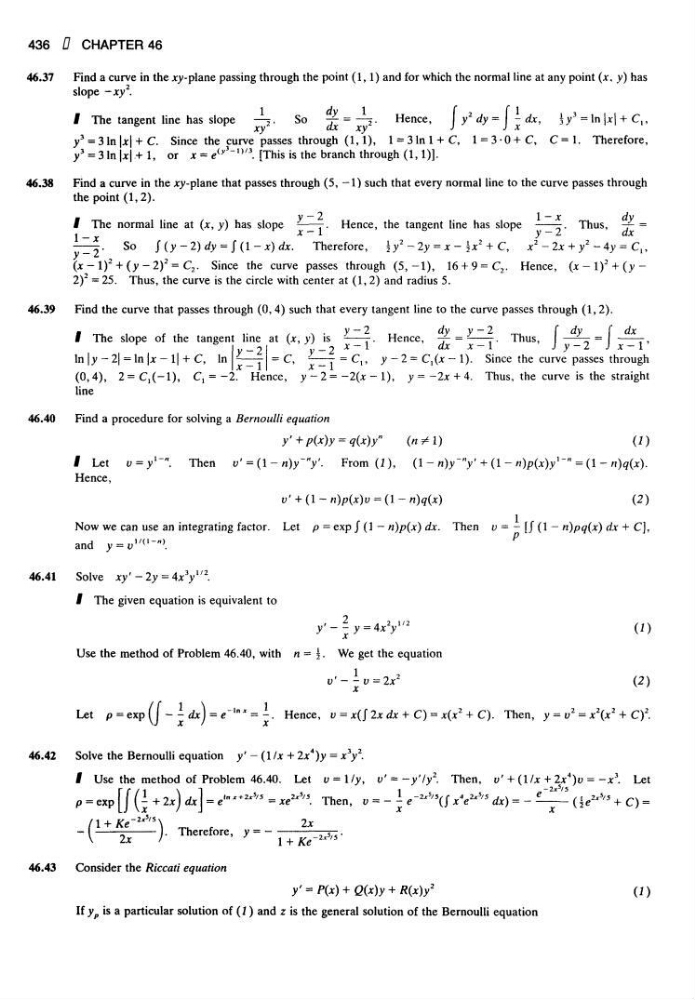
Find a curve in the ry-plane passing through the point (1,1) and for which the normal line at any point (x, y) has
slope -xy
2 .
The tangent line has slope
So
Hence,
y
3 = 3 In |*| + C. Since the curve passes through (1,1), l = 31nl + C, 1 = 3-0+C, C=l. Therefore,
v
3 = 31n*.+ l, °
r * = e
(yi ~"
13 . [This is the branch through (1,1)].
46.38
Find a curve in the xy-p\ane that passes through (5, -1) such that every normal line to the curve passes through
the point (1,2).
The normal line at (x, y) has slope
Hence, the tangent line has slope
Thus,
So
((y-2)dy=((l-x)dx. Therefore,
(x-l)
2 + (y-2)
2 =C2. Since the curve passes through (5,-1), 16 + 9= C2. Hence, (x - I)2 + (y -
2)
2 = 25. Thus, the curve is the circle with center at (1, 2) and radius 5.
46.39
Find the curve that passes through (0,4) such that every tangent line to the curve passes through (1,2).
The slope of the tangent line at (x. y) is
Hence,
Thus,
ln|y-2| = ln|x-l| + C,
y —2= C,(x — \). Since the curve passes through
(0,4), 2=C,(-1), C\ =-2. Hence, y - 2= -2(x - 1), y = -2* + 4. Thus, the curve is the straight
line
46.40
Find a procedure for solving a Bernoulli equation
y' + p(x)y = q(x)y"
(„*!)
(1}
46.41
Use the method of Problem 46.40, with
We get the equation
The given equation is equivalent to
Let v=y
1 ~". Then
v' = (1 - n)y~"y'.
From (J), (1 - n)y~V + (1 - n)p(x)y
l ~" = (1 - n)q(x).
Hence,
v'+ (1 - n)p(x)v = (1 - n)q(x)
(2)
Now we can use an integrating factor. Let p = exp J (1 - n)p(x) dx. Then
and v = w
I/(l ->.
[S(l-n)pq(x)dx+C],
Solve xy' - 2y = 4x
3 y "
2
.
Let
Hence, v = x($ 2x dx + C) = x(x
2 + C). Then, y = v
2 = x
2 (x
2 + C)
2 .
46.42
Solve the Bernoulli equation /-(!/* + 2x
4 )y = x*y
2 .
If y p is a particular solution of (1) and z is the general solution of the Bernoulli equation
(1)
y' = P(x) + Q(x)y 4- R(x)y
2
46.43
Consider the Riccati equation
Therefore,
Use the method of Problem 46.40. Let v = l/y, v' = -y'/y
2 . Then, v' + (l/x + 2x
4 )v = -x
3 . Let
Then,
CHAPTER 46
46.37
Find a curve in the ry-plane passing through the point (1,1) and for which the normal line at any point (x, y) has
slope -xy
2 .
The tangent line has slope
So
Hence,
y
3 = 3 In |*| + C. Since the curve passes through (1,1), l = 31nl + C, 1 = 3-0+C, C=l. Therefore,
v
3 = 31n*.+ l, °
r * = e
(yi ~"
13 . [This is the branch through (1,1)].
46.38
Find a curve in the xy-p\ane that passes through (5, -1) such that every normal line to the curve passes through
the point (1,2).
The normal line at (x, y) has slope
Hence, the tangent line has slope
Thus,
So
((y-2)dy=((l-x)dx. Therefore,
(x-l)
2 + (y-2)
2 =C2. Since the curve passes through (5,-1), 16 + 9= C2. Hence, (x - I)2 + (y -
2)
2 = 25. Thus, the curve is the circle with center at (1, 2) and radius 5.
46.39
Find the curve that passes through (0,4) such that every tangent line to the curve passes through (1,2).
The slope of the tangent line at (x. y) is
Hence,
Thus,
ln|y-2| = ln|x-l| + C,
y —2= C,(x — \). Since the curve passes through
(0,4), 2=C,(-1), C\ =-2. Hence, y - 2= -2(x - 1), y = -2* + 4. Thus, the curve is the straight
line
46.40
Find a procedure for solving a Bernoulli equation
y' + p(x)y = q(x)y"
(„*!)
(1}
46.41
Use the method of Problem 46.40, with
We get the equation
The given equation is equivalent to
Let v=y
1 ~". Then
v' = (1 - n)y~"y'.
From (J), (1 - n)y~V + (1 - n)p(x)y
l ~" = (1 - n)q(x).
Hence,
v'+ (1 - n)p(x)v = (1 - n)q(x)
(2)
Now we can use an integrating factor. Let p = exp J (1 - n)p(x) dx. Then
and v = w
I/(l ->.
[S(l-n)pq(x)dx+C],
Solve xy' - 2y = 4x
3 y "
2
.
Let
Hence, v = x($ 2x dx + C) = x(x
2 + C). Then, y = v
2 = x
2 (x
2 + C)
2 .
46.42
Solve the Bernoulli equation /-(!/* + 2x
4 )y = x*y
2 .
If y p is a particular solution of (1) and z is the general solution of the Bernoulli equation
(1)
y' = P(x) + Q(x)y 4- R(x)y
2
46.43
Consider the Riccati equation
Therefore,
Use the method of Problem 46.40. Let v = l/y, v' = -y'/y
2 . Then, v' + (l/x + 2x
4 )v = -x
3 . Let
Then,