

DIFFERENTIAL EQUATIONS
435
46.28
Solve
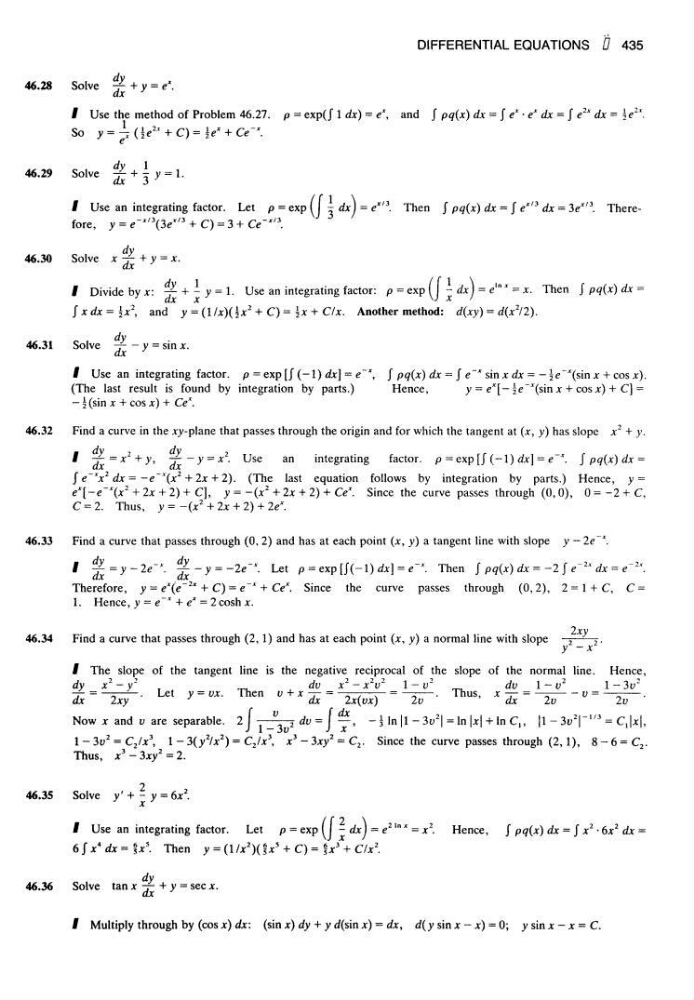
Use the method of Problem 46.27. p = exp(J 1 dx) = e", and J pq(x) dx = J e* • e* dx = J e
2 " dx
So
46.29
Solve
Use an integrating factor. Let p = exp
Then / pq(x) dx. = \ e"
3 dx = 3e*
13 . Therefore, v = e-"\3e*
/3 + C) = 3 + Ce~"\
46.30
Solve
Divide by x:
Use an integrating factor: p = exp
= e"' = x. Then J pq(x) dx =
and y = (l/x)
Another method: d(xy) = d(x 12).
46.31
Solve
Use an integrating factor, p =exp [J (-1) dx] = e *, J pq(x) dx = J e * sin x dx =
(The last result is found by integration by parts.)
Hence,
y = e*[—^e~*(sinx + cosx)+C] =
(sin x + cos x) + Ce*.
46.32
Find a curve in the jty-plane that passes through the origin and for which the tangent at (x, y) has slope x
2 + y.
Use
an
integrating factor, p = exp [J (-1) dx] = e *. J pq(x) dx =
J" e *x
2 dx=-e \x
2 + 2x + 2). (The last equation follows by integration by parts.) Hence, y =
e*[-e~*(x
2 + 2x + 2)+C], y = -(x
2 + 2x + 2) + Ce*. Since the curve passes through (0, 0), 0 = -2 + C,
C = 2. Thus, y = -(x
2 + 2x + 2) + 2e*.
46.33
Find a curve that passes through (0, 2) and has at each point (x, y) a tangent line with slope y - 2e
Therefore, y = e
x (e
2 '+ C) = e * + Ce\ Since the curve passes through (0,2), 2 = 1 + C, C =
1. Hence, y = e~* + e* = 2 cosh x.
Let p = exp[$(-l)dx] = e '. Then J pq(x) dx = -2 f e
2
" d* = e
2> .
46.34
Find a curve that passes through (2,1) and has at each point (x, y) a normal line with slope
The slope of the tangent line is the negative reciprocal of the slope of the normal line. Hence,
Thus,
Let y = vx. Then
Now x and v are separable.
1 - 3u
2 = C2/x3, 1 - 3(y2/x2) = C2/x\ x3 - 3xy2 = C2. Since the curve passes through (2,1), 8 - 6 = C2.
Thus, x
3 - 3xy
2 = 2.
46.35
Solve
Use an integrating factor. Let p = exp
Hence, J pq(x) dx = f x
2 • 6x
2 dx =
Then y = (\lx
2 )(
46.36
Solve tan
Multiply through by (cos x) dx: (sin x) dy + y d(sin x) = dx, d(y sin x - x) = 0; y sin x - x = C.
'(sin x + cos x).
435
46.28
Solve
Use the method of Problem 46.27. p = exp(J 1 dx) = e", and J pq(x) dx = J e* • e* dx = J e
2 " dx
So
46.29
Solve
Use an integrating factor. Let p = exp
Then / pq(x) dx. = \ e"
3 dx = 3e*
13 . Therefore, v = e-"\3e*
/3 + C) = 3 + Ce~"\
46.30
Solve
Divide by x:
Use an integrating factor: p = exp
= e"' = x. Then J pq(x) dx =
and y = (l/x)
Another method: d(xy) = d(x 12).
46.31
Solve
Use an integrating factor, p =exp [J (-1) dx] = e *, J pq(x) dx = J e * sin x dx =
(The last result is found by integration by parts.)
Hence,
y = e*[—^e~*(sinx + cosx)+C] =
(sin x + cos x) + Ce*.
46.32
Find a curve in the jty-plane that passes through the origin and for which the tangent at (x, y) has slope x
2 + y.
Use
an
integrating factor, p = exp [J (-1) dx] = e *. J pq(x) dx =
J" e *x
2 dx=-e \x
2 + 2x + 2). (The last equation follows by integration by parts.) Hence, y =
e*[-e~*(x
2 + 2x + 2)+C], y = -(x
2 + 2x + 2) + Ce*. Since the curve passes through (0, 0), 0 = -2 + C,
C = 2. Thus, y = -(x
2 + 2x + 2) + 2e*.
46.33
Find a curve that passes through (0, 2) and has at each point (x, y) a tangent line with slope y - 2e
Therefore, y = e
x (e
2 '+ C) = e * + Ce\ Since the curve passes through (0,2), 2 = 1 + C, C =
1. Hence, y = e~* + e* = 2 cosh x.
Let p = exp[$(-l)dx] = e '. Then J pq(x) dx = -2 f e
2
" d* = e
2> .
46.34
Find a curve that passes through (2,1) and has at each point (x, y) a normal line with slope
The slope of the tangent line is the negative reciprocal of the slope of the normal line. Hence,
Thus,
Let y = vx. Then
Now x and v are separable.
1 - 3u
2 = C2/x3, 1 - 3(y2/x2) = C2/x\ x3 - 3xy2 = C2. Since the curve passes through (2,1), 8 - 6 = C2.
Thus, x
3 - 3xy
2 = 2.
46.35
Solve
Use an integrating factor. Let p = exp
Hence, J pq(x) dx = f x
2 • 6x
2 dx =
Then y = (\lx
2 )(
46.36
Solve tan
Multiply through by (cos x) dx: (sin x) dy + y d(sin x) = dx, d(y sin x - x) = 0; y sin x - x = C.
'(sin x + cos x).