

434
CHAPTER 46
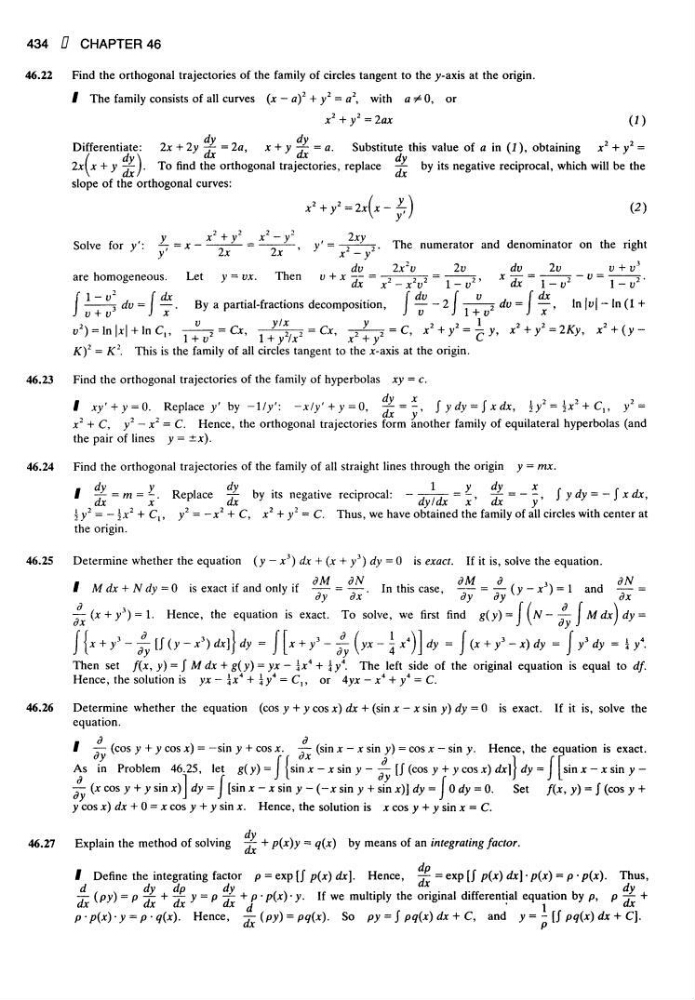
46.22
Find the orthogonal trajectories of the family of circles tangent to the y-axis at the origin.
The family consists of all curves (jc - a)
2 + y
2 = a
2 , with a ^ 0, or
x
2 + y
2 = 2ax
(1)
Differentiate:
Substitute this value of a in (1), obtaining x
2 + y
2 =
To find the orthogonal trajectories, replace
by its negative reciprocal, which will be the
slope of the orthogonal curves:
Solve for
The numerator and denominator on the right
are homogeneous.
Let y — vx.
Then
By a partial-fractions decomposition,
x
2 + y
2 = 2Ky, x
2 + (y -
K)
2 = K
2 . This is the family of all circles tangent to the x-axis at the origin.
46.23 Find the orthogonal trajectories of the family of hyperbolas xy = c.
46.27
46.26
Explain the method of solving
p(x)y = q(x) by means of an integrating factor.
Define the integrating factor p = exp [J p(x) dx]. Hence,
If we multiply the original differential equation by p,
Hence,
So
and
Determine whether the equation (cos y + y cos x) dx + (sin x - x sin y) dy = 0 is exact. If it is, solve the
equation.
(cos y + y cos x) = -sin y + cos x.
(sin x - x sin y) = cos x — sin y. Hence, the equation is exact.
As in Problem 46.25, let e(y) =
y cos x) dx + 0 = x cos y + y sin x. Hence, the solution is x cos y + y sin x = C
0 dy = 0. Set f(x, y) = / (cos y +
[sin x - x sin y - (-x sin y + sin x)] dy =
(x cos y + y sin x) dy =
sin x — x sin
[J (cos y + y cos x) dx] dy
sin x - x sin y —
46.25
46.24
Determine whether the equation (y - x
3 ) dx + (x + y
3 ) dy = 0 is exact. If it is, solve the equation.
Find the orthogonal trajectories of the family of all straight lines through the origin y = mx.
Replace
by its negative reciprocal:
y
2 = -x
2 + C, x
2 + y
2 = C. Thus, we have obtained the family of all circles with center at
the origin.
M dx + N dy = 0 is exact if and only if
In this case,
and
Hence, the equation is exact. To solve, we first find
Then set f(x, y) = f M dx + g(y) = yx -
The left side of the original equation is equal to df.
Hence, the solution is
or 4yx - x + y = C.
Replace
Hence, the orthogonal trajectories form another family of equilateral hyperbolas (and
the pair of lines
In
Thus
CHAPTER 46
46.22
Find the orthogonal trajectories of the family of circles tangent to the y-axis at the origin.
The family consists of all curves (jc - a)
2 + y
2 = a
2 , with a ^ 0, or
x
2 + y
2 = 2ax
(1)
Differentiate:
Substitute this value of a in (1), obtaining x
2 + y
2 =
To find the orthogonal trajectories, replace
by its negative reciprocal, which will be the
slope of the orthogonal curves:
Solve for
The numerator and denominator on the right
are homogeneous.
Let y — vx.
Then
By a partial-fractions decomposition,
x
2 + y
2 = 2Ky, x
2 + (y -
K)
2 = K
2 . This is the family of all circles tangent to the x-axis at the origin.
46.23 Find the orthogonal trajectories of the family of hyperbolas xy = c.
46.27
46.26
Explain the method of solving
p(x)y = q(x) by means of an integrating factor.
Define the integrating factor p = exp [J p(x) dx]. Hence,
If we multiply the original differential equation by p,
Hence,
So
and
Determine whether the equation (cos y + y cos x) dx + (sin x - x sin y) dy = 0 is exact. If it is, solve the
equation.
(cos y + y cos x) = -sin y + cos x.
(sin x - x sin y) = cos x — sin y. Hence, the equation is exact.
As in Problem 46.25, let e(y) =
y cos x) dx + 0 = x cos y + y sin x. Hence, the solution is x cos y + y sin x = C
0 dy = 0. Set f(x, y) = / (cos y +
[sin x - x sin y - (-x sin y + sin x)] dy =
(x cos y + y sin x) dy =
sin x — x sin
[J (cos y + y cos x) dx] dy
sin x - x sin y —
46.25
46.24
Determine whether the equation (y - x
3 ) dx + (x + y
3 ) dy = 0 is exact. If it is, solve the equation.
Find the orthogonal trajectories of the family of all straight lines through the origin y = mx.
Replace
by its negative reciprocal:
y
2 = -x
2 + C, x
2 + y
2 = C. Thus, we have obtained the family of all circles with center at
the origin.
M dx + N dy = 0 is exact if and only if
In this case,
and
Hence, the equation is exact. To solve, we first find
Then set f(x, y) = f M dx + g(y) = yx -
The left side of the original equation is equal to df.
Hence, the solution is
or 4yx - x + y = C.
Replace
Hence, the orthogonal trajectories form another family of equilateral hyperbolas (and
the pair of lines
In
Thus