

DIFFERENTIAL EQUATIONS
433
i; are separable.
46.19
Solve
The variables are not separable. But the numerator and denominator are homogeneous in x and y of degree
2. Let y = vx. Then
Therefore,
Hence,
The variables v and x are separable.
In |2 + 3v
2 + 3i>
3 | = -In |*| + In C,,
|2 + 3v
2 + 3i;
3 |
1/3 = C,/|x|,
|2 -t- 3u
2 + 3u
3 | = C 2 /|x|
3 ,
|2"+ 3(y/;t)
2 + 3(y/x)
3 | = C 2 /|x|
3 , |2x
3 + 3xy
2 + 3y
3
| = C 2 , 2jc
3 + 3xy
2 + 3y
3 = C.
In |1 + 4i; - 3u
2 | = In |*| + In C t , In |1+ 4v - 3u
2 |~
1/2 =
ln(C,M),
l + 4v-3v
2 = l/(C 2 x
2 ), l + 4(y/jc)3(y/x)
2 = 1 /(C 2 *
2 ), x
2 + 4xy - 3y
2 = C.
46.20
46.21
Find the curve that passes through the point (1, 3) and whose tangent line at (x, y) has slope —(1 + ylx),
Let y = vx.
Now x
and v are separable.
Clx
2 , 2(y/x) + 1= C/x
2 , 2xy + x
2 = C. Since the curve passes through (1,3), 6+l = C. Hence, 2xy +
x
2 =7.
In^y + l^-lnlxl + lnC!, \2v + l|
1/2 = CJ\x\, 2v + 1 =
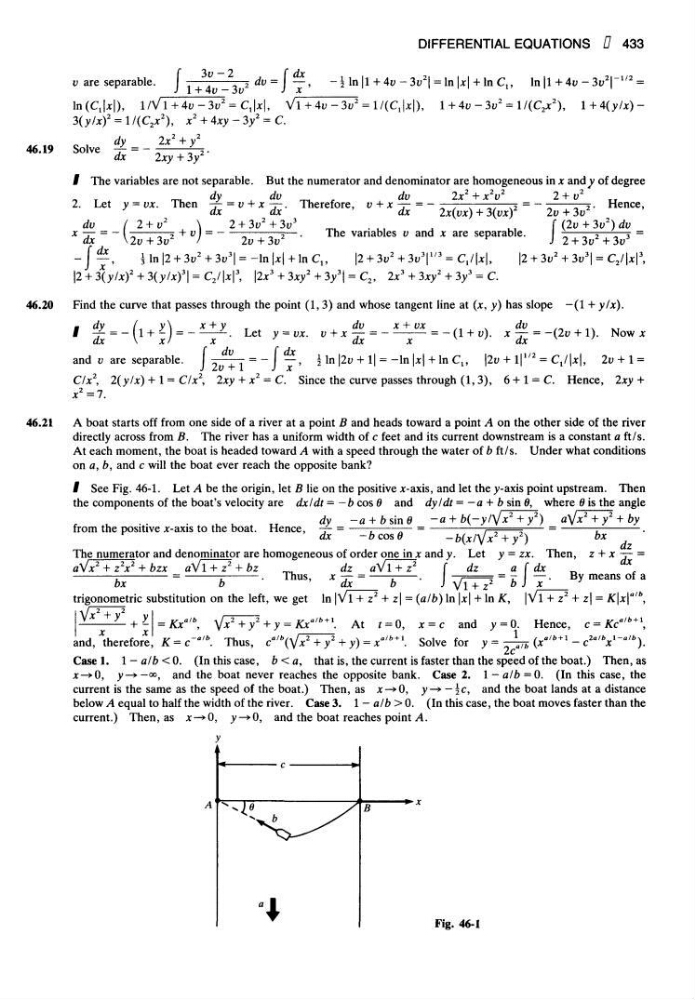
A boat starts off from one side of a river at a point B and heads toward a point A on the other side of the river
directly across from B. The river has a uniform width of c feet and its current downstream is a constant a ft/s.
At each moment, the boat is headed toward A with a speed through the water of b ft/s. Under what conditions
on a, b, and c will the boat ever reach the opposite bank?
See Fig. 46-1. Let A be the origin, let B lie on the positive x-axis, and let the y-axis point upstream. Then
the components of the boat's velocity are dxldt = -focos 9 and dyldt= -a + b sin 0, where 6 is the angle
from the positive x-axis to the boat. Hence,
Fig. 46-1
Case 1. l-a/b<0. (In this case, b
current is the same as the speed of the boat.) Then, as *-»0, y—» — \c, and the boat lands at a distance
below A equal to half the width of the river. Case 3. l-a/b>0. (In this case, the boat moves faster than the
current.) Then, as x—>0, y—»0, and the boat reaches point A.
and, therefore, K = c °
lb . Thus,
Solve for
trigonometric substitution on the left, we get
Thus,
At
By means of a
The numerator and denominator are homogeneous of order one in x and y. Let y = zx. Then,
and
Hence
433
i; are separable.
46.19
Solve
The variables are not separable. But the numerator and denominator are homogeneous in x and y of degree
2. Let y = vx. Then
Therefore,
Hence,
The variables v and x are separable.
In |2 + 3v
2 + 3i>
3 | = -In |*| + In C,,
|2 + 3v
2 + 3i;
3 |
1/3 = C,/|x|,
|2 -t- 3u
2 + 3u
3 | = C 2 /|x|
3 ,
|2"+ 3(y/;t)
2 + 3(y/x)
3 | = C 2 /|x|
3 , |2x
3 + 3xy
2 + 3y
3
| = C 2 , 2jc
3 + 3xy
2 + 3y
3 = C.
In |1 + 4i; - 3u
2 | = In |*| + In C t , In |1+ 4v - 3u
2 |~
1/2 =
ln(C,M),
l + 4v-3v
2 = l/(C 2 x
2 ), l + 4(y/jc)3(y/x)
2 = 1 /(C 2 *
2 ), x
2 + 4xy - 3y
2 = C.
46.20
46.21
Find the curve that passes through the point (1, 3) and whose tangent line at (x, y) has slope —(1 + ylx),
Let y = vx.
Now x
and v are separable.
Clx
2 , 2(y/x) + 1= C/x
2 , 2xy + x
2 = C. Since the curve passes through (1,3), 6+l = C. Hence, 2xy +
x
2 =7.
In^y + l^-lnlxl + lnC!, \2v + l|
1/2 = CJ\x\, 2v + 1 =
A boat starts off from one side of a river at a point B and heads toward a point A on the other side of the river
directly across from B. The river has a uniform width of c feet and its current downstream is a constant a ft/s.
At each moment, the boat is headed toward A with a speed through the water of b ft/s. Under what conditions
on a, b, and c will the boat ever reach the opposite bank?
See Fig. 46-1. Let A be the origin, let B lie on the positive x-axis, and let the y-axis point upstream. Then
the components of the boat's velocity are dxldt = -focos 9 and dyldt= -a + b sin 0, where 6 is the angle
from the positive x-axis to the boat. Hence,
Fig. 46-1
Case 1. l-a/b<0. (In this case, b
current is the same as the speed of the boat.) Then, as *-»0, y—» — \c, and the boat lands at a distance
below A equal to half the width of the river. Case 3. l-a/b>0. (In this case, the boat moves faster than the
current.) Then, as x—>0, y—»0, and the boat reaches point A.
and, therefore, K = c °
lb . Thus,
Solve for
trigonometric substitution on the left, we get
Thus,
At
By means of a
The numerator and denominator are homogeneous of order one in x and y. Let y = zx. Then,
and
Hence