

438
CHAPTER 46
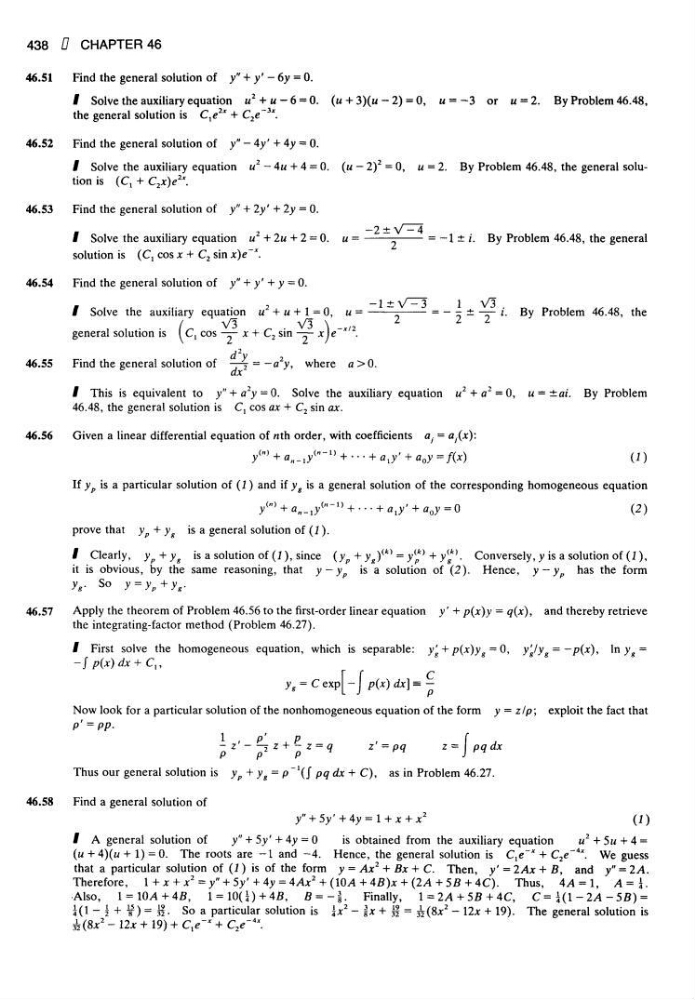
46.51
Find the general solution of y" + y' — 6y = 0.
Solve the auxiliary equation u
2 + u - 6 = 0. (M + 3)(M -2) = 0, u = -3 or « = 2. By Problem 46.48,
the general solution is C,e
2jr + C 2 e~
3 *.
46.52
Find the general solution of y" - 4y' + 4y = 0.
Solve the auxiliary equation u
2 — 4u + 4 = 0. (a — 2)
2 = 0, u = 2. By Problem 46.48, the general solution is (C l + C 2 x)e
2 ".
46.53
Find the general solution of y" + 2y' + 2y = 0.
Now look for a particular solution of the nonhomogeneous equation of the form y = zip; exploit the fact that
P' = PPThus our general solution is y p + y g = p '(J pqdx+ C), as in Problem 46.27.
46.58
Find a general solution of
y" + 5y' + 4y = 1 + x + x
2
(1)
A general solution of
y" + 5y' + 4y = 0
is obtained from the auxiliary equation
u
2 +5u + 4 =
(u + 4)(u + 1) = 0. The roots are -1 and -4. Hence, the general solution is C l e~
x + C 2 e~**. We guess
that a particular solution of (1) is of the form y = Ax
2 + Bx + C. Then, y' = 2Ax + B, and y" - 2A.
Therefore, 1 + x + x
2 =/' + 5y' + 4y = 4 Ax
2 + (WA + 4B)x + (2A + 5B + 4C). Thus, 4A = 1,
Also, 1 = 10X4- 4B,
So a particular solution is
The general solution is
Finally, 1 = 2 A + 5B + 4C,
First solve the homogeneous equation, which is separable:
- f p(x) dx+C,,
46.57
Apply the theorem of Problem 46.56 to the first-order linear equation y' + p(x)y = q(x), and thereby retrieve
the integrating-factor method (Problem 46.27).
Solve the auxiliary equation u
2 + 2u + 2 = 0.
By Problem 46.48, the general
solution is (C, cos x + C 2 sin x)e *.
46.54
Find the general solution of y" + y' + y = 0.
Solve the auxiliary equation u
2 + u + 1 = 0,
By Problem 46.48, the
general solution is
46.55
Find the general solution of
where a > 0.
This is equivalent to y" + a
2 y = Q. Solve the auxiliary equation «
2 +
46.56
Given a linear differential equation of nth order, with coefficients a, = a,(x):
/"' + a.-i/""" + ''' + «,/ + a 0 y =/(*)
(1)
If y p is a particular solution of (1) and if y g is a general solution of the corresponding homogeneous equation
y
( "
) + a n _ 1 y
( "-" + --- + a l y' + a a y=Q (
prove that y p + y g is a general solution of (1).
Clearly, yp + yg is a solution of (1), since (yp + yg)w = //' + y™. Conversely, y is a solution of (1),
it is obvious, by the same reasoning, that y - y p is a solution of (2). Hence, y — y p has the form
y,So
y = y P + y g -
(2)
CHAPTER 46
46.51
Find the general solution of y" + y' — 6y = 0.
Solve the auxiliary equation u
2 + u - 6 = 0. (M + 3)(M -2) = 0, u = -3 or « = 2. By Problem 46.48,
the general solution is C,e
2jr + C 2 e~
3 *.
46.52
Find the general solution of y" - 4y' + 4y = 0.
Solve the auxiliary equation u
2 — 4u + 4 = 0. (a — 2)
2 = 0, u = 2. By Problem 46.48, the general solution is (C l + C 2 x)e
2 ".
46.53
Find the general solution of y" + 2y' + 2y = 0.
Now look for a particular solution of the nonhomogeneous equation of the form y = zip; exploit the fact that
P' = PPThus our general solution is y p + y g = p '(J pqdx+ C), as in Problem 46.27.
46.58
Find a general solution of
y" + 5y' + 4y = 1 + x + x
2
(1)
A general solution of
y" + 5y' + 4y = 0
is obtained from the auxiliary equation
u
2 +5u + 4 =
(u + 4)(u + 1) = 0. The roots are -1 and -4. Hence, the general solution is C l e~
x + C 2 e~**. We guess
that a particular solution of (1) is of the form y = Ax
2 + Bx + C. Then, y' = 2Ax + B, and y" - 2A.
Therefore, 1 + x + x
2 =/' + 5y' + 4y = 4 Ax
2 + (WA + 4B)x + (2A + 5B + 4C). Thus, 4A = 1,
Also, 1 = 10X4- 4B,
So a particular solution is
The general solution is
Finally, 1 = 2 A + 5B + 4C,
First solve the homogeneous equation, which is separable:
- f p(x) dx+C,,
46.57
Apply the theorem of Problem 46.56 to the first-order linear equation y' + p(x)y = q(x), and thereby retrieve
the integrating-factor method (Problem 46.27).
Solve the auxiliary equation u
2 + 2u + 2 = 0.
By Problem 46.48, the general
solution is (C, cos x + C 2 sin x)e *.
46.54
Find the general solution of y" + y' + y = 0.
Solve the auxiliary equation u
2 + u + 1 = 0,
By Problem 46.48, the
general solution is
46.55
Find the general solution of
where a > 0.
This is equivalent to y" + a
2 y = Q. Solve the auxiliary equation «
2 +
46.56
Given a linear differential equation of nth order, with coefficients a, = a,(x):
/"' + a.-i/""" + ''' + «,/ + a 0 y =/(*)
(1)
If y p is a particular solution of (1) and if y g is a general solution of the corresponding homogeneous equation
y
( "
) + a n _ 1 y
( "-" + --- + a l y' + a a y=Q (
prove that y p + y g is a general solution of (1).
Clearly, yp + yg is a solution of (1), since (yp + yg)w = //' + y™. Conversely, y is a solution of (1),
it is obvious, by the same reasoning, that y - y p is a solution of (2). Hence, y — y p has the form
y,So
y = y P + y g -
(2)