

428
CHAPTER 45
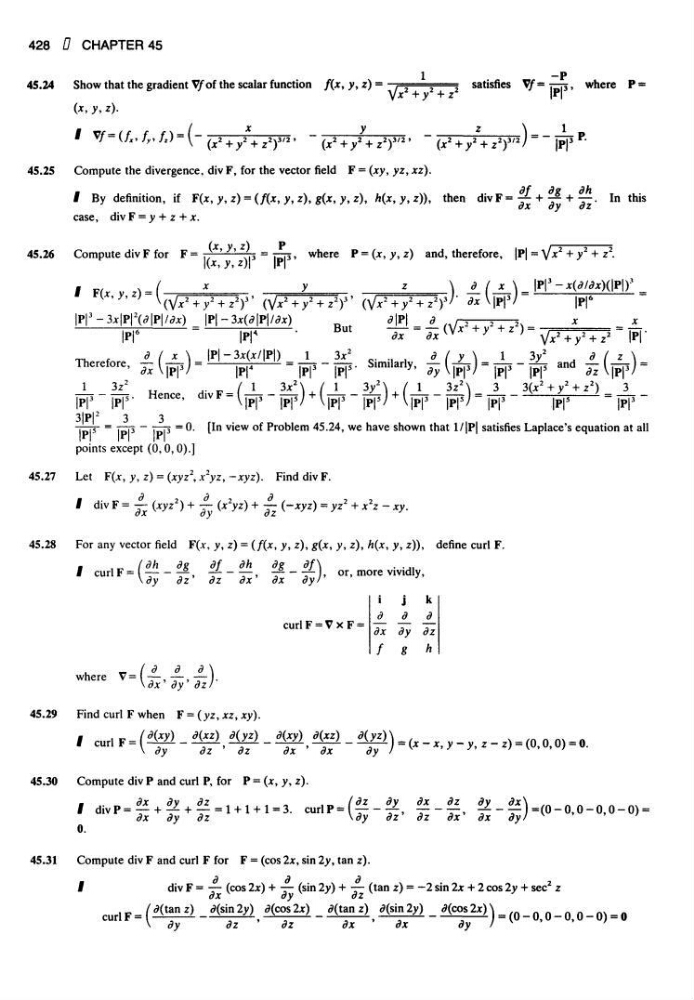
45.24 Show that the gradient V/of the scalar function
satisfies
where P =
(x, y, *).
45.25 Compute the divergence, div F, for the vector field F = (xy, yz, xz).
45.26 Compute div F for
where P = (x, y, z) and, therefore,
By definition, if f(x, y, z) = (f(x, y, z), g(x, y, z), h(x, y, z)), then div
In this
case, div F = y + z + x.
But
Similarly,
and
Therefore,
Hence, div
[In view of Problem 45.24, we have shown that 1/|P| satisfies Laplace's equation at all
points except (0,0,0).]
45.27
45.28
Let F(x, y, z) = (xyz
2 , x
2 yz, -xyz). Find div F.
div
For any vector field F(.v, y, z) = (/(*, y, z), g(x, y, z), h(x, y, z)), define curl F.
curl
or, more vividly,
curl
where
45.29 Find curl F when F = (yz, xz, xy).
curl
45.30 Compute div P and curl P, for P = (x, y, z).
div
curl
45.31
Compute div F and curl F for F = (cos 2x, sin 2y, tan z).
curl
div
CHAPTER 45
45.24 Show that the gradient V/of the scalar function
satisfies
where P =
(x, y, *).
45.25 Compute the divergence, div F, for the vector field F = (xy, yz, xz).
45.26 Compute div F for
where P = (x, y, z) and, therefore,
By definition, if f(x, y, z) = (f(x, y, z), g(x, y, z), h(x, y, z)), then div
In this
case, div F = y + z + x.
But
Similarly,
and
Therefore,
Hence, div
[In view of Problem 45.24, we have shown that 1/|P| satisfies Laplace's equation at all
points except (0,0,0).]
45.27
45.28
Let F(x, y, z) = (xyz
2 , x
2 yz, -xyz). Find div F.
div
For any vector field F(.v, y, z) = (/(*, y, z), g(x, y, z), h(x, y, z)), define curl F.
curl
or, more vividly,
curl
where
45.29 Find curl F when F = (yz, xz, xy).
curl
45.30 Compute div P and curl P, for P = (x, y, z).
div
curl
45.31
Compute div F and curl F for F = (cos 2x, sin 2y, tan z).
curl
div