

VECTOR FUNCTIONS IN SPACE
427
45.17
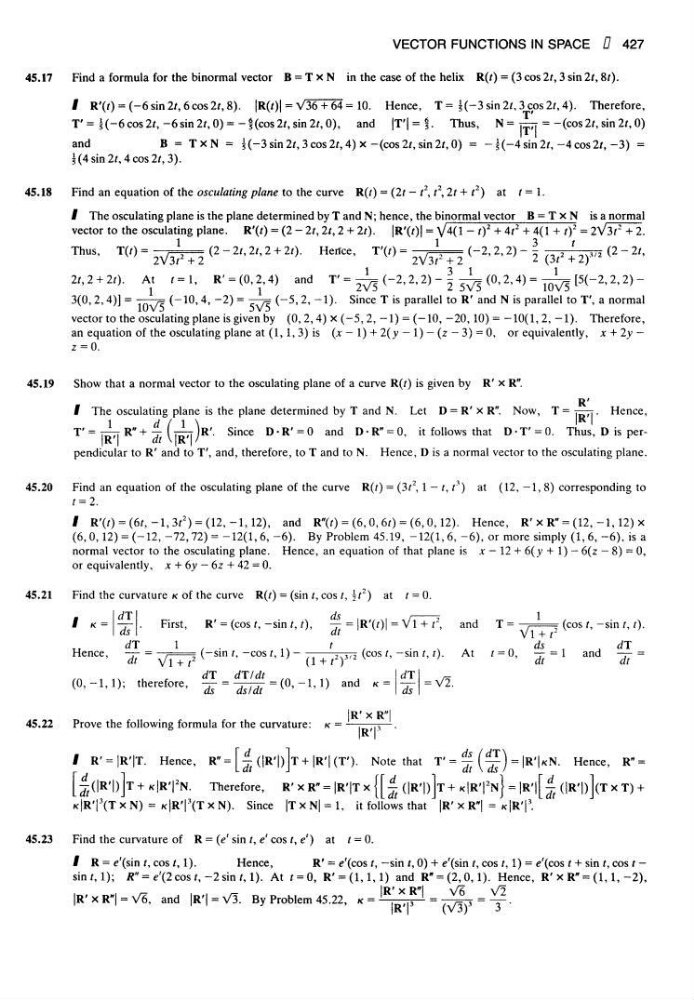
Find a formula for the binorma! vector B = TxN
in the case of the helix R(() = (3cos2f, 3sin2(, 8f).
45.18
R'(0 = (-6sin2/,6cos2f,8). |R(<)| = V36 + 64 = 10. Hence,
Therefore,
and
Thus,
and
B = TxN
Find an equation of the osculating plane to the curve R(/) = (2t - t
2 , t
2 ,2t + t
2 ) at <=1.
The osculating plane is the plane determined by T and N; hence, the binormal vector B = T x N is a normal
vector to the osculating plane. R'(0 = (2 - 2t, 2t, 2 + 2t).
|R'(r)| = V4(l - t)
2 + 4t
2 + 4(1 + t)
2 = 2\/3r + 2.
Thus,
Hertce,
and
At
Since T is parallel to R' and N is parallel to T', a normal
vector to the osculating plane is given by (0, 2,4) x (-5, 2, -1) = (-10, -20,10) = -10(1, 2, -1).
Therefore,
an equation of the osculating plane at (1,1, 3) is (x - 1) + 2(y — 1) - (z - 3) = 0, or equivalently, x + 2y —
z = 0.
45.19
45.20
Show that a normal vector to the osculating plane of a curve R(f) is given by R' x R".
45.23
45.22
Prove the following formula for the curvature:
Find the curvature of R = (e
1 sin /, e' cos t, e') at t = 0.
R = e'(sin r, cos t, 1).
Hence,
R' = e'(cos t, -sin f, 0) + e'(sin t, cos /, 1) = e'(cos t + sin t, cos t -
sint, 1); R"=e'(2cost, -2sin/,l). At t = 0, R'= (1,1,1) and R" = (2,0,1). Hence, R'x R" = (1,1,-2),
|R'xR"| = V6, and |R'| = V3. By Problem 45.22,
K|R'|
3 (T x N) = fo|RT(T x N). Since |T x N| = 1, it follows that |R' x R"| = K |RT.
Therefore,
Note that
Hence,
Hence,
45.21
Find the curvature K of the curve R(t) - (sin f, cos /,
at t = 0.
First, R' = (cos f, -sin t, t),
and
Hence,
and
and
therefore,
The osculating plane is the plane determined by T and N. Let D = R' x R". Now,
Hence,
Since D • R' = 0 and D • R" = 0, it follows that D • T' = 0. Thus, D is perpendicular to R' and to T', and, therefore, to T and to N. Hence, D is a normal vector to the osculating plane.
Find an equation of the osculating plane of the curve R(f) = (3>t
2 ,1 - t, t
3 ) at (12, —1, 8) corresponding to
f = 2.
R'(0 = (6f, -I,3f
2 ) = (12, -1,12), and R"(r) = (6,0,60 = (6,0,12). Hence, R' x R" = (12, -1,12) x
(6, 0,12) = (-12, -72,72) = -12(1, 6, -6). By Problem 45.19, -12(1, 6, -6), or more simply (1, 6, -6), is a
normal vector to the osculating plane. Hence, an equation of that plane is x — 12 + 6(y + 1) — 6(z — 8) = 0,
or equivalently, x + 6y — 6z + 42 = 0.
427
45.17
Find a formula for the binorma! vector B = TxN
in the case of the helix R(() = (3cos2f, 3sin2(, 8f).
45.18
R'(0 = (-6sin2/,6cos2f,8). |R(<)| = V36 + 64 = 10. Hence,
Therefore,
and
Thus,
and
B = TxN
Find an equation of the osculating plane to the curve R(/) = (2t - t
2 , t
2 ,2t + t
2 ) at <=1.
The osculating plane is the plane determined by T and N; hence, the binormal vector B = T x N is a normal
vector to the osculating plane. R'(0 = (2 - 2t, 2t, 2 + 2t).
|R'(r)| = V4(l - t)
2 + 4t
2 + 4(1 + t)
2 = 2\/3r + 2.
Thus,
Hertce,
and
At
Since T is parallel to R' and N is parallel to T', a normal
vector to the osculating plane is given by (0, 2,4) x (-5, 2, -1) = (-10, -20,10) = -10(1, 2, -1).
Therefore,
an equation of the osculating plane at (1,1, 3) is (x - 1) + 2(y — 1) - (z - 3) = 0, or equivalently, x + 2y —
z = 0.
45.19
45.20
Show that a normal vector to the osculating plane of a curve R(f) is given by R' x R".
45.23
45.22
Prove the following formula for the curvature:
Find the curvature of R = (e
1 sin /, e' cos t, e') at t = 0.
R = e'(sin r, cos t, 1).
Hence,
R' = e'(cos t, -sin f, 0) + e'(sin t, cos /, 1) = e'(cos t + sin t, cos t -
sint, 1); R"=e'(2cost, -2sin/,l). At t = 0, R'= (1,1,1) and R" = (2,0,1). Hence, R'x R" = (1,1,-2),
|R'xR"| = V6, and |R'| = V3. By Problem 45.22,
K|R'|
3 (T x N) = fo|RT(T x N). Since |T x N| = 1, it follows that |R' x R"| = K |RT.
Therefore,
Note that
Hence,
Hence,
45.21
Find the curvature K of the curve R(t) - (sin f, cos /,
at t = 0.
First, R' = (cos f, -sin t, t),
and
Hence,
and
and
therefore,
The osculating plane is the plane determined by T and N. Let D = R' x R". Now,
Hence,
Since D • R' = 0 and D • R" = 0, it follows that D • T' = 0. Thus, D is perpendicular to R' and to T', and, therefore, to T and to N. Hence, D is a normal vector to the osculating plane.
Find an equation of the osculating plane of the curve R(f) = (3>t
2 ,1 - t, t
3 ) at (12, —1, 8) corresponding to
f = 2.
R'(0 = (6f, -I,3f
2 ) = (12, -1,12), and R"(r) = (6,0,60 = (6,0,12). Hence, R' x R" = (12, -1,12) x
(6, 0,12) = (-12, -72,72) = -12(1, 6, -6). By Problem 45.19, -12(1, 6, -6), or more simply (1, 6, -6), is a
normal vector to the osculating plane. Hence, an equation of that plane is x — 12 + 6(y + 1) — 6(z — 8) = 0,
or equivalently, x + 6y — 6z + 42 = 0.