

426
CHAPTER 45
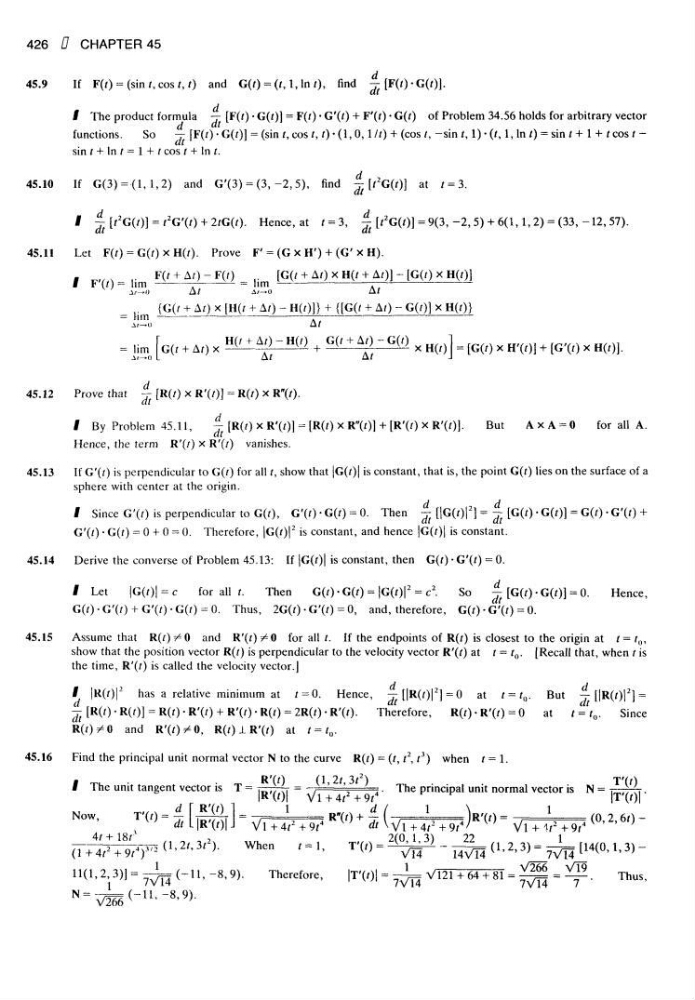
45.9
If F(t) = (sin /, cos t, t) and G(t) = (t, 1, In t), find
The product formula
of Problem 34.56 holds for arbitrary vector
functions.
So
[F(0-G(0] = F(0'G'(0 + F'(0-G(0
[F(r)-G(r)] = (sin t,cost, O'O.0,1/0 + (cos/, -sin t, !)•(*, 1, In /) = sin t + 1 + t cos t -
sin / + In t = 1 + / cos / + In t.
45.10
If G(3) =•(!,!, 2) and G'(3) = (3,-2,5), find
Hence, at t = 3,
[rG(f)] at / = 3.
45.11
45.12
45.13
Prove that
[R(/> X R'(/)] = R(/) X «•(/).
By Problem 45.11,
[R(0 x R'(01 - [R(f) x R"(t)l + [R'(f) x R'(f)l.
But
A x A = 0
for all A.
Hence, the term R'(/) x R'(/) vanishes.
If G'(0 is perpendicular to G(f) for all t, show that |G(f)| is constant, that is, the point G(t) lies on the surface of £
sphere with center at the origin.
Since G'(0 is perpendicular to G(r), G'(f) • G(t) = 0. Then
G'(0 ' G(f) = 0 + 0 = 0. Therefore, |G(r)|
2 is constant, and hence |G(f)| is constant.
45.14
45.15
Derive the converse of Problem 45.13: If |G(f)| is constant, then G(f) • G'(0 = 0.
The unit tangent vector is
The principal unit normal vector is
Now,
When
Therefore,
Thus,
45.16
Find the principal unit normal vector N to the curve R(f) = (t, t
2 , t
3 ) when f=l.
has a relative minimum at f = 0. Hence,
[R(0 • R(r)] = R(f) • R'(/) + R'(0' R(0 = 2R(0 • R'(0Therefore,
R(r)-R'(0=0 at t = t 0 . Since
R(0^0 and R'(r)^0, R(t) 1 R'(0 at t = t a .
Assume that R(f) ^ 0 and R'(f)-^0 for all t. If the endpoints of R(f) is closest to the origin at t = t 0 ,
show that the position vector R(t) is perpendicular to the velocity vector R'(0 at f = t 0 . [Recall that, when t is
the time, R'(') is called the velocity vector.)
Let
|G(/)| = c
for all t.
Then
G(t)-G(t) = |G(f)|
2 = c
2
So
G(0-G'(0 + G'(0'G(r) = 0. Thus, 2G(r)-G'(0 =0, and, therefore, G(f)-G'(f) = 0.
[G(0-G(0] = 0.
Hence,
[G(0-G(r)] = G(0-G'(0 +
[F(0-G(0].
[r
2 G(/)J = t
2 G'(t) + 2tG(t).
[t
2 G(t)] = 9(3, -2, 5) + 6(1,1,2) = (33, -12, 57).
Let F(0 = G(0 x H(/). Prove F'= (G X H') + (G
1 x H).
CHAPTER 45
45.9
If F(t) = (sin /, cos t, t) and G(t) = (t, 1, In t), find
The product formula
of Problem 34.56 holds for arbitrary vector
functions.
So
[F(0-G(0] = F(0'G'(0 + F'(0-G(0
[F(r)-G(r)] = (sin t,cost, O'O.0,1/0 + (cos/, -sin t, !)•(*, 1, In /) = sin t + 1 + t cos t -
sin / + In t = 1 + / cos / + In t.
45.10
If G(3) =•(!,!, 2) and G'(3) = (3,-2,5), find
Hence, at t = 3,
[rG(f)] at / = 3.
45.11
45.12
45.13
Prove that
[R(/> X R'(/)] = R(/) X «•(/).
By Problem 45.11,
[R(0 x R'(01 - [R(f) x R"(t)l + [R'(f) x R'(f)l.
But
A x A = 0
for all A.
Hence, the term R'(/) x R'(/) vanishes.
If G'(0 is perpendicular to G(f) for all t, show that |G(f)| is constant, that is, the point G(t) lies on the surface of £
sphere with center at the origin.
Since G'(0 is perpendicular to G(r), G'(f) • G(t) = 0. Then
G'(0 ' G(f) = 0 + 0 = 0. Therefore, |G(r)|
2 is constant, and hence |G(f)| is constant.
45.14
45.15
Derive the converse of Problem 45.13: If |G(f)| is constant, then G(f) • G'(0 = 0.
The unit tangent vector is
The principal unit normal vector is
Now,
When
Therefore,
Thus,
45.16
Find the principal unit normal vector N to the curve R(f) = (t, t
2 , t
3 ) when f=l.
has a relative minimum at f = 0. Hence,
[R(0 • R(r)] = R(f) • R'(/) + R'(0' R(0 = 2R(0 • R'(0Therefore,
R(r)-R'(0=0 at t = t 0 . Since
R(0^0 and R'(r)^0, R(t) 1 R'(0 at t = t a .
Assume that R(f) ^ 0 and R'(f)-^0 for all t. If the endpoints of R(f) is closest to the origin at t = t 0 ,
show that the position vector R(t) is perpendicular to the velocity vector R'(0 at f = t 0 . [Recall that, when t is
the time, R'(') is called the velocity vector.)
Let
|G(/)| = c
for all t.
Then
G(t)-G(t) = |G(f)|
2 = c
2
So
G(0-G'(0 + G'(0'G(r) = 0. Thus, 2G(r)-G'(0 =0, and, therefore, G(f)-G'(f) = 0.
[G(0-G(0] = 0.
Hence,
[G(0-G(r)] = G(0-G'(0 +
[F(0-G(0].
[r
2 G(/)J = t
2 G'(t) + 2tG(t).
[t
2 G(t)] = 9(3, -2, 5) + 6(1,1,2) = (33, -12, 57).
Let F(0 = G(0 x H(/). Prove F'= (G X H') + (G
1 x H).