

425
CHAPTER 45
Vector Functions in Space.
Divergence and Curl. Line Integrals
45.1
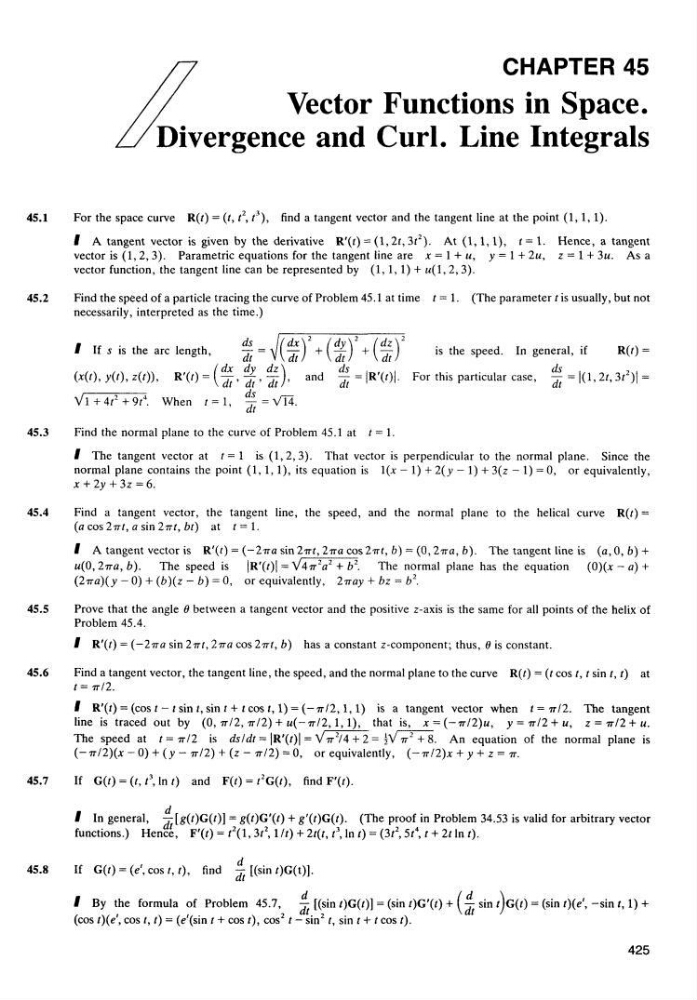
For the space curve R(t) = (t, t, t ), find a tangent vector and the tangent line at the point (1,1, 1).
A tangent vector is given by the derivative R'(t) = (l,2t,3t ). At (1,1,1), <=1. Hence, a tangent
vector is (1, 2, 3). Parametric equations for the tangent line are x = 1 + w, y = 1 + 2a, z = 1 + 3w. As a
vector function, the tangent line can be represented by (1,1,1) + u(l, 2, 3).
45.2
Find the speed of a particle tracing the curve of Problem 45.1 at time t = 1. (The parameter/is usually, but not
necessarily, interpreted as the time.)
If 5 is the arc length,
is the speed. In general, if
For this particular case,
and
When
45.3
Find the normal plane to the curve of Problem 45.1 at t = \.
The tangent vector at t = l is (1,2,3). That vector is perpendicular to the normal plane. Since the
normal plane contains the point (1,1,1), its equation is \(x - 1) + 2(y - 1) + 3(z - 1) = 0, or equivalently,
x + 2y + 3z = 6.
45.4
Find a tangent vector, the tangent line, the speed, and the normal plane to the helical curve R(t) =
(a cos 2irt, a sin 2irt, bt) at f = l.
A tangent vector is R'(Q = (-2ira sin 2irt, 2-rra cos 2irt, b) = (0, 2-rra, b). The tangent line is (a,0, b) +
u(0, 2TTd, b). The speed is
R'(0l = V4?r V + b
2 . The normal plane has the equation (0)(;e - a) +
(2trd)(y - 0) + (b)(z - b) = 0, or equivalently, 2-rray + bz = b
2 .
By the formula of Problem 45.7,
(cos t)(e, cos t, t) = (e'(sin t + cos t), cos
2 1 - sin
2 1, sin r + t cos t).
If G(t) = (e',cost,t), find
45.8
45.7
In general,
(The proof in Problem 34.53 is valid for arbitrary vector
functions.) Hence, F'(0 = r(l, 3f
2 ,1 It) + 2t(t, t\ In t) = (3/
2 , 5f
4 , t + 2t In t).
If G(0 = (M
3 ,lnf) and ¥(t) = t
2 G(t), find F'(045.5
45.6
Prove that the angle 6 between a tangent vector and the positive z-axis is the same for all points of the helix of
Problem 45.4.
R'(0
= (-2TTO sin 2Trt, 27ra cos 2irt, b) has a constant z-component; thus, 0 is constant.
Find a tangent vector, the tangent line, the speed, and the normal plane to the curve R(t) - (t cos t, t sin t, t) at
t=TT/2.
R'(t) = (cos t- tsin t, sin t+ teas t, !) = (- it 12,1,1) is a tangent vector when t=TT/2, The tangent
line is traced out by (0, it II, it 12) + u(-ir/2,1, 1), that is, x = (-ir/2)u, y = -rrl2+u, z = it 12 + u.
The speed at t = ir/2 is
(-7T/2)(jc-0) + (y-7r/2) + (z-7r/2)=0, or equivalently, (-ir/2)x + y + z = ir.
An equation of the normal plane is
CHAPTER 45
Vector Functions in Space.
Divergence and Curl. Line Integrals
45.1
For the space curve R(t) = (t, t, t ), find a tangent vector and the tangent line at the point (1,1, 1).
A tangent vector is given by the derivative R'(t) = (l,2t,3t ). At (1,1,1), <=1. Hence, a tangent
vector is (1, 2, 3). Parametric equations for the tangent line are x = 1 + w, y = 1 + 2a, z = 1 + 3w. As a
vector function, the tangent line can be represented by (1,1,1) + u(l, 2, 3).
45.2
Find the speed of a particle tracing the curve of Problem 45.1 at time t = 1. (The parameter/is usually, but not
necessarily, interpreted as the time.)
If 5 is the arc length,
is the speed. In general, if
For this particular case,
and
When
45.3
Find the normal plane to the curve of Problem 45.1 at t = \.
The tangent vector at t = l is (1,2,3). That vector is perpendicular to the normal plane. Since the
normal plane contains the point (1,1,1), its equation is \(x - 1) + 2(y - 1) + 3(z - 1) = 0, or equivalently,
x + 2y + 3z = 6.
45.4
Find a tangent vector, the tangent line, the speed, and the normal plane to the helical curve R(t) =
(a cos 2irt, a sin 2irt, bt) at f = l.
A tangent vector is R'(Q = (-2ira sin 2irt, 2-rra cos 2irt, b) = (0, 2-rra, b). The tangent line is (a,0, b) +
u(0, 2TTd, b). The speed is
R'(0l = V4?r V + b
2 . The normal plane has the equation (0)(;e - a) +
(2trd)(y - 0) + (b)(z - b) = 0, or equivalently, 2-rray + bz = b
2 .
By the formula of Problem 45.7,
(cos t)(e, cos t, t) = (e'(sin t + cos t), cos
2 1 - sin
2 1, sin r + t cos t).
If G(t) = (e',cost,t), find
45.8
45.7
In general,
(The proof in Problem 34.53 is valid for arbitrary vector
functions.) Hence, F'(0 = r(l, 3f
2 ,1 It) + 2t(t, t\ In t) = (3/
2 , 5f
4 , t + 2t In t).
If G(0 = (M
3 ,lnf) and ¥(t) = t
2 G(t), find F'(045.5
45.6
Prove that the angle 6 between a tangent vector and the positive z-axis is the same for all points of the helix of
Problem 45.4.
R'(0
= (-2TTO sin 2Trt, 27ra cos 2irt, b) has a constant z-component; thus, 0 is constant.
Find a tangent vector, the tangent line, the speed, and the normal plane to the curve R(t) - (t cos t, t sin t, t) at
t=TT/2.
R'(t) = (cos t- tsin t, sin t+ teas t, !) = (- it 12,1,1) is a tangent vector when t=TT/2, The tangent
line is traced out by (0, it II, it 12) + u(-ir/2,1, 1), that is, x = (-ir/2)u, y = -rrl2+u, z = it 12 + u.
The speed at t = ir/2 is
(-7T/2)(jc-0) + (y-7r/2) + (z-7r/2)=0, or equivalently, (-ir/2)x + y + z = ir.
An equation of the normal plane is