

VECTOR FUNCTIONS IN SPACE
429
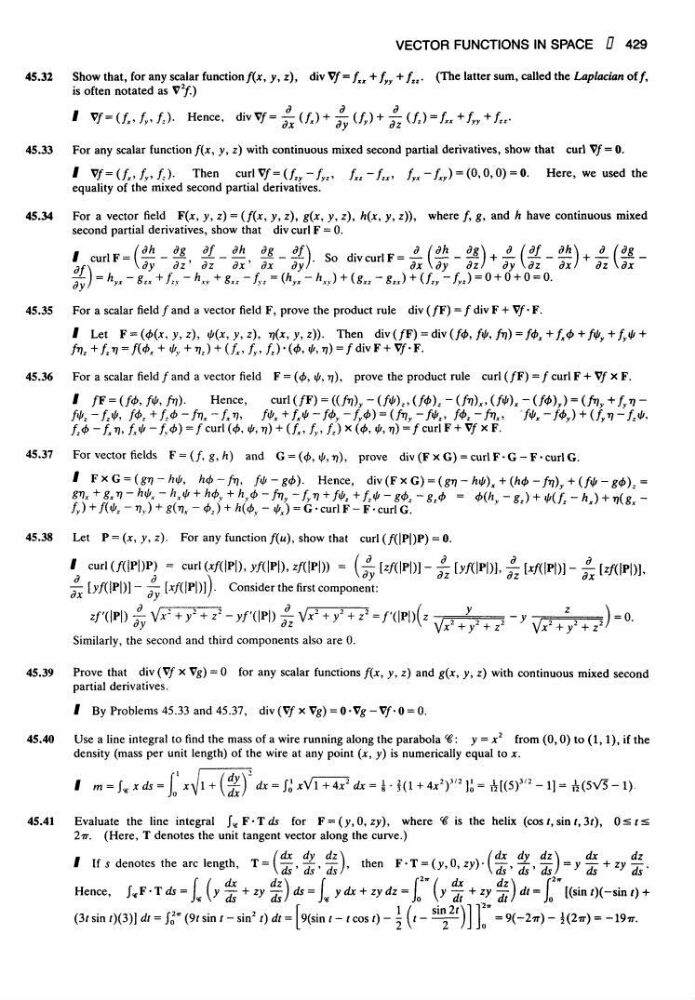
45.32 Show that, for any scalar function f(x, y, z), div yf
= f xx +f yy + /„ • (The latter sum, called the Laplacian off,
is often notated as V
2
/.)
V=(/,./,,/*)• Hence, div
45.33 For any scalar function f(x, y, z) with continuous mixed second partial derivatives, show that curl V/= 0.
V= (/,./,./*)• Then curH5f= (/„-/„, /„-/„, /,„ -/„) = (0,0,0) =0. Here, we used the
equality of the mixed second partial derivatives.
45.34
For a vector field V(x, y, z) = (f(x, y, z), g(x, y, z), h(x, y, z)), where /, g, and h have continuous mixed
second partial derivatives, show that div curl F = 0.
curl
So div curl
45.35 For a scalar field / and a vector field F, prove the product rule div (/F) = / div F + Vf' F.
45.36 For a scalar field / and a vector field F = (, if>, 77), prove the product rule curl (/F) = / curl F + Vf x F.
/F = (ft, ft, h).
Hence,
curl (/F) = ((fy) y - (ft),, (ft), - (fi,) x , (ft), - (ft) y ) = (fy y + f y1 , -
ft, -/>, /& +f,4> ~h, "A*/, ft* + /> -fa -/,*) = (fily -ft,, ft, ~fa, ft* -ft y } + (/,*»-/>,
L ~f,-n, /> -/><*>) =/curl (*, V, T?) + (/„ f y , f,) x (
/r» z +/ 2 T/=/(^ + ^ v + ^) + (/,,/ v ,/ 2 )-(^^r,)=/divF + V/-F.
45.37 For vector fields F = (f,g,h) and G = (, ty, ij), prove div (F x G) = curl F-G - F-curlG.
FxG = (gT?-/?i/f, h(f>-fr), ft-g). Hence, div(Fx G) = (grj - hifi) x + (htf> -fy) y + (ft -g). =
CT, + g,v ~ h*, ~ h,* + h4> y + h y-fy y -f^+ft, +/ 2 ^ - g, - g,4> = (h y - g ,) + ftf, - h,) + T,(g" -
/,.) +/(«/-. - i7 y ) + 8(V X - *,) + h(4>, - -AJ = G-curlF- F-curlG.
45.38 Let P = (x, y, z). For any function /(«), show that curl (/(|P|)P) = 0.
45.41
Evaluate the line integral ^F-Tds for F = (y,0, zv), where <# is the helix (cos /, sin t, 3t), Os r<
2ir. (Here, T denotes the unit tangent vector along the curve.)
If 5 denotes the arc length,
then
Hence,
45.39
45.40
Use a line integral to find the mass of a wire running along the parabola
( €: y = x
2
from (0,0) to (1,1), if the
density (mass per unit length) of the wire at any point (x, y) is numerically equal to x.
By Problems 45.33 and 45.37, div(V/ x Vg) = 0-Vg-V/-0 = 0.
Prove that div (Vf x Vg) = 0 for any scalar functions f(x, y, z) and g(x, y, z) with continuous mixed second
partial derivatives.
Similarly, the second and third components also are 0.
Consider the first component:
429
45.32 Show that, for any scalar function f(x, y, z), div yf
= f xx +f yy + /„ • (The latter sum, called the Laplacian off,
is often notated as V
2
/.)
V=(/,./,,/*)• Hence, div
45.33 For any scalar function f(x, y, z) with continuous mixed second partial derivatives, show that curl V/= 0.
V= (/,./,./*)• Then curH5f= (/„-/„, /„-/„, /,„ -/„) = (0,0,0) =0. Here, we used the
equality of the mixed second partial derivatives.
45.34
For a vector field V(x, y, z) = (f(x, y, z), g(x, y, z), h(x, y, z)), where /, g, and h have continuous mixed
second partial derivatives, show that div curl F = 0.
curl
So div curl
45.35 For a scalar field / and a vector field F, prove the product rule div (/F) = / div F + Vf' F.
45.36 For a scalar field / and a vector field F = (
/F = (ft, ft, h).
Hence,
curl (/F) = ((fy) y - (ft),, (ft), - (fi,) x , (ft), - (ft) y ) = (fy y + f y1 , -
ft, -/>, /& +f,4> ~h, "A*/, ft* + /> -fa -/,*) = (fily -ft,, ft, ~fa, ft* -ft y } + (/,*»-/>,
L
/r» z +/ 2 T/=/(^ + ^ v + ^) + (/,,/ v ,/ 2 )-(^^r,)=/divF + V/-F.
45.37 For vector fields F = (f,g,h) and G = (, ty, ij), prove div (F x G) = curl F-G - F-curlG.
FxG = (gT?-/?i/f, h(f>-fr), ft-g
CT, + g,v ~ h*, ~ h,* + h4> y + h y
/,.) +/(«/-. - i7 y ) + 8(V X - *,) + h(4>, - -AJ = G-curlF- F-curlG.
45.38 Let P = (x, y, z). For any function /(«), show that curl (/(|P|)P) = 0.
45.41
Evaluate the line integral ^F-Tds for F = (y,0, zv), where <# is the helix (cos /, sin t, 3t), Os r<
2ir. (Here, T denotes the unit tangent vector along the curve.)
If 5 denotes the arc length,
then
Hence,
45.39
45.40
Use a line integral to find the mass of a wire running along the parabola
( €: y = x
2
from (0,0) to (1,1), if the
density (mass per unit length) of the wire at any point (x, y) is numerically equal to x.
By Problems 45.33 and 45.37, div(V/ x Vg) = 0-Vg-V/-0 = 0.
Prove that div (Vf x Vg) = 0 for any scalar functions f(x, y, z) and g(x, y, z) with continuous mixed second
partial derivatives.
Similarly, the second and third components also are 0.
Consider the first component: