

Fig. 43-4
DIRECTIONAL DERIVATIVES AND THE GRADIENT
401
43.56
State a theorem that justifies the method of Lagrange multipliers.
g(x 0 , y 0 ) = 0 and / has an extreme value at (*„, y 0 ) relative to all nearby points that satisfy the "constraint"
g(x,y) = 0, and if Vg(* 0 , y 0 )^Q, then V/(x 0 , y 0 ) = A Vg(x 0 , y 0 ) for some constant A (called a Lagrange
multiplier). Thus, the points at which extrema occur will be found among the common solutions of g(x, y) = 0
and V/=AVg [or, equivalently, V(/-Ag) = 0]. Similar results hold for more than two variables.
Moreover, for a function f(x, y, z) and two constraints g(x, y, z) = 0 and h(x, y, z) = 0, one solves
Vf = A Vg + /A Vh together with the constraint equations.
43.57 With reference to Problem 43.56, interpret the condition V/(x 0 , y 0 ) = A Vg(* 0 , y 0 ) in terms of the directional
derivative.
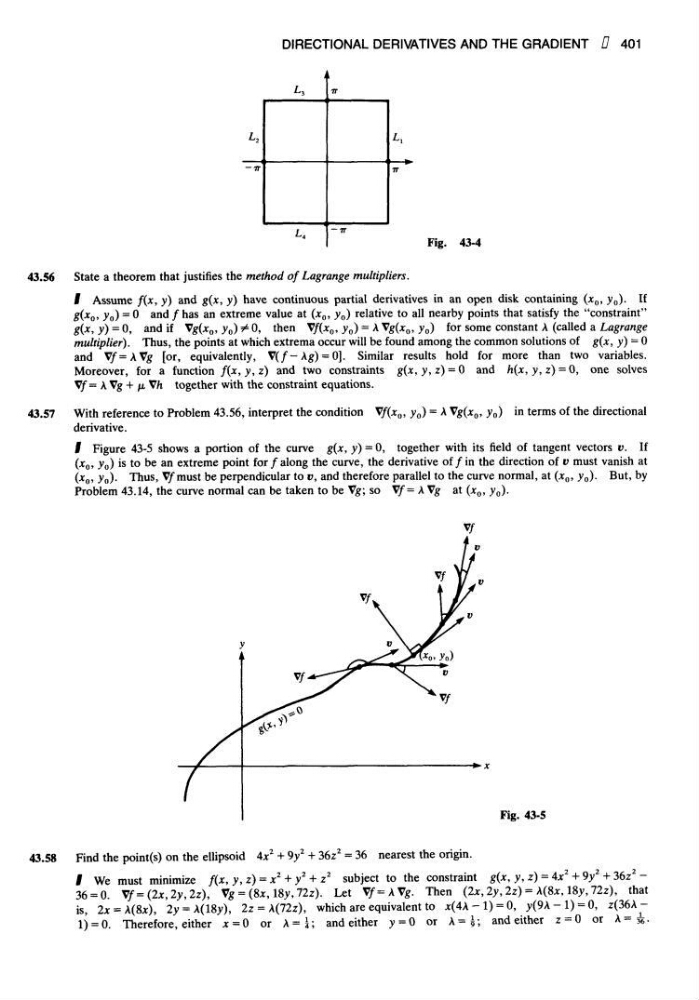
(x 0 , y 0 ) is to be an extreme point for/along the curve, the derivative of/in the direction of v must vanish at
(jc 0 , y 0 ). Thus, V/must be perpendicular to v, and therefore parallel to the curve normal, at (x 0 , y 0 ). But, by
Problem 43.14, the curve normal can be taken to be Vg; so V/= A Vg at (x 0 , y 0 ).
Fig. 43-5
43.58
Find the point(s) on the ellipsoid 4*
2 + 9y
2 + 36z
2 = 36 nearest the origin.
36 = 0. Vf=(2x,2y,2z),
Vg = (8x, ISy,72z). Let V/=AVg. Then (2x,2y,2z) = \(8x, 18y,72z), that
is, 2* = A(8*), 2y = A(18y), 2z = A(72z), which are equivalent to ^:(4A-1) = 0, y(9A-l) = 0, z(36An = 0. Therefore, either x=0 or A=i; and either y = 0 or A=^; and either z = 0 or A=35We must minimize f(x, y, z) = x2 + y2 + z2 subject to the constraint g(x, y, z) = 4x2 + 9y2 + 36z2 -
Figure 43-5 shows a portion of the curve g(x, y) = 0, together with its field of tangent vectors v. If
Assume f(x, y) and g(x, y) have continuous partial derivatives in an open disk containing (x0, y0). If
DIRECTIONAL DERIVATIVES AND THE GRADIENT
401
43.56
State a theorem that justifies the method of Lagrange multipliers.
g(x 0 , y 0 ) = 0 and / has an extreme value at (*„, y 0 ) relative to all nearby points that satisfy the "constraint"
g(x,y) = 0, and if Vg(* 0 , y 0 )^Q, then V/(x 0 , y 0 ) = A Vg(x 0 , y 0 ) for some constant A (called a Lagrange
multiplier). Thus, the points at which extrema occur will be found among the common solutions of g(x, y) = 0
and V/=AVg [or, equivalently, V(/-Ag) = 0]. Similar results hold for more than two variables.
Moreover, for a function f(x, y, z) and two constraints g(x, y, z) = 0 and h(x, y, z) = 0, one solves
Vf = A Vg + /A Vh together with the constraint equations.
43.57 With reference to Problem 43.56, interpret the condition V/(x 0 , y 0 ) = A Vg(* 0 , y 0 ) in terms of the directional
derivative.
(x 0 , y 0 ) is to be an extreme point for/along the curve, the derivative of/in the direction of v must vanish at
(jc 0 , y 0 ). Thus, V/must be perpendicular to v, and therefore parallel to the curve normal, at (x 0 , y 0 ). But, by
Problem 43.14, the curve normal can be taken to be Vg; so V/= A Vg at (x 0 , y 0 ).
Fig. 43-5
43.58
Find the point(s) on the ellipsoid 4*
2 + 9y
2 + 36z
2 = 36 nearest the origin.
36 = 0. Vf=(2x,2y,2z),
Vg = (8x, ISy,72z). Let V/=AVg. Then (2x,2y,2z) = \(8x, 18y,72z), that
is, 2* = A(8*), 2y = A(18y), 2z = A(72z), which are equivalent to ^:(4A-1) = 0, y(9A-l) = 0, z(36An = 0. Therefore, either x=0 or A=i; and either y = 0 or A=^; and either z = 0 or A=35We must minimize f(x, y, z) = x2 + y2 + z2 subject to the constraint g(x, y, z) = 4x2 + 9y2 + 36z2 -
Figure 43-5 shows a portion of the curve g(x, y) = 0, together with its field of tangent vectors v. If
Assume f(x, y) and g(x, y) have continuous partial derivatives in an open disk containing (x0, y0). If