

400
CHAPTER 43
43.53
43.54
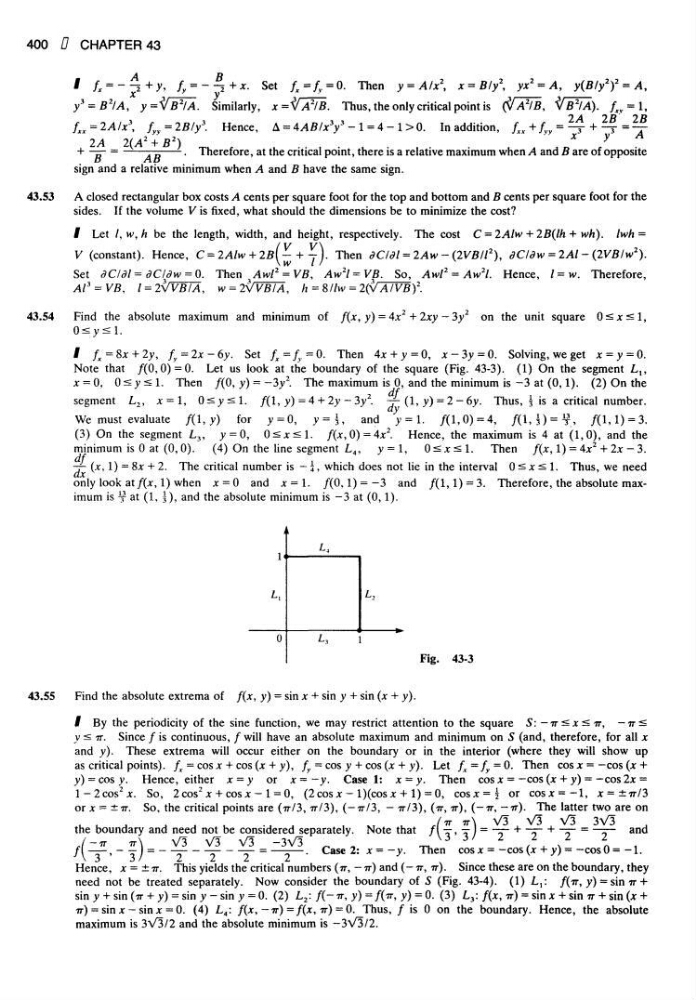
Fig. 43-3
43.55
y
3 = B
2 /A, y =VB
2 /A. Similarly, x =^A
2 IB. Thus, the only critical point is (V/4
2 /B, VB
2 /A). /„ = 1,
f xx = 2Alx\ f=2B/y\
Hence, A = 4AB/x
3 y
3 - 1 = 4 - 1 >0. In addition,
Set fx=f,=0. Then y = A/x2, x = B/y2, yx2 = A, y(B/y2)2 = A,
Therefore, at the critical point, there is a relative maximum when A and B are of opposite
sign and a relative minimum when A and B have the same sign.
A closed rectangular box costs A cents per square foot for the top and bottom and B cents per square foot for the
sides. If the volume V is fixed, what should the dimensions be to minimize the cost?
V (constant). Hence,
Then 3C/3l = 2Aw - (2VB/1
2 ), dCldw = 2Al- (2VBIw
2 ).
Set dCldl=dCldw = Q. Then Awl2 = VB, Aw2l = VB So, Awl2 = Aw2l. Hence, l=w. Therefore,
A1
3 = VB, l = 2\/VB7A, w = 2\fVBIA, h = 8/lw = 2(\M/FB)
2 .
Find the absolute maximum and minimum of f(x, y) = 4x
2 + 2xy — 3y
2 on the unit square Os x si,
0
v < TT. Since / is continuous, / will have an absolute maximum and minimum on S (and, therefore, for all x
and y). These extrema will occur either on the boundary or in the interior (where they will show up
as critical points). f x = cos x + cos (x + y), f f = cos y + cos (x + y). Let f x = f y = 0. Then cos x = —cos (x +
y) = cosy. Hence, either x = y or x = -y. Case 1: x = y. Then cos x = — cos (x + y) = — cos 2x =
l-2cos
2 *. So, 2 cos
2 x + cos* - 1 = 0, (2 cos x - l)(cos x + 1) = 0, cos*=j or cos* = -l, x=±7r/3
or x - ±ir. So, the critical points are (ir/3, Tr/3), (-ir/3, - ir/3), (TT, TT), (-TT, -IT). The latter two are on
the boundary and need not be considered separately. Note that
and
Case2:x=-y. Then cosx = -cos(* + v) = -cosO= -1.
Hence, X-±TT. This yields the critical numbers (TT, - TT) and (- TT, IT). Since these are on the boundary, they
need not be treated separately. Now consider the boundary of S (Fig. 43-4). (1) L,: f(ir, y) = sin TT +
sin y + sin (TT + y) = sin y - sin y = 0. (2) L 2 : /(- TT, y) = /(TT, y) = 0. (3) L 3 : f(x, IT) = sin x + sin TT + sin (x +
TT) = sin x - sin x = 0. (4) L t : f(x, -TT) =f(x, IT) = 0. Thus, / is 0 on the boundary. Hence, the absolute
maximum is 3V3/2 and the absolute minimum is -3V3/2.
x =8x + 2y, f y =2x-6y. Set £ =/ v =0. Then 4x + y=0, x-3y = 0. Solving, we get x = y = Q.
Note that /(0,0) = 0. Let us look at the boundary of the square (Fig. 43-3). (1) On the segment L,,
x = 0, 0
2 . The maximum is 0, and the minimum is-3 at (0,1). (2) On the
segment L 2 , x = 1, 0
.
We must evaluate /(I, y) for y=0,
(3) On the segment L 3 , y = 0, 0<:c
2
. Hence, the maximum is 4 at (1,0), and the
minimum is 0 at (0,0). (4) On the line segment L,, y = l, 0
2 + 2x -3.
(l,3>) = 2-6y. Thus, is a critical number.
(x, 1) = 8x + 2. The critical number is
which does not lie in the interval O^xs 1. Thus, we need
only look at f(x, 1) when x = 0 and x = l. /(0,1) = -3 and /(1,1) = 3. Therefore, the absolute maximum is T at (1> I), and the absolute minimum is -3 at (0,1).
and y = l. /(1,0) = 4,
/(1,D = 3.
By the periodicity of the sine function, we may restrict attention to the square S: — TT-SX-STT, —ITS
Let l,w,h be the length, width, and height, respectively. The cost C = 2Alw + 2B(lh + wh). Iwh =
CHAPTER 43
43.53
43.54
Fig. 43-3
43.55
y
3 = B
2 /A, y =VB
2 /A. Similarly, x =^A
2 IB. Thus, the only critical point is (V/4
2 /B, VB
2 /A). /„ = 1,
f xx = 2Alx\ f=2B/y\
Hence, A = 4AB/x
3 y
3 - 1 = 4 - 1 >0. In addition,
Set fx=f,=0. Then y = A/x2, x = B/y2, yx2 = A, y(B/y2)2 = A,
Therefore, at the critical point, there is a relative maximum when A and B are of opposite
sign and a relative minimum when A and B have the same sign.
A closed rectangular box costs A cents per square foot for the top and bottom and B cents per square foot for the
sides. If the volume V is fixed, what should the dimensions be to minimize the cost?
V (constant). Hence,
Then 3C/3l = 2Aw - (2VB/1
2 ), dCldw = 2Al- (2VBIw
2 ).
Set dCldl=dCldw = Q. Then Awl2 = VB, Aw2l = VB So, Awl2 = Aw2l. Hence, l=w. Therefore,
A1
3 = VB, l = 2\/VB7A, w = 2\fVBIA, h = 8/lw = 2(\M/FB)
2 .
Find the absolute maximum and minimum of f(x, y) = 4x
2 + 2xy — 3y
2 on the unit square Os x si,
0
v < TT. Since / is continuous, / will have an absolute maximum and minimum on S (and, therefore, for all x
and y). These extrema will occur either on the boundary or in the interior (where they will show up
as critical points). f x = cos x + cos (x + y), f f = cos y + cos (x + y). Let f x = f y = 0. Then cos x = —cos (x +
y) = cosy. Hence, either x = y or x = -y. Case 1: x = y. Then cos x = — cos (x + y) = — cos 2x =
l-2cos
2 *. So, 2 cos
2 x + cos* - 1 = 0, (2 cos x - l)(cos x + 1) = 0, cos*=j or cos* = -l, x=±7r/3
or x - ±ir. So, the critical points are (ir/3, Tr/3), (-ir/3, - ir/3), (TT, TT), (-TT, -IT). The latter two are on
the boundary and need not be considered separately. Note that
and
Case2:x=-y. Then cosx = -cos(* + v) = -cosO= -1.
Hence, X-±TT. This yields the critical numbers (TT, - TT) and (- TT, IT). Since these are on the boundary, they
need not be treated separately. Now consider the boundary of S (Fig. 43-4). (1) L,: f(ir, y) = sin TT +
sin y + sin (TT + y) = sin y - sin y = 0. (2) L 2 : /(- TT, y) = /(TT, y) = 0. (3) L 3 : f(x, IT) = sin x + sin TT + sin (x +
TT) = sin x - sin x = 0. (4) L t : f(x, -TT) =f(x, IT) = 0. Thus, / is 0 on the boundary. Hence, the absolute
maximum is 3V3/2 and the absolute minimum is -3V3/2.
x =8x + 2y, f y =2x-6y. Set £ =/ v =0. Then 4x + y=0, x-3y = 0. Solving, we get x = y = Q.
Note that /(0,0) = 0. Let us look at the boundary of the square (Fig. 43-3). (1) On the segment L,,
x = 0, 0
segment L 2 , x = 1, 0
.
We must evaluate /(I, y) for y=0,
(3) On the segment L 3 , y = 0, 0<:c
. Hence, the maximum is 4 at (1,0), and the
minimum is 0 at (0,0). (4) On the line segment L,, y = l, 0
(l,3>) = 2-6y. Thus, is a critical number.
(x, 1) = 8x + 2. The critical number is
which does not lie in the interval O^xs 1. Thus, we need
only look at f(x, 1) when x = 0 and x = l. /(0,1) = -3 and /(1,1) = 3. Therefore, the absolute maximum is T at (1> I), and the absolute minimum is -3 at (0,1).
and y = l. /(1,0) = 4,
/(1,D = 3.
By the periodicity of the sine function, we may restrict attention to the square S: — TT-SX-STT, —ITS
Let l,w,h be the length, width, and height, respectively. The cost C = 2Alw + 2B(lh + wh). Iwh =