

402
CHAPTER 43
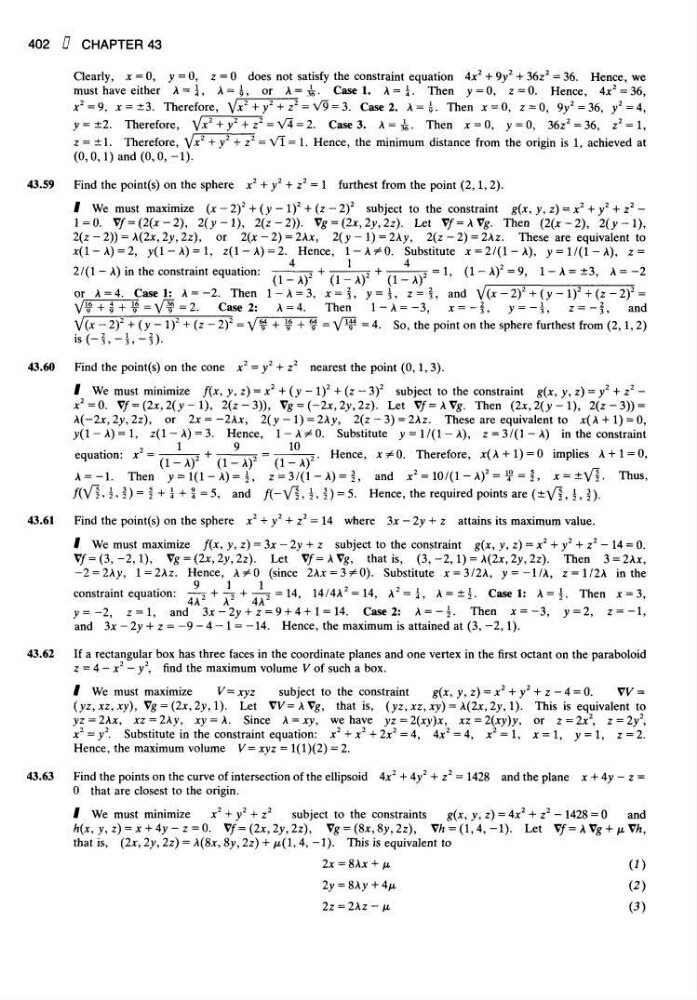
43.59
Find the point(s) on the sphere x
2 + y
2 + z
2 = 1 furthest from the point (2,1,2).
1=0. V/=(2(*-2), 2(y-l), 2('z-2)). Vg = (2*, 2y,2z). Let V/=AVg. Then (2(jc-2), 2(y-l),
2(z-2)) = \(2x,2y,2z), or 2(x - 2) = 2\x, 2(y-l) = 2\y, 2(z-2) = 2\z. These are equivalent to
x(l-A) = 2, y(l-\) = l, z(l-A) = 2. Hence, 1-A^O. Substitute * = 2/(l-A), y = !/(!- A), z =
2/(I - A) in the constraint equation:
(1-A)
2 = 9, 1-A=±3, A =-2
43.60
Find the point(s) on the cone x
2 = y
2 + z
2
nearest the point (0,1,3).
*
2 = 0. Vf=(2x,2(y-l),
2(z-3)), Vg = (-2x,2y,2z). Let V/=AVg. Then (2*,2(y-l), 2(z - 3)) =
A(-2*, 2y, 2z), or 2x = -2\x,
2(y-l) = 2Ay, 2(z - 3) = 2Az. These are equivalent to jt(A + l) = 0,
y(l-A) = l, z(l-A) = 3. Hence, 1-A^O. Substitute y = 11(1- A), z = 3/(l-A) in the constraint
Hence, x^Q. Therefore, x(A + l) = 0 implies A + 1 = 0,
equation:
A = -l.
Then
and
Hence, the required points are
Thus,
and
or A = 4. Case 1: A = -2. Then 1 - A = 3,
and
(x - 2)
2 + (y - I)
2 + (z - 2)
2 =
and
Case 2: A = 4. Then
1 - A = -3,
So, the point on the sphere furthest from (2,1,2)
is
43.61
Find the point(s) on the sphere x
2 + y
2 + z
2 = 14 where 3x - 2y + z attains its maximum value.
V/=(3, -2,1), Vg = (2;t,2y,2z). Let V/=AVg, that is, (3, -2,1) = A(2x,2y,2z). Then 3 = 2Ax,
-2 = 2Ay, l = 2Az. Hence, A^O (since 2Ax = 3^0). Substitute * = 3/2A, >> = -l/A, z = l/2A in the
constraint equation:
14/4A
2 = 14,
Case 1:
Then x = 3,
y=-2, z = l, and 3x -2y + z = 9 + 4+ 1 = 14. Case 2: A = -|. Then x = -3, y = 2, z = -l,
and 3x -2y + z = — 9-4— 1 = —14. Hence, the maximum is attained at (3, —2,1).
43.62
If a rectangular box has three faces in the coordinate planes and one vertex in the first octant on the paraboloid
z = 4 - x
2 - y
2 , find the maximum volume V of such a box.
(yz,xz,xy), Vg = (2x,2y,l). Let W=AVg, that is, (yz, xz, xy) = A(2*, 2y, 1). This is equivalent to
yz = 2\x, xz = 2\y, xy = A. Since A = xy, we have yz = 2(xy)x, xz = 2(xy)y, or z = 2*
2
, z = 2y
2 ,
x
2 = y
2 . Substitute in the constraint equation: x
2 + x
2 + 2x
2 = 4, 4x
2 = 4, x
2 = l, x = l, y = l, z=2.
Hence, the maximum volume V= xyz = 1(1)(2) = 2.
43.63
Find the points on the curve of intersection of the ellipsoid 4.x
2 + 4y
2 + z
2 = 1428 and the plane x + 4y - z =
0 that are closest to the origin.
h(x, y, z) = * + 4y-z = 0. Vf=(2x,2y,2z), Vg = (8x,8y,2z), VA = (1,4,-1). Let V/= A Vg + ju, Vh,
that is, (2x, 2y, 2z) = A(8*, 8y,2z) + w(l,4, -1). This is equivalent to
2x = 8\x + M
2y = 8Ay + 4^
2z = 2Az - p.
(1)
(2)
(3)
Clearly, x = 0, y = 0, z = 0 does not satisfy the constraint equation 4x
2 + 9y
2 + 36z
2 = 36. Hence, we
Then y = 0, z = 0. Hence, 4x
2 = 36,
y = ±2. Therefore, V*
2 + / + z
2 = V4 = 2. Case 3.
Then * = 0, y = 0, 36z
2 = 36, z
2 = l,
z - ±1. Therefore, yx
2 + y
2 + z
2 = VT = 1. Hence, the minimum distance from the origin is 1, achieved at
(0,0,1) and (0,0,-1).
must have either
x
2 = 9, x = ±3. Therefore, \x
2 + y
2 + z =V9 = 3. Case 2.
Then x = 0, z = 0, 9v
2 = 36, y
2 =4,
Case 1.
or
We must minimize x2 + y2 + z2 subject to the constraints g(x, y, z) = 4x2 + z2 — 1428 = 0 and
We must maximize V=xyz subject to the constraint g(x, y, z) = x2 + y2 + z -4 = 0. W =
We must maximize f(x, y, z) = 3x — 2y + z subject to the constraint g(x, y, z) = x2 + y2 + z2 — 14 = 0.
We must minimize f(x, y, z) = x2 + (y - I)2 + (z - 3)2 subject to the constraint g(x, y, z) = y2 + z2 -
We must maximize (x -2)2 + (y - I)2 + (z -2)2 subject to the constraint g(x, y, z) = x2 + y2 + z2 -
CHAPTER 43
43.59
Find the point(s) on the sphere x
2 + y
2 + z
2 = 1 furthest from the point (2,1,2).
1=0. V/=(2(*-2), 2(y-l), 2('z-2)). Vg = (2*, 2y,2z). Let V/=AVg. Then (2(jc-2), 2(y-l),
2(z-2)) = \(2x,2y,2z), or 2(x - 2) = 2\x, 2(y-l) = 2\y, 2(z-2) = 2\z. These are equivalent to
x(l-A) = 2, y(l-\) = l, z(l-A) = 2. Hence, 1-A^O. Substitute * = 2/(l-A), y = !/(!- A), z =
2/(I - A) in the constraint equation:
(1-A)
2 = 9, 1-A=±3, A =-2
43.60
Find the point(s) on the cone x
2 = y
2 + z
2
nearest the point (0,1,3).
*
2 = 0. Vf=(2x,2(y-l),
2(z-3)), Vg = (-2x,2y,2z). Let V/=AVg. Then (2*,2(y-l), 2(z - 3)) =
A(-2*, 2y, 2z), or 2x = -2\x,
2(y-l) = 2Ay, 2(z - 3) = 2Az. These are equivalent to jt(A + l) = 0,
y(l-A) = l, z(l-A) = 3. Hence, 1-A^O. Substitute y = 11(1- A), z = 3/(l-A) in the constraint
Hence, x^Q. Therefore, x(A + l) = 0 implies A + 1 = 0,
equation:
A = -l.
Then
and
Hence, the required points are
Thus,
and
or A = 4. Case 1: A = -2. Then 1 - A = 3,
and
(x - 2)
2 + (y - I)
2 + (z - 2)
2 =
and
Case 2: A = 4. Then
1 - A = -3,
So, the point on the sphere furthest from (2,1,2)
is
43.61
Find the point(s) on the sphere x
2 + y
2 + z
2 = 14 where 3x - 2y + z attains its maximum value.
V/=(3, -2,1), Vg = (2;t,2y,2z). Let V/=AVg, that is, (3, -2,1) = A(2x,2y,2z). Then 3 = 2Ax,
-2 = 2Ay, l = 2Az. Hence, A^O (since 2Ax = 3^0). Substitute * = 3/2A, >> = -l/A, z = l/2A in the
constraint equation:
14/4A
2 = 14,
Case 1:
Then x = 3,
y=-2, z = l, and 3x -2y + z = 9 + 4+ 1 = 14. Case 2: A = -|. Then x = -3, y = 2, z = -l,
and 3x -2y + z = — 9-4— 1 = —14. Hence, the maximum is attained at (3, —2,1).
43.62
If a rectangular box has three faces in the coordinate planes and one vertex in the first octant on the paraboloid
z = 4 - x
2 - y
2 , find the maximum volume V of such a box.
(yz,xz,xy), Vg = (2x,2y,l). Let W=AVg, that is, (yz, xz, xy) = A(2*, 2y, 1). This is equivalent to
yz = 2\x, xz = 2\y, xy = A. Since A = xy, we have yz = 2(xy)x, xz = 2(xy)y, or z = 2*
2
, z = 2y
2 ,
x
2 = y
2 . Substitute in the constraint equation: x
2 + x
2 + 2x
2 = 4, 4x
2 = 4, x
2 = l, x = l, y = l, z=2.
Hence, the maximum volume V= xyz = 1(1)(2) = 2.
43.63
Find the points on the curve of intersection of the ellipsoid 4.x
2 + 4y
2 + z
2 = 1428 and the plane x + 4y - z =
0 that are closest to the origin.
h(x, y, z) = * + 4y-z = 0. Vf=(2x,2y,2z), Vg = (8x,8y,2z), VA = (1,4,-1). Let V/= A Vg + ju, Vh,
that is, (2x, 2y, 2z) = A(8*, 8y,2z) + w(l,4, -1). This is equivalent to
2x = 8\x + M
2y = 8Ay + 4^
2z = 2Az - p.
(1)
(2)
(3)
Clearly, x = 0, y = 0, z = 0 does not satisfy the constraint equation 4x
2 + 9y
2 + 36z
2 = 36. Hence, we
Then y = 0, z = 0. Hence, 4x
2 = 36,
y = ±2. Therefore, V*
2 + / + z
2 = V4 = 2. Case 3.
Then * = 0, y = 0, 36z
2 = 36, z
2 = l,
z - ±1. Therefore, yx
2 + y
2 + z
2 = VT = 1. Hence, the minimum distance from the origin is 1, achieved at
(0,0,1) and (0,0,-1).
must have either
x
2 = 9, x = ±3. Therefore, \x
2 + y
2 + z =V9 = 3. Case 2.
Then x = 0, z = 0, 9v
2 = 36, y
2 =4,
Case 1.
or
We must minimize x2 + y2 + z2 subject to the constraints g(x, y, z) = 4x2 + z2 — 1428 = 0 and
We must maximize V=xyz subject to the constraint g(x, y, z) = x2 + y2 + z -4 = 0. W =
We must maximize f(x, y, z) = 3x — 2y + z subject to the constraint g(x, y, z) = x2 + y2 + z2 — 14 = 0.
We must minimize f(x, y, z) = x2 + (y - I)2 + (z - 3)2 subject to the constraint g(x, y, z) = y2 + z2 -
We must maximize (x -2)2 + (y - I)2 + (z -2)2 subject to the constraint g(x, y, z) = x2 + y2 + z2 -