

DIRECTIONAL DERIVATIVES AND THE GRADIENT
397
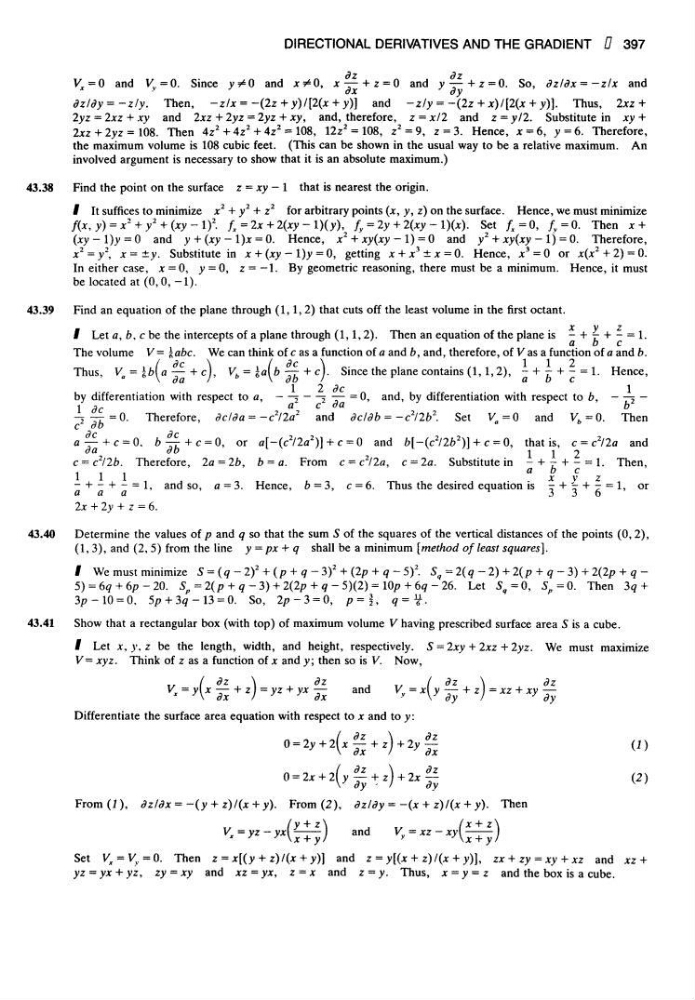
2yz = 2*z + xy and 2*z + 2yz = 2yz + xy, and, therefore, z = x/2 and z = y/2. Substitute in xy +
2xz + 2yz = 108. Then 4z
2 + 4z
2 + 4z
2 = 108, 12z
2 = 108, z
2 = 9, z = 3. Hence, x = 6, y = 6. Therefore,
the maximum volume is 108 cubic feet. (This can be shown in the usual way to be a relative maximum. An
involved argument is necessary to show that it is an absolute maximum.)
V, =0 and V v =0. Since y^O and jc^O,
+ z = 0 and
+ z=0. So, dzldx=-zlx and
43.38 Find the point on the surface z—xy — \ that is nearest the origin.
f(x, y) = x
2 + y
2 + (xy - I)
2
. /, = 2* + 2(xy -l)(y), f y = 2y + 2(xy - l)(x). Set / x =0, / v =0. Then x +
(xy-l)y = 0 and y + (xy - l)x = 0. Hence, x
2 + xy(xy - 1) = 0 and y
2 + xy(xy - 1) = 0. Therefore,
x
2 = y
2 , x = ±y. Substitute in x + (xy - l)y = 0, getting x + x
3 ± x - 0. Hence, x
3 = 0 or x(x
2 + 2) = 0.
In either case, x = 0, y = 0, z = —1. By geometric reasoning, there must be a minimum. Hence, it must
be located at (0, 0, -1).
43.39 Find an equation of the plane through (1,1,2) that cuts off the least volume in the first octant.
The volume
We can think of c as a function of a and b, and, therefore, of V as a function of a and b.
Thus,
Since the plane contains (1,1,2),
Hence,
Set V, = V y =Q. Then z = x[(y + z)/(x + y)] and z = y[(x + z)l(x + y)], zx + zy = xy + xz and xz +
yz = yx + yz, zy = xy and xz = yx, z = x and z = y. Thus, x = y = z and the box is a cube.
From(l), jz/dx = -(y + z)/(x + y). From (2), dzldy = -(x + z)l(x + y). Then
and
Differentiate the surface area equation with respect to x and to y:
and
Show that a rectangular box (with top) of maximum volume V having prescribed surface area S is a cube.
V= xyz. Think of z as a function of x and y; then so is V. Now,
43.41
43.40
Determine the values of p and q so that the sum 5 of the squares of the vertical distances of the points (0, 2),
(1,3), and (2,5) from the line y = px + q shall be a minimum [method of least squares].
5) = 6q + 6p-20. S p =2(p + q-3) + 2(2p + q-5)(2) = Wp + 6q-26. Let S a =0, £„ = 0. Then 3q +
3p-10 = 0, 5p + 3<7-13 = 0. So, 2^-3 = 0,
by differentiation with respect to a,
and, by differentiation with respect to b,
Therefore, dc/da = -c
2 !2a
2
and dcldb = -c
2 !2b
2 . Set V a =0 and V b =0. Then
or
and fe[-(c
2 /2£
2 )] + c = 0, that is, c = c
2 /2a and
c = c
2 /2b. Therefore, la = 2b, b = a. From c = c
2 /2a, c = 2a. Substitute in
Then,
and so, a = 3. Hence, 6=3, c = 6. Thus the desired equation is
or
2x + 2y + z = 6.
It suffices to minimize x2 + y2 + z2 for arbitrary points (x, y, z) on the surface. Hence, we must minimize
Let a, b, c be the intercepts of a plane through (1,1,2). Then an equation of the plane is
e must minimize S = (q - 2)2 + (p + q - 3)2 + (2p + q - 5)2. 5, = 2(q - 2) + 2(p + q - 3) + 2(2p + q -
et x, y, z be the length, width, and height, respectively. S = 2xy + 2xz + 2yz. We must maximize
397
2yz = 2*z + xy and 2*z + 2yz = 2yz + xy, and, therefore, z = x/2 and z = y/2. Substitute in xy +
2xz + 2yz = 108. Then 4z
2 + 4z
2 + 4z
2 = 108, 12z
2 = 108, z
2 = 9, z = 3. Hence, x = 6, y = 6. Therefore,
the maximum volume is 108 cubic feet. (This can be shown in the usual way to be a relative maximum. An
involved argument is necessary to show that it is an absolute maximum.)
V, =0 and V v =0. Since y^O and jc^O,
+ z = 0 and
+ z=0. So, dzldx=-zlx and
43.38 Find the point on the surface z—xy — \ that is nearest the origin.
f(x, y) = x
2 + y
2 + (xy - I)
2
. /, = 2* + 2(xy -l)(y), f y = 2y + 2(xy - l)(x). Set / x =0, / v =0. Then x +
(xy-l)y = 0 and y + (xy - l)x = 0. Hence, x
2 + xy(xy - 1) = 0 and y
2 + xy(xy - 1) = 0. Therefore,
x
2 = y
2 , x = ±y. Substitute in x + (xy - l)y = 0, getting x + x
3 ± x - 0. Hence, x
3 = 0 or x(x
2 + 2) = 0.
In either case, x = 0, y = 0, z = —1. By geometric reasoning, there must be a minimum. Hence, it must
be located at (0, 0, -1).
43.39 Find an equation of the plane through (1,1,2) that cuts off the least volume in the first octant.
The volume
We can think of c as a function of a and b, and, therefore, of V as a function of a and b.
Thus,
Since the plane contains (1,1,2),
Hence,
Set V, = V y =Q. Then z = x[(y + z)/(x + y)] and z = y[(x + z)l(x + y)], zx + zy = xy + xz and xz +
yz = yx + yz, zy = xy and xz = yx, z = x and z = y. Thus, x = y = z and the box is a cube.
From(l), jz/dx = -(y + z)/(x + y). From (2), dzldy = -(x + z)l(x + y). Then
and
Differentiate the surface area equation with respect to x and to y:
and
Show that a rectangular box (with top) of maximum volume V having prescribed surface area S is a cube.
V= xyz. Think of z as a function of x and y; then so is V. Now,
43.41
43.40
Determine the values of p and q so that the sum 5 of the squares of the vertical distances of the points (0, 2),
(1,3), and (2,5) from the line y = px + q shall be a minimum [method of least squares].
5) = 6q + 6p-20. S p =2(p + q-3) + 2(2p + q-5)(2) = Wp + 6q-26. Let S a =0, £„ = 0. Then 3q +
3p-10 = 0, 5p + 3<7-13 = 0. So, 2^-3 = 0,
by differentiation with respect to a,
and, by differentiation with respect to b,
Therefore, dc/da = -c
2 !2a
2
and dcldb = -c
2 !2b
2 . Set V a =0 and V b =0. Then
or
and fe[-(c
2 /2£
2 )] + c = 0, that is, c = c
2 /2a and
c = c
2 /2b. Therefore, la = 2b, b = a. From c = c
2 /2a, c = 2a. Substitute in
Then,
and so, a = 3. Hence, 6=3, c = 6. Thus the desired equation is
or
2x + 2y + z = 6.
It suffices to minimize x2 + y2 + z2 for arbitrary points (x, y, z) on the surface. Hence, we must minimize
Let a, b, c be the intercepts of a plane through (1,1,2). Then an equation of the plane is
e must minimize S = (q - 2)2 + (p + q - 3)2 + (2p + q - 5)2. 5, = 2(q - 2) + 2(p + q - 3) + 2(2p + q -
et x, y, z be the length, width, and height, respectively. S = 2xy + 2xz + 2yz. We must maximize