

396
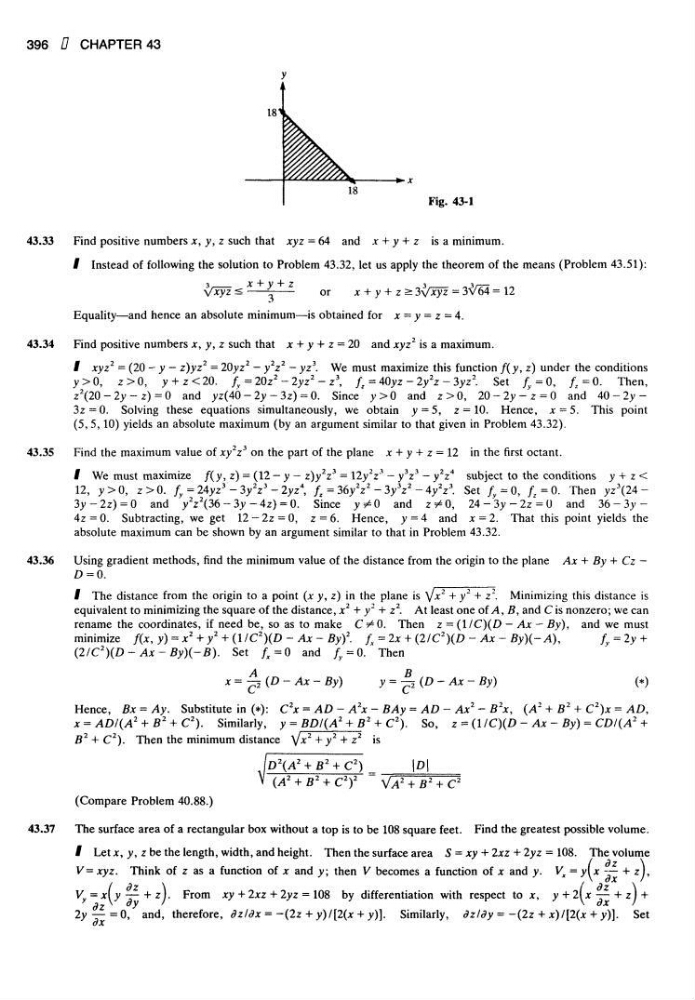
Fig. 43-1
Equality—and hence an absolute minimum—is obtained for x = y = z = 4.
43.34 Find positive numbers x, y, z such that x + y + z = 20 and xyz
2 is a maximum.
y>0, z>0, y + z<20. f y = 20z
2 - 2yz
2 - z
3 , f, = 40yz - 2y
2 z - 3yz
2
. Set f y = 0, / z =0. Then,
z
2 (20 - 2y - z) = 0 and yz(40 - 2y - 3z) = 0. Since y > 0 and z > 0, 20 - 2y - z = 0 and 40 - 2y -
3z = 0. Solving these equations simultaneously, we obtain y
= 5, z = 10. Hence, ;c = 5. This point
(5, 5,10) yields an absolute maximum (by an argument similar to that given in Problem 43.32).
43.35 Find the maximum value of xy
2 z
3 on the part of the plane x + y + z = 12 in the first octant.
12, y > 0, z > 0. fy = 24yz3 - 3yV - 2yz4, £ = 36yV - 3y3z2 - 4yV. Set fy = 0, f,= 0. Then yz3(24 -
3y - 2z) = 0 and y
2 z
2 (36 - 3y - 4z) = 0. Since y ^ 0 and z * 0, 24 - 3y - 2z = 0 and 36 - 3y -
4z = 0. Subtracting, we get 12 - 2z = 0, z = 6. Hence, y = 4 and x = 2. That this point yields the
absolute maximum can be shown by an argument similar to that in Problem 43.32.
43.36
Using gradient methods, find the minimum value of the distance from the origin to the plane Ax + By + Cz -
D = 0.
equivalent to minimizing the square of the distance, x
2 + y
2 + z
2 . At least one of A, B, and C is nonzero; we can
rename the coordinates, if need be, so as to make C^O. Then z = (1/C)(D — Ax — By), and we must
minimize f(x, y) = x
2 + y
2 + (1/C
2 )(D - Ax - By)
2 . /,. = 2x + (2/C
2 )(D - Ax - By)(-A),
f y = 2y +
(2/C
2 )(D- Ax-By)(-B). Set /,=0 and / = 0. Then
Hence, Bx = Ay. Substitute in (*): C2x = AD - A2x - BAy = AD - Ax2 - B2x, (A2 + B2 + C2)x = AD,
x = AD/(A2 +B2 + C2). Similarly, y = BD/(A2 + B2 + C2). So, z = (l/C)(D - Ax - By) = CD/(A2 +
B
2 + C
2 ). Then the minimum distance
(Compare Problem 40.88.)
43.37
The surface area of a rectangular box without a top is to be 108 square feet. Find the greatest possible volume.
V= xyz. Think of z as a function of x and y; then V becomes a function of x and y.
From xy + 2xz + 2yz = 108 by differentiation with respect to x,
and, therefore, dzldx = -(2z + y)/[2(.x + y)]. Similarly, dzldy = -(2z + x)/[2(x + y)]. Set
is
Minimizing this distance is
43.33 Find positive numbers x, y, z such that .xyz = 64 and x + y + z is a minimum.
or
x
2 + y
2 + z*.
CHAPTER 43
Instead of following the solution to Problem 43.32, let us apply the theorem of the means (Problem 43.51):
yz2 = (20 - y — z)yz2 = 20yz2 — y2z2 - yz3. We must maximize this function f(y, z) under the conditions
We must maximize /(y, z) = (12-y - z)yV = 12y2z3 - y3z3 - y2z4 subject to the conditions y+z<
The distance from the origin to a point (x y, z) in the plane is
Let x, y, z be the length, width, and height. Then the surface area S = xy + 2xz + 2yz = 108. The volume
Fig. 43-1
Equality—and hence an absolute minimum—is obtained for x = y = z = 4.
43.34 Find positive numbers x, y, z such that x + y + z = 20 and xyz
2 is a maximum.
y>0, z>0, y + z<20. f y = 20z
2 - 2yz
2 - z
3 , f, = 40yz - 2y
2 z - 3yz
2
. Set f y = 0, / z =0. Then,
z
2 (20 - 2y - z) = 0 and yz(40 - 2y - 3z) = 0. Since y > 0 and z > 0, 20 - 2y - z = 0 and 40 - 2y -
3z = 0. Solving these equations simultaneously, we obtain y
= 5, z = 10. Hence, ;c = 5. This point
(5, 5,10) yields an absolute maximum (by an argument similar to that given in Problem 43.32).
43.35 Find the maximum value of xy
2 z
3 on the part of the plane x + y + z = 12 in the first octant.
12, y > 0, z > 0. fy = 24yz3 - 3yV - 2yz4, £ = 36yV - 3y3z2 - 4yV. Set fy = 0, f,= 0. Then yz3(24 -
3y - 2z) = 0 and y
2 z
2 (36 - 3y - 4z) = 0. Since y ^ 0 and z * 0, 24 - 3y - 2z = 0 and 36 - 3y -
4z = 0. Subtracting, we get 12 - 2z = 0, z = 6. Hence, y = 4 and x = 2. That this point yields the
absolute maximum can be shown by an argument similar to that in Problem 43.32.
43.36
Using gradient methods, find the minimum value of the distance from the origin to the plane Ax + By + Cz -
D = 0.
equivalent to minimizing the square of the distance, x
2 + y
2 + z
2 . At least one of A, B, and C is nonzero; we can
rename the coordinates, if need be, so as to make C^O. Then z = (1/C)(D — Ax — By), and we must
minimize f(x, y) = x
2 + y
2 + (1/C
2 )(D - Ax - By)
2 . /,. = 2x + (2/C
2 )(D - Ax - By)(-A),
f y = 2y +
(2/C
2 )(D- Ax-By)(-B). Set /,=0 and / = 0. Then
Hence, Bx = Ay. Substitute in (*): C2x = AD - A2x - BAy = AD - Ax2 - B2x, (A2 + B2 + C2)x = AD,
x = AD/(A2 +B2 + C2). Similarly, y = BD/(A2 + B2 + C2). So, z = (l/C)(D - Ax - By) = CD/(A2 +
B
2 + C
2 ). Then the minimum distance
(Compare Problem 40.88.)
43.37
The surface area of a rectangular box without a top is to be 108 square feet. Find the greatest possible volume.
V= xyz. Think of z as a function of x and y; then V becomes a function of x and y.
From xy + 2xz + 2yz = 108 by differentiation with respect to x,
and, therefore, dzldx = -(2z + y)/[2(.x + y)]. Similarly, dzldy = -(2z + x)/[2(x + y)]. Set
is
Minimizing this distance is
43.33 Find positive numbers x, y, z such that .xyz = 64 and x + y + z is a minimum.
or
x
2 + y
2 + z*.
CHAPTER 43
Instead of following the solution to Problem 43.32, let us apply the theorem of the means (Problem 43.51):
yz2 = (20 - y — z)yz2 = 20yz2 — y2z2 - yz3. We must maximize this function f(y, z) under the conditions
We must maximize /(y, z) = (12-y - z)yV = 12y2z3 - y3z3 - y2z4 subject to the conditions y+z<
The distance from the origin to a point (x y, z) in the plane is
Let x, y, z be the length, width, and height. Then the surface area S = xy + 2xz + 2yz = 108. The volume