

398
CHAPTER 43
43.42 Find the volume V of the largest rectangular box that may be inscribed in the ellipsoid
V= 8*yz. Think of z as a function of x and y. Then V is a function of x and y.
Differentiating the equation of the ellipsoid, we get
and
Thus,
and
Hence,
and
Set V X = V=0. Then z = cV/za
2 , z = c
2 y
2 /zb
2 . Therefore, x
2 /a
2 = x
2 /c
2 = y
2 /b
2 .
The equation of the ellipsoid now gives: x = a/V3, z = c/V3, y = bN 3, and V= 8abc/3V3.
43.43 Divide 120 into three nonnegative parts so that the sum of the products taken two at a time is a maximum.
y) + y(l20 - * - y) = *y + 120* - x2 - xy + 120y - xy - y2 = 120* + 120y - x2 - xy - y2. fx = 120 - 2x - y,
fy = 120 - * - 2y. Set f,=fy=Q and solve: 120 - 2x - y = 0, 240 - 2x - 4y = 0. Hence, 120 - 3y = 0,
y = 40, x = 40. Thus, the division is into three equal parts. Note that fxy = -l, fxjt = -2, fyy = -2, A = 41 = 3 > 0, and /„ + f yy = -4 > 0. Hence, the critical point (40, 40) yields a relative maximum /(40, 40) =
4800. To see that this is an absolute maximum, observe that the continuous function f(x, y) must have an
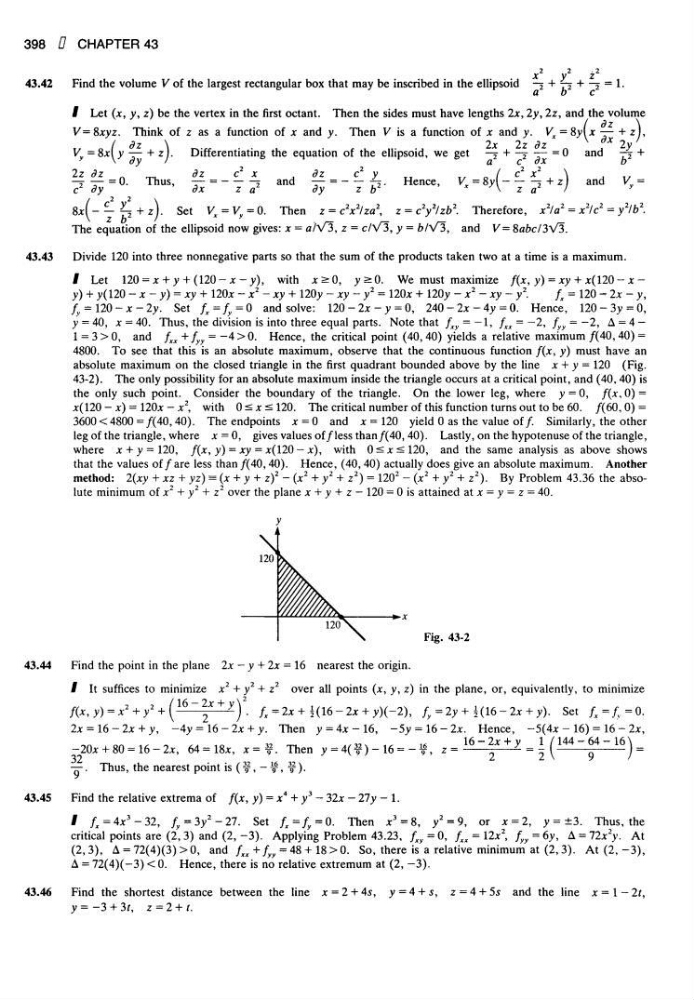
absolute maximum on the closed triangle in the first quadrant bounded above by the line x + y = 120 (Fig.
43-2). The only possibility for an absolute maximum inside the triangle occurs at a critical point, and (40,40) is
the only such point. Consider the boundary of the triangle. On the lower leg, where y = 0, f(x, 0) =
*(120-*) = 120*-*
2
, with 0<*<120. The critical number of this function turns out to be 60. /(60, 0) =
3600 < 4800 = /(40,40). The endpoints * = 0 and * = 120 yield 0 as the value of/. Similarly, the other
leg of the triangle, where * = 0, gives values of/less than/(40, 40). Lastly, on the hypotenuse of the triangle,
where * + y = 120, /(*, y) = *y = *(120 —*), with 0^*sl20, and the same analysis as above shows
that the values of / are less than /(40,40). Hence, (40, 40) actually does give an absolute maximum. Another
method: 2(xy + xz + yz) = (x + y + z)
2 - (x
2 + y
2 + z
2 ) = 120
2 - (x
2 + y
2 + z
2 ). By Problem 43.36 the absolute minimum of x
2 + y
2 + z
2 over the plane * + y + z — 120 = 0 is attained at x = y = z = 40.
Fig. 43-2
43.44
Find the point in the plane 2x - y + 2x = 16 nearest the origin.
/ t =2*+Kl6-2* + y)(-2), f y =2y+l(16-2x + y). Set /,=/ v =0.
2x = 16 - 2x + y, -4y = 16-2* + y. Then y = 4*-16, -5y = 16-2*. Hence, -5(4* - 16) = 16 - 2*,
-20* + 80 = 16 - 2x, 64=18*,
Then
Thus, the nearest point is
43.45 Find the relative extrema of /(*, y) = *
4 + y
3 -32*-27y - 1.
critical points are (2, 3) and (2, -3). Applying Problem 43.23, f xy = 0, /„ = 12*
2
, f yy = 6y, A = 72*
2
y. At
(2,3), A = 72(4)(3)>0, and /„+/ yy = 48 + 18>0. So, there is a relative minimum at (2, 3). At (2,-3),
A = 72(4)(-3) < 0. Hence, there is no relative extremum at (2, -3).
43.46 Find the shortest distance between the line x = 2 + 4s, y=4 + s, z = 4 + 5s and the line * = 1 — 2t,
y=-3 + 3f, z = 2+t.
r = 4*3-32, fy=3y2-27. Set ft=fy=0. Then *3=8, y2 = 9, or * = 2, y = ±3. Thus, the
Let 120 = x + y + (120- x-y), with *>0, y>0. We must maximize /(*, y) = xy + *(120- x -
Let (A:, y, z) be the vertex in the first octant. Then the sides must have lengths 2x, 2y, 2z, and the volume
It suffices to minimize x2 + y2 + z2 over all points (*, y, z) in the plane, or, equivalently, to minimize
CHAPTER 43
43.42 Find the volume V of the largest rectangular box that may be inscribed in the ellipsoid
V= 8*yz. Think of z as a function of x and y. Then V is a function of x and y.
Differentiating the equation of the ellipsoid, we get
and
Thus,
and
Hence,
and
Set V X = V=0. Then z = cV/za
2 , z = c
2 y
2 /zb
2 . Therefore, x
2 /a
2 = x
2 /c
2 = y
2 /b
2 .
The equation of the ellipsoid now gives: x = a/V3, z = c/V3, y = bN 3, and V= 8abc/3V3.
43.43 Divide 120 into three nonnegative parts so that the sum of the products taken two at a time is a maximum.
y) + y(l20 - * - y) = *y + 120* - x2 - xy + 120y - xy - y2 = 120* + 120y - x2 - xy - y2. fx = 120 - 2x - y,
fy = 120 - * - 2y. Set f,=fy=Q and solve: 120 - 2x - y = 0, 240 - 2x - 4y = 0. Hence, 120 - 3y = 0,
y = 40, x = 40. Thus, the division is into three equal parts. Note that fxy = -l, fxjt = -2, fyy = -2, A = 41 = 3 > 0, and /„ + f yy = -4 > 0. Hence, the critical point (40, 40) yields a relative maximum /(40, 40) =
4800. To see that this is an absolute maximum, observe that the continuous function f(x, y) must have an
absolute maximum on the closed triangle in the first quadrant bounded above by the line x + y = 120 (Fig.
43-2). The only possibility for an absolute maximum inside the triangle occurs at a critical point, and (40,40) is
the only such point. Consider the boundary of the triangle. On the lower leg, where y = 0, f(x, 0) =
*(120-*) = 120*-*
2
, with 0<*<120. The critical number of this function turns out to be 60. /(60, 0) =
3600 < 4800 = /(40,40). The endpoints * = 0 and * = 120 yield 0 as the value of/. Similarly, the other
leg of the triangle, where * = 0, gives values of/less than/(40, 40). Lastly, on the hypotenuse of the triangle,
where * + y = 120, /(*, y) = *y = *(120 —*), with 0^*sl20, and the same analysis as above shows
that the values of / are less than /(40,40). Hence, (40, 40) actually does give an absolute maximum. Another
method: 2(xy + xz + yz) = (x + y + z)
2 - (x
2 + y
2 + z
2 ) = 120
2 - (x
2 + y
2 + z
2 ). By Problem 43.36 the absolute minimum of x
2 + y
2 + z
2 over the plane * + y + z — 120 = 0 is attained at x = y = z = 40.
Fig. 43-2
43.44
Find the point in the plane 2x - y + 2x = 16 nearest the origin.
/ t =2*+Kl6-2* + y)(-2), f y =2y+l(16-2x + y). Set /,=/ v =0.
2x = 16 - 2x + y, -4y = 16-2* + y. Then y = 4*-16, -5y = 16-2*. Hence, -5(4* - 16) = 16 - 2*,
-20* + 80 = 16 - 2x, 64=18*,
Then
Thus, the nearest point is
43.45 Find the relative extrema of /(*, y) = *
4 + y
3 -32*-27y - 1.
critical points are (2, 3) and (2, -3). Applying Problem 43.23, f xy = 0, /„ = 12*
2
, f yy = 6y, A = 72*
2
y. At
(2,3), A = 72(4)(3)>0, and /„+/ yy = 48 + 18>0. So, there is a relative minimum at (2, 3). At (2,-3),
A = 72(4)(-3) < 0. Hence, there is no relative extremum at (2, -3).
43.46 Find the shortest distance between the line x = 2 + 4s, y=4 + s, z = 4 + 5s and the line * = 1 — 2t,
y=-3 + 3f, z = 2+t.
r = 4*3-32, fy=3y2-27. Set ft=fy=0. Then *3=8, y2 = 9, or * = 2, y = ±3. Thus, the
Let 120 = x + y + (120- x-y), with *>0, y>0. We must maximize /(*, y) = xy + *(120- x -
Let (A:, y, z) be the vertex in the first octant. Then the sides must have lengths 2x, 2y, 2z, and the volume
It suffices to minimize x2 + y2 + z2 over all points (*, y, z) in the plane, or, equivalently, to minimize