

390
CHAPTER 42
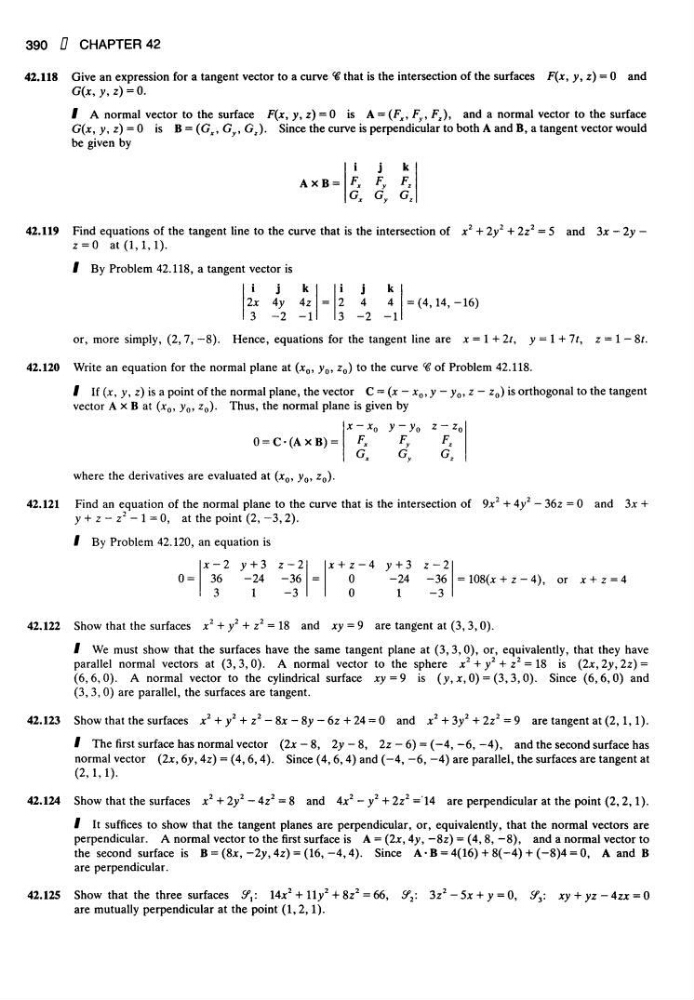
42.118 Give an expression for a tangent vector to a curve <£ that is the intersection of the surfaces F(x, y, z) = 0 and
G(*,y,z)=0.
A normal vector to the surface F(x, y,z) = 0 is A = (F x , F y , F z ), and a normal vector to the surface
G(x, y, z) = 0 is B = (G^, G y , G z ). Since the curve is perpendicular to both A and B, a tangent vector would
be given by
42.119 Find equations of the tangent line to the curve that is the intersection of x
2 + 2y
2 + 2z
2 = 5 and 3x-2y —
z = 0 at (1,1,1).
By Problem 42.118, a tangent vector is
or, more simply, (2,7, —8). Hence, equations for the tangent line are x = 1 + 2t, y = 1 + It, z = 1 —8t.
42.120 Write an equation for the normal plane at (x 0 , y 0 , z 0 ) to the curve <€ of Problem 42.118.
If (x, v, z) is a point of the normal plane, the vector C = (x — x 0 , y — y 0 , z — z 0 ) is orthogonal to the tangent
vector A x B at (x a , y 0 , z 0 ). Thus, the normal plane is given by
where the derivatives are evaluated at (x a , v 0 , z 0 ).
42.121 Find an equation of the normal plane to the curve that is the intersection of 9x
2 + 4y
2 - 36z = 0 and 3x +
y + z-z
2 -l=0, at the point (2,-3,2).
By Problem 42.120, an equation is
or
42.122 Show that the surfaces x
2 + y
2 + z
2 = 18 and xy = 9 are tangent at (3, 3,0).
We must show that the surfaces have the same tangent plane at (3,3,0), or, equivalently, that they have
parallel normal vectors at (3,3,0). A normal vector to the sphere x
2 + y
2 + z
2 = 18 is (2x, 2y, 2z) —
(6,6,0). A normal vector to the cylindrical surface xy=9 is (y, x,0) = (3,3,0). Since (6,6,0) and
(3, 3, 0) are parallel, the surfaces are tangent.
42.123 Show that the surfaces x
2 + y
2 + z
2 - 8x - 8y -6z + 24 = 0 and x
2 + 3y
2 + 2z
2 = 9 are tangent at (2,1,1).
The first surface has normal vector (2x - 8, 2y - 8, 2z - 6) = (-4, -6, -4), and the second surface has
normal vector (2x, 6y, 4z) = (4,6,4). Since (4, 6,4) and (—4, —6, —4) are parallel, the surfaces are tangent at
(2,1,1).
42.124 Show that the surfaces x
2 + 2y
2 - 4z
2 = 8 and 4x
2 - y
2 + 2z
2 ='14 are perpendicular at the point (2,2,1).
It suffices to show that the tangent planes are perpendicular, or, equivalently, that the normal vectors are
perpendicular. A normal vector to the first surface is A = (2x, 4y, — 8z) = (4, 8, — 8), and a normal vector to
the second surface is B = (8*, -2y,4z) = (16, -4,4). Since A-B = 4(16) + 8(-4) + (-8)4 = 0, A and B
are perpendicular.
42.125 Show that the three surfaces y t : I4x
2 + lly
2 + 8z
2 = 66, y 2 : 3z
2 - 5* + y = 0, y,: xy + yz-4zx = 0
are mutually perpendicular at the point (1,2,1).
CHAPTER 42
42.118 Give an expression for a tangent vector to a curve <£ that is the intersection of the surfaces F(x, y, z) = 0 and
G(*,y,z)=0.
A normal vector to the surface F(x, y,z) = 0 is A = (F x , F y , F z ), and a normal vector to the surface
G(x, y, z) = 0 is B = (G^, G y , G z ). Since the curve is perpendicular to both A and B, a tangent vector would
be given by
42.119 Find equations of the tangent line to the curve that is the intersection of x
2 + 2y
2 + 2z
2 = 5 and 3x-2y —
z = 0 at (1,1,1).
By Problem 42.118, a tangent vector is
or, more simply, (2,7, —8). Hence, equations for the tangent line are x = 1 + 2t, y = 1 + It, z = 1 —8t.
42.120 Write an equation for the normal plane at (x 0 , y 0 , z 0 ) to the curve <€ of Problem 42.118.
If (x, v, z) is a point of the normal plane, the vector C = (x — x 0 , y — y 0 , z — z 0 ) is orthogonal to the tangent
vector A x B at (x a , y 0 , z 0 ). Thus, the normal plane is given by
where the derivatives are evaluated at (x a , v 0 , z 0 ).
42.121 Find an equation of the normal plane to the curve that is the intersection of 9x
2 + 4y
2 - 36z = 0 and 3x +
y + z-z
2 -l=0, at the point (2,-3,2).
By Problem 42.120, an equation is
or
42.122 Show that the surfaces x
2 + y
2 + z
2 = 18 and xy = 9 are tangent at (3, 3,0).
We must show that the surfaces have the same tangent plane at (3,3,0), or, equivalently, that they have
parallel normal vectors at (3,3,0). A normal vector to the sphere x
2 + y
2 + z
2 = 18 is (2x, 2y, 2z) —
(6,6,0). A normal vector to the cylindrical surface xy=9 is (y, x,0) = (3,3,0). Since (6,6,0) and
(3, 3, 0) are parallel, the surfaces are tangent.
42.123 Show that the surfaces x
2 + y
2 + z
2 - 8x - 8y -6z + 24 = 0 and x
2 + 3y
2 + 2z
2 = 9 are tangent at (2,1,1).
The first surface has normal vector (2x - 8, 2y - 8, 2z - 6) = (-4, -6, -4), and the second surface has
normal vector (2x, 6y, 4z) = (4,6,4). Since (4, 6,4) and (—4, —6, —4) are parallel, the surfaces are tangent at
(2,1,1).
42.124 Show that the surfaces x
2 + 2y
2 - 4z
2 = 8 and 4x
2 - y
2 + 2z
2 ='14 are perpendicular at the point (2,2,1).
It suffices to show that the tangent planes are perpendicular, or, equivalently, that the normal vectors are
perpendicular. A normal vector to the first surface is A = (2x, 4y, — 8z) = (4, 8, — 8), and a normal vector to
the second surface is B = (8*, -2y,4z) = (16, -4,4). Since A-B = 4(16) + 8(-4) + (-8)4 = 0, A and B
are perpendicular.
42.125 Show that the three surfaces y t : I4x
2 + lly
2 + 8z
2 = 66, y 2 : 3z
2 - 5* + y = 0, y,: xy + yz-4zx = 0
are mutually perpendicular at the point (1,2,1).