

PARTIAL DERIVATIVES
389
42.112 Find an equation of the tangent plane to the ellipsoid
= 1 at a point (*„, y 0 , z a ).
By Problem 42.109, a normal vector to the tangent plane is
or, better, the vector
Hence, an equation of the tangent plane is
or,
equivalently
42.113 Let a>0. The tangent plane to the surface xyz = a at a point (x a , y 0 , z 0 ) in the first octant forms a
tetrahedron with the coordinate planes. Show that such tetrahedrons all have the same volume.
By Problem 42.109, a normal vector to the tangent plane is (y 0 z 0 , x 0 z 0 , x 0 y a ). Hence, that tangent plane has
an equation y 0 z 0 (x- X 0 ) + x 0 z 0 (y -y 0 ) + x 0 y 0 (z - z 0 ) = 0, or, equivalently, y 0 z 0 x +x 0 z 0 y + x a y a z =
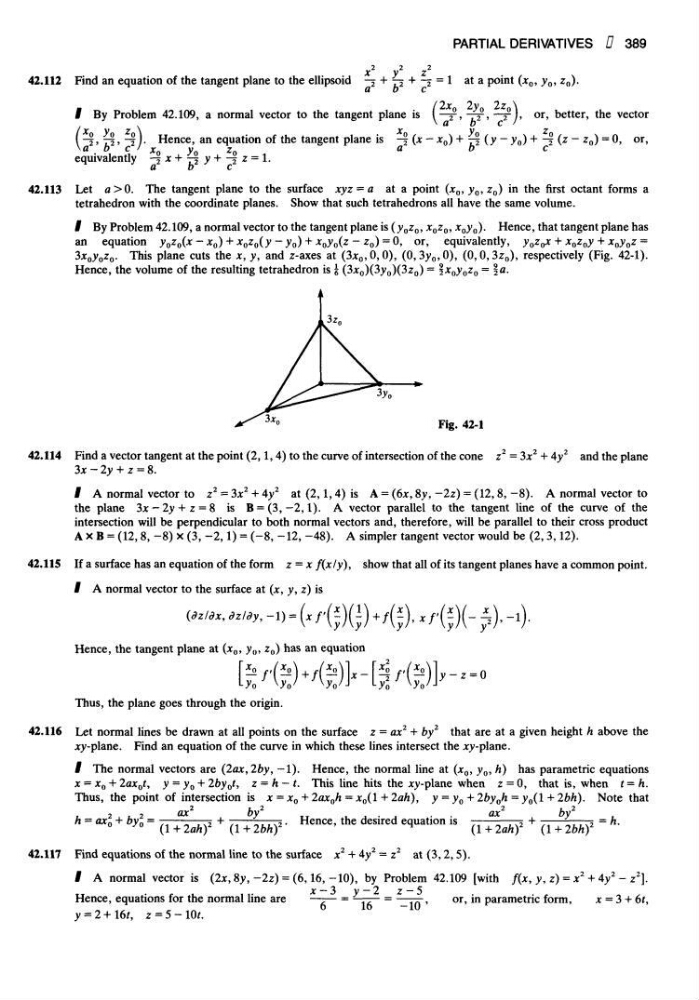
3x 0 y 0 z 0 . This plane cuts the x, y, and z-axes at (3* 0 ,0,0), (0,3y 0 ,0), (0,0,3z 0 ), respectively (Fig. 42-1).
Hence, the volume of the resulting tetrahedron is g (3jt 0 )(3y 0 )(3z 0 ) = f * 0 y 0 z 0 = \a.
Fig. 42-1
42.114 Find a vector tangent at the point (2,1,4) to the curve of intersection of the cone z
2 = 3x
2 + 4y
2 and the plane
3* - 2y + z = 8.
A normal vector to Z
2 = 3x
2 + 4y
2 at (2,1,4) is A = (6x, 8y, -2z) = (12,8, -8). A normal vector to
the plane 3x — 2y + z = 8 is B = (3, —2,1). A vector parallel to the tangent line of the curve of the
intersection will be perpendicular to both normal vectors and, therefore, will be parallel to their cross product
A x B = (12, 8, -8) X (3, -2,1) = (-8, -12, -48). A simpler tangent vector would be (2,3,12).
42.115 If a surface has an equation of the form z = x f(x/y), show that all of its tangent planes have a common point.
A normal vector to the surface at (x, y, z) is
Hence, the tangent plane at (*„, y 0 , z 0 ) has an equation
Thus, the plane goes through the origin.
42.116 Let normal lines be drawn at all points on the surface z = ax
2 + by
2
that are at a given height h above the
jcy-plane. Find an equation of the curve in which these lines intersect the xy-plane.
The normal vectors are (2ax,2by, — 1). Hence, the normal line at (x g , y 0 , h) has parametric equations
x = x a + 2ax 0 t, y = y 0 + 2by 0 t, z = h — t. This line hits the *y-plane when z = 0, that is, when t=h.
Thus, the point of intersection is x = x 0 + 2ax 0 h = x 0 (l + 2ah), y = y 0 + 2by 0 h = y 0 (l + 2bh). Note that
Hence, the desired equation is
42.117 Find equations of the normal line to the surface *
2 +4y
2 = z
2 at (3,2,5).
Hence, equations for the normal line are
or, in parametric form,
x = 3 + 6t,
y = 2+ I6t, z = 5 - Wt.
A normal vector is (2x,8y, -2z) = (6,16, -10), by Problem 42.109 [with f(x, y, z) = x2 + 4y2 - zzl.
389
42.112 Find an equation of the tangent plane to the ellipsoid
= 1 at a point (*„, y 0 , z a ).
By Problem 42.109, a normal vector to the tangent plane is
or, better, the vector
Hence, an equation of the tangent plane is
or,
equivalently
42.113 Let a>0. The tangent plane to the surface xyz = a at a point (x a , y 0 , z 0 ) in the first octant forms a
tetrahedron with the coordinate planes. Show that such tetrahedrons all have the same volume.
By Problem 42.109, a normal vector to the tangent plane is (y 0 z 0 , x 0 z 0 , x 0 y a ). Hence, that tangent plane has
an equation y 0 z 0 (x- X 0 ) + x 0 z 0 (y -y 0 ) + x 0 y 0 (z - z 0 ) = 0, or, equivalently, y 0 z 0 x +x 0 z 0 y + x a y a z =
3x 0 y 0 z 0 . This plane cuts the x, y, and z-axes at (3* 0 ,0,0), (0,3y 0 ,0), (0,0,3z 0 ), respectively (Fig. 42-1).
Hence, the volume of the resulting tetrahedron is g (3jt 0 )(3y 0 )(3z 0 ) = f * 0 y 0 z 0 = \a.
Fig. 42-1
42.114 Find a vector tangent at the point (2,1,4) to the curve of intersection of the cone z
2 = 3x
2 + 4y
2 and the plane
3* - 2y + z = 8.
A normal vector to Z
2 = 3x
2 + 4y
2 at (2,1,4) is A = (6x, 8y, -2z) = (12,8, -8). A normal vector to
the plane 3x — 2y + z = 8 is B = (3, —2,1). A vector parallel to the tangent line of the curve of the
intersection will be perpendicular to both normal vectors and, therefore, will be parallel to their cross product
A x B = (12, 8, -8) X (3, -2,1) = (-8, -12, -48). A simpler tangent vector would be (2,3,12).
42.115 If a surface has an equation of the form z = x f(x/y), show that all of its tangent planes have a common point.
A normal vector to the surface at (x, y, z) is
Hence, the tangent plane at (*„, y 0 , z 0 ) has an equation
Thus, the plane goes through the origin.
42.116 Let normal lines be drawn at all points on the surface z = ax
2 + by
2
that are at a given height h above the
jcy-plane. Find an equation of the curve in which these lines intersect the xy-plane.
The normal vectors are (2ax,2by, — 1). Hence, the normal line at (x g , y 0 , h) has parametric equations
x = x a + 2ax 0 t, y = y 0 + 2by 0 t, z = h — t. This line hits the *y-plane when z = 0, that is, when t=h.
Thus, the point of intersection is x = x 0 + 2ax 0 h = x 0 (l + 2ah), y = y 0 + 2by 0 h = y 0 (l + 2bh). Note that
Hence, the desired equation is
42.117 Find equations of the normal line to the surface *
2 +4y
2 = z
2 at (3,2,5).
Hence, equations for the normal line are
or, in parametric form,
x = 3 + 6t,
y = 2+ I6t, z = 5 - Wt.
A normal vector is (2x,8y, -2z) = (6,16, -10), by Problem 42.109 [with f(x, y, z) = x2 + 4y2 - zzl.