

388
CHAPTER 42
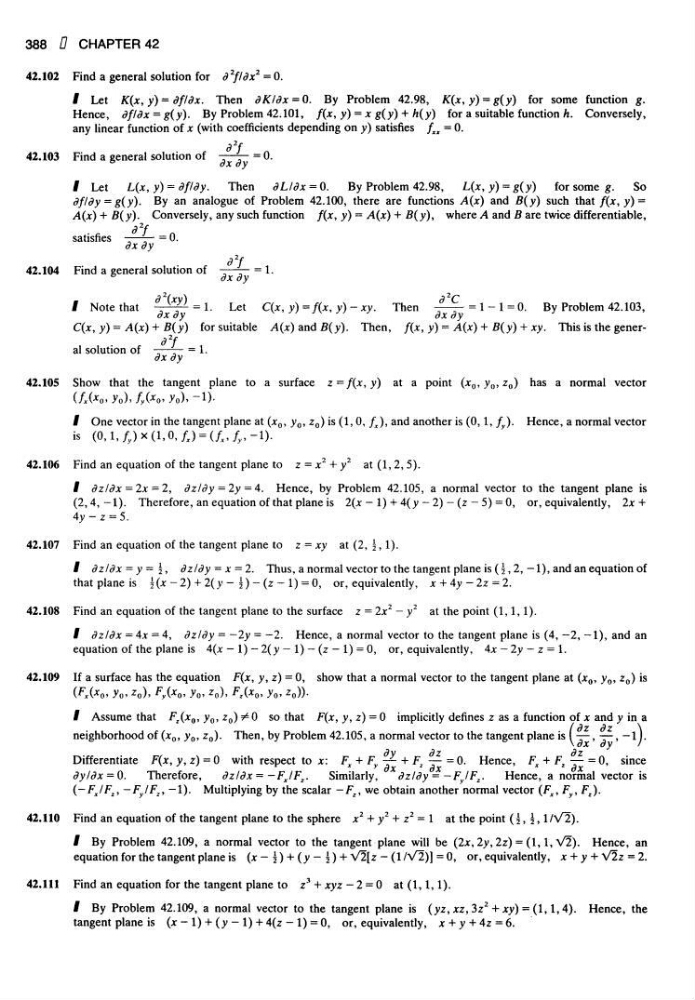
42.102 Find a general solution for
Let K(x, y) = dfldx. Then 3Kldx = Q. By Problem 42.98, K(x, y) = g(y) for some function g.
Hence, dfldx = g(y)- By Problem 42.101, f(x, y) = x g(y) + h(y) for a suitable function h. Conversely,
any linear function of x (with coefficients depending on y) satisfies /„ = 0.
42.103 Find a general solution of
Let L(x,y) = dflSy. Then SL/dx = Q. By Problem 42.98, L(x,y) = g(y) for some g. So
dfldy=:g(y). By an analogue of Problem 42.100, there are functions A(x) and B(y) such that /(AC, y) =
A(x) + B(y). Conversely, any such function f(x, y) — A(x) + B(y), where A and B are twice differentiable,
satisfies
42.104 Find a general solution of
Note that
= 1. Let C(x, y)=f(x, y)-xy. Then
= 1-1=0. By Problem 42.103,
C(x, y)=A(x) + B(y) for suitable A(x) and B(y). Then, f(x, y) = A(x) + B(y) + xy. This is the general solution of
= 1.
42.105 Show that the tangent plane to a surface z=f(x, y) at a point (jc 0 , y 0 , z 0 ) has a normal vector
(/*(*<» y 0 ), /,(*o. .Vo). -!)•
One vector in the tangent plane at (x 0 , y 0 , z 0 ) is (1,0, f x ), and another is (0,1, f y ). Hence, a normal vector
is (0,l,/,)x(l, <),/,) = (/„/,,-!).
42.106 Find an equation of the tangent plane to z = x
2 + y
2
at (1,2, 5).
dzldx = 2x-2, dz/dy = 2y = 4. Hence, by Problem 42.105, a normal vector to the tangent plane is
(2,4,-1). Therefore, an equation of that plane is 2(x - 1) + 4(y -2) - (z - 5) = 0, or, equivalently, 2x +
4y - z = 5.
42.107 Find an equation of the tangent plane to z = xy at (2, |, 1).
dzldx=y= |, dzldy = x = 2. Thus, a normal vector to the tangent plane is (5, 2,—1), and an equation of
that plane is \(x -2) + 2(y — j) — (z - 1) = 0, or, equivalently, x + 4y — 2z = 2.
42.108 Find an equation of the tangent plane to the surface z = 2x
2 - y
2
at the point (1,1,1).
dzldx = 4x = 4, dzldy = —2y = —2. Hence, a normal vector to the tangent plane is (4, —2, -1), and an
equation of the plane is 4(x — 1) - 2(y — 1) - (z — 1) = 0, or, equivalently, 4x — 2y - z = 1.
42.109 If a surface has the equation F(x, y, z) = 0, show that a normal vector to the tangent plane at (x 0 , y 0 , z 0 ) is
(F*(x0> y0> zo)» Fy(x<>, y0, z0). F,(xo> y0' 2o))Assume that F z (x 0 , y 0 , z^^O so that F(x, y, z) = 0 implicitly defines z as a function of A: and y in a
neighborhood of (*„, y 0 , z 0 ). Then, by Problem 42.105, a normal vector to the tangent plane is
Differentiate F(x, y, z) = 0 with respect to x:
Hence,
since
dy/dx = Q.
Therefore,
dzldx= -FJF 2 .
Similarly, dzldy = -F y IF z .
Hence, a normal vector is
(~FJCIFI, -FyIF2, -1). Multiplying by the scalar -Fz, we obtain another normal vector (Fx, Fy, FJ.
42.110 Find an equation of the tangent plane to the sphere x
2 + y
2 + z
2 = 1 at the point (5, |, 1 /V2).
By Problem 42.109, a normal vector to the tangent plane will be (2x, 2y,2z) = (1,1, V5). Hence, an
equation for the tangent plane is (x - |) + (y - {) + V2[z - (1/V2)] =0, or, equivalently, x + y + V2z=2.
42.111 Find an equation for the tangent plane to z
3 + xyz — 2 = 0 at (1,1,1).
By Problem 42.109, a normal vector to the tangent plane is (yz, xz, 3z
2 + xy) = (1,1,4). Hence, the
tangent plane is (jc-l) + (y-l) + 4(z-l) = 0, or, equivalently, * + y + 4z=6.
Download
from Wow! eBook
CHAPTER 42
42.102 Find a general solution for
Let K(x, y) = dfldx. Then 3Kldx = Q. By Problem 42.98, K(x, y) = g(y) for some function g.
Hence, dfldx = g(y)- By Problem 42.101, f(x, y) = x g(y) + h(y) for a suitable function h. Conversely,
any linear function of x (with coefficients depending on y) satisfies /„ = 0.
42.103 Find a general solution of
Let L(x,y) = dflSy. Then SL/dx = Q. By Problem 42.98, L(x,y) = g(y) for some g. So
dfldy=:g(y). By an analogue of Problem 42.100, there are functions A(x) and B(y) such that /(AC, y) =
A(x) + B(y). Conversely, any such function f(x, y) — A(x) + B(y), where A and B are twice differentiable,
satisfies
42.104 Find a general solution of
Note that
= 1. Let C(x, y)=f(x, y)-xy. Then
= 1-1=0. By Problem 42.103,
C(x, y)=A(x) + B(y) for suitable A(x) and B(y). Then, f(x, y) = A(x) + B(y) + xy. This is the general solution of
= 1.
42.105 Show that the tangent plane to a surface z=f(x, y) at a point (jc 0 , y 0 , z 0 ) has a normal vector
(/*(*<» y 0 ), /,(*o. .Vo). -!)•
One vector in the tangent plane at (x 0 , y 0 , z 0 ) is (1,0, f x ), and another is (0,1, f y ). Hence, a normal vector
is (0,l,/,)x(l, <),/,) = (/„/,,-!).
42.106 Find an equation of the tangent plane to z = x
2 + y
2
at (1,2, 5).
dzldx = 2x-2, dz/dy = 2y = 4. Hence, by Problem 42.105, a normal vector to the tangent plane is
(2,4,-1). Therefore, an equation of that plane is 2(x - 1) + 4(y -2) - (z - 5) = 0, or, equivalently, 2x +
4y - z = 5.
42.107 Find an equation of the tangent plane to z = xy at (2, |, 1).
dzldx=y= |, dzldy = x = 2. Thus, a normal vector to the tangent plane is (5, 2,—1), and an equation of
that plane is \(x -2) + 2(y — j) — (z - 1) = 0, or, equivalently, x + 4y — 2z = 2.
42.108 Find an equation of the tangent plane to the surface z = 2x
2 - y
2
at the point (1,1,1).
dzldx = 4x = 4, dzldy = —2y = —2. Hence, a normal vector to the tangent plane is (4, —2, -1), and an
equation of the plane is 4(x — 1) - 2(y — 1) - (z — 1) = 0, or, equivalently, 4x — 2y - z = 1.
42.109 If a surface has the equation F(x, y, z) = 0, show that a normal vector to the tangent plane at (x 0 , y 0 , z 0 ) is
(F*(x0> y0> zo)» Fy(x<>, y0, z0). F,(xo> y0' 2o))Assume that F z (x 0 , y 0 , z^^O so that F(x, y, z) = 0 implicitly defines z as a function of A: and y in a
neighborhood of (*„, y 0 , z 0 ). Then, by Problem 42.105, a normal vector to the tangent plane is
Differentiate F(x, y, z) = 0 with respect to x:
Hence,
since
dy/dx = Q.
Therefore,
dzldx= -FJF 2 .
Similarly, dzldy = -F y IF z .
Hence, a normal vector is
(~FJCIFI, -FyIF2, -1). Multiplying by the scalar -Fz, we obtain another normal vector (Fx, Fy, FJ.
42.110 Find an equation of the tangent plane to the sphere x
2 + y
2 + z
2 = 1 at the point (5, |, 1 /V2).
By Problem 42.109, a normal vector to the tangent plane will be (2x, 2y,2z) = (1,1, V5). Hence, an
equation for the tangent plane is (x - |) + (y - {) + V2[z - (1/V2)] =0, or, equivalently, x + y + V2z=2.
42.111 Find an equation for the tangent plane to z
3 + xyz — 2 = 0 at (1,1,1).
By Problem 42.109, a normal vector to the tangent plane is (yz, xz, 3z
2 + xy) = (1,1,4). Hence, the
tangent plane is (jc-l) + (y-l) + 4(z-l) = 0, or, equivalently, * + y + 4z=6.
Download
from Wow! eBook