

PARTIAL DERIVATIVES
387
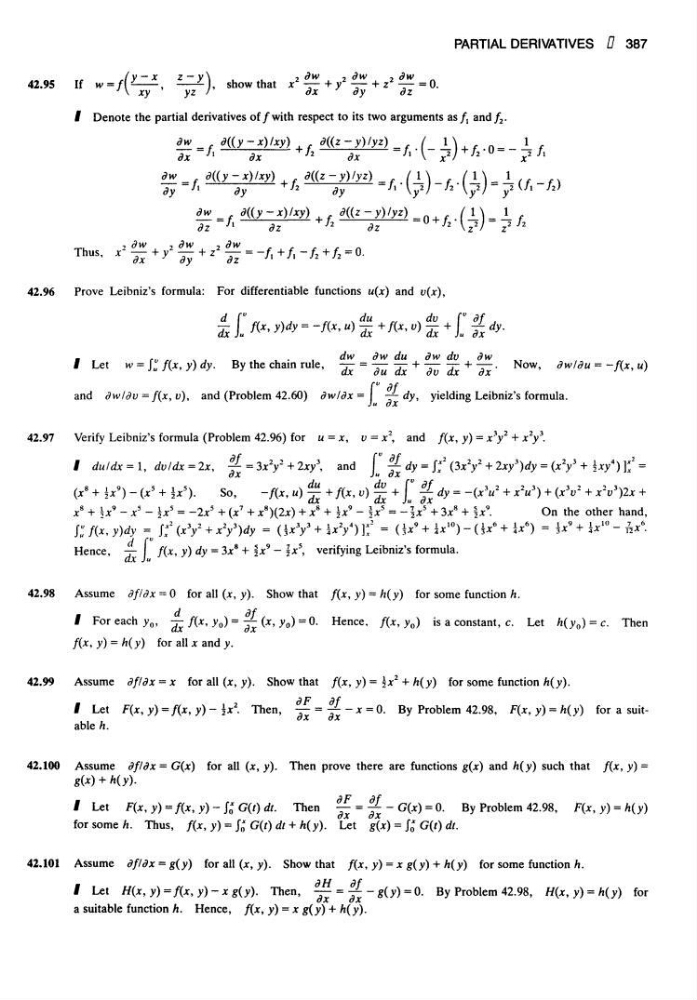
42.95
If w=f
show that
Denote the partial derivatives of/with respect to its two arguments as/, and/ 2 .
Thus,
42.96
Prove Leibniz's formula: For differentiable functions u(x) and v(x),
Let
By the chain rule,
Now,
and dwldv =f(x, v), and (Problem 42.60) dwldx =
dy, yielding Leibniz's formula.
42.97
Verify Leibniz's formula (Problem 42.96) for u = x, v = x
2 , and f(x, y) = x*y
2 + x
2 y
3 .
and
duldx = l, dv/dx = 2x,
So,
On the other hand,
Hence,
verifying Leibniz's formula.
42.98 Assume dfldx = Q for all (x, y). Show that f(x,y) = h(y) for some function h.
For each y0,
f(x, y) = h(y) for all x and y.
42.99 Assume dfldx = x for all (x, y). Show that f(x, y) = |x
2 + h(y) for some function h(y).
Let F(x,y)=f(x,y)-$x2. Then,
able h.
42.100 Assume dfldx = G(x) for all (x, y). Then prove there are functions g(x) and h(y) such that f(x, y) =
*M + *<30Let F(x, y) = f(x, y) - £ G« dr. Then
-G(x) = 0. By Problem 42.98, F(x,y) = h(y)
for some h. Thus, /(*, y) = J 0 " G(f) d/ + /«(>•). Let g(x) = ft G(t) dt.
42.101 Assume ^//d»x = g(y) for all (j:, y). Show that /(*, y) = x g(y) + h(y) for some function h.
Let H(x,y)=f(x,y)-xg(y). Then,
a suitable function A. Hence, /(AT, .y) = xg(_y) + A(y).
w = /; flx, y) dy.
dwldu = -f(x, M)
(x, y0)=0. Hence. f(x,y00) is a constant, c. Let h(y0) = c. Then
- x = 0. By Problem 42.98, F(x, y) = h(y) for a suit-g(>0 = 0. By Problem 42.98, //(x, y) = /i(y) for
387
42.95
If w=f
show that
Denote the partial derivatives of/with respect to its two arguments as/, and/ 2 .
Thus,
42.96
Prove Leibniz's formula: For differentiable functions u(x) and v(x),
Let
By the chain rule,
Now,
and dwldv =f(x, v), and (Problem 42.60) dwldx =
dy, yielding Leibniz's formula.
42.97
Verify Leibniz's formula (Problem 42.96) for u = x, v = x
2 , and f(x, y) = x*y
2 + x
2 y
3 .
and
duldx = l, dv/dx = 2x,
So,
On the other hand,
Hence,
verifying Leibniz's formula.
42.98 Assume dfldx = Q for all (x, y). Show that f(x,y) = h(y) for some function h.
For each y0,
f(x, y) = h(y) for all x and y.
42.99 Assume dfldx = x for all (x, y). Show that f(x, y) = |x
2 + h(y) for some function h(y).
Let F(x,y)=f(x,y)-$x2. Then,
able h.
42.100 Assume dfldx = G(x) for all (x, y). Then prove there are functions g(x) and h(y) such that f(x, y) =
*M + *<30Let F(x, y) = f(x, y) - £ G« dr. Then
-G(x) = 0. By Problem 42.98, F(x,y) = h(y)
for some h. Thus, /(*, y) = J 0 " G(f) d/ + /«(>•). Let g(x) = ft G(t) dt.
42.101 Assume ^//d»x = g(y) for all (j:, y). Show that /(*, y) = x g(y) + h(y) for some function h.
Let H(x,y)=f(x,y)-xg(y). Then,
a suitable function A. Hence, /(AT, .y) = xg(_y) + A(y).
w = /; flx, y) dy.
dwldu = -f(x, M)
(x, y0)=0. Hence. f(x,y00) is a constant, c. Let h(y0) = c. Then
- x = 0. By Problem 42.98, F(x, y) = h(y) for a suit-g(>0 = 0. By Problem 42.98, //(x, y) = /i(y) for